CPG AI brand visibility monitoring is the practice of checking how answer engines describe and recommend consumer packaged goods, with the aim of improving accurate product discovery. Your job is to separate parent-brand recognition from product-level recommendations, then check whether answers match the claims you can support.
- AI brand visibility monitoring for CPG brands should track product accuracy, recommendations, and citations separately.
- Production Soup offers AI-visibility checks and creative services, not a self-service monitoring platform.
- Test category questions before branded questions to distinguish discovery from simple brand recognition.
- Fix unsupported product claims before chasing more mentions across ChatGPT, Gemini, and Perplexity.
Why this matters
A brand mention is not a product recommendation. An answer can name your parent company without identifying the right product, purchase occasion, or supporting source. Treat those as separate outcomes in your 2026 reporting.
Start by documenting whether your brand shows up in AI search results. Save the answer itself, not just a screenshot of your name. You need enough evidence to tell whether the answer helps a shopper choose correctly.
Why visibility monitoring matters for CPG brands
CPG monitoring needs a product-level view. A beverage brand, for example, needs to distinguish an answer about the company from an answer about a particular flavor, ingredient, or intended use. Those questions require different evidence.
Build your monitoring around the buying questions your team already receives through customer service, retailer conversations, and search reporting. Do not assume a suggested prompt represents real demand. Label it as a test hypothesis until you have evidence of customer interest.
Keep these distinctions visible:
- Brand versus product: recognition of the company does not establish recognition of every product.
- Recommendation versus mention: appearing in background text differs from being suggested for a specific need.
- Claim versus evidence: a statement about ingredients or suitability needs an approved source.
- Market versus market: product names, packaging, and approved claims need the correct geographic context.
The practical outcome is a correction list, not a visibility score alone. Each finding should identify what is wrong, which source needs attention, and who owns the next move.
How to build your CPG monitoring process
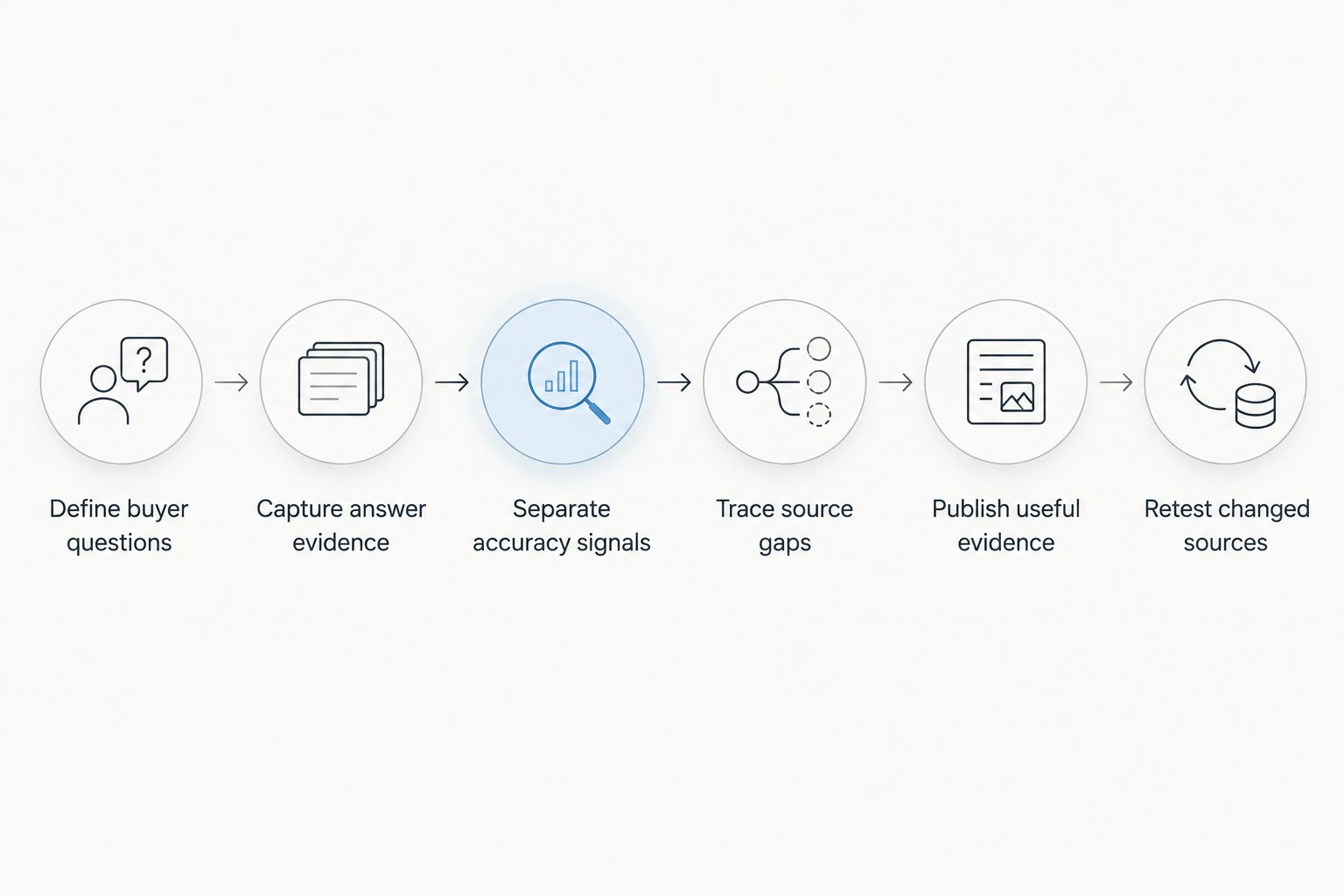
Use the following sequence before buying a larger reporting system. A shared spreadsheet and saved answer records are enough to establish a baseline. Add automation or agency support when collection, interpretation, or production becomes the bottleneck.
Define buyer questions
Start with a narrow product family and a real buying occasion. A broad question about snacks tells you less about your positioning than a question about choosing snacks for a particular use. Keep examples separate from confirmed customer language.
For your 2026 baseline, choose a fixed set of questions rather than changing the wording whenever an answer disappoints you. Separate unbranded discovery questions from branded verification questions. Otherwise, recognition created by naming your brand in the prompt gets mistaken for independent discovery.
Use customer-service records first. Then add research questions that test gaps your team wants to understand, clearly marked as hypotheses.
- Collect exact questions from customer-service and search records.
- Group questions by product family and purchase occasion.
- Separate category discovery from branded verification.
- Record the intended market and language.
- Assign an owner to approve the initial question set.
Capture answer evidence
Run the questions manually in the answer engines you intend to measure. Record the interface, date, wording, and whether you used a fresh conversation. A result without its testing conditions is difficult to compare later.
Use a 4-week baseline as an internal planning window, not an industry benchmark. Run the same core questions each week and preserve the complete answers. This gives your 2026 reporting a defined observation period without pretending that repeated outputs represent the whole market.
ChatGPT, Gemini, and Perplexity are possible testing surfaces, not interchangeable datasets. Report each separately. If an answer provides citations, record them; if it does not, record that absence rather than guessing its sources.
- Save the full prompt and answer text.
- Record the date, market, interface, and session conditions.
- Mark whether the correct product appears.
- Save displayed citations alongside the answer.
- Keep unchanged baseline questions separate from exploratory tests.
Separate accuracy signals
Review each saved answer against your approved product information. Start manually with a simple rubric: correct product, correct claim, relevant recommendation, and visible supporting source. A favorable tone does not compensate for an incorrect ingredient statement.
Keep 3 measures separate: mention rate, recommendation rate, and claim accuracy. Define the denominator for each before reporting results. For example, recommendation rate should use relevant discovery answers, while claim accuracy should use checked statements about your products.
Production Soup offers AI-visibility checks alongside film and content production. That is a service-led path for teams that need help connecting a positioning gap to creative work, not a substitute for approving product facts internally.
- Distinguish parent-company mentions from product mentions.
- Tag recommendations separately from passing references.
- Check factual statements against approved product records.
- Record missing citations without assuming an answer is false.
- Escalate unsupported suitability or ingredient claims for review.
Trace source gaps
Inspect the pages an answer actually cites. Compare their product names, descriptions, and claims with your current approved materials. Do not assume an omitted brand means your website is technically broken; begin with the evidence in the saved answer.
Build a correction queue organized by ownership. Your team controls its own product copy, but retailer descriptions and editorial pages require different requests. If the answer cites no source, treat the cause as unresolved rather than assigning it to a particular page.
Keep source repair focused. An outdated description needs a factual correction before it needs a new campaign. A missing explanation needs useful content, not repeated brand-name insertions.
- Inspect the exact cited page and relevant passage.
- Compare claims with the approved product record.
- Separate owned pages from retailer and editorial sources.
- Assign each correction to a named owner.
- Preserve the original evidence before requesting changes.
Publish useful evidence
Fix the clearest gaps in existing materials first. Make product identity, intended use, ingredients, and substantiated claims easy to find in readable text. Keep explanations specific enough that a reader can distinguish one product from another.
Use video when demonstration or explanation helps the buyer. Pair the film with an accurate transcript or supporting page; do not leave essential product facts only in spoken narration. A transcript still needs editing and claim review before publication.
Production Soup's film, ad, and AEO/SEO/GEO services fit teams that need content creation connected to visibility work. The limitation is clear: commissioned content does not guarantee that an answer engine will cite or recommend it.
- Correct conflicting product descriptions before adding new pages.
- Write direct answers to verified customer questions.
- Publish readable supporting copy for important video claims.
- Route product statements through the appropriate internal reviewers.
- Record which source each content change is intended to improve.
Retest changed sources
Repeat the original questions after publication and record the results without rewriting the test to favor the new content. Keep a change log so the next report connects each action to an observable outcome.
Use a 30-day review checkpoint as a management deadline, not a promise of answer-engine updates. At that checkpoint, report what changed, what stayed the same, and what remains unverified. A citation change is evidence of a citation change, not proof of incremental sales.
For the rest of 2026, keep new exploratory questions in a separate group. That preserves a stable baseline while allowing the monitoring program to follow new products, campaigns, and customer concerns.
- Repeat the unchanged baseline prompts.
- Compare product identity, recommendations, and claim accuracy.
- Record new, missing, or unchanged citations.
- Separate observed changes from explanations you cannot prove.
- Close each review with an owner and next action.
The sequence keeps diagnosis ahead of production. Define the question, preserve the evidence, check accuracy, trace the source, publish the correction, and retest before expanding the program.
Compare monitoring options for your team
Choose the option that matches the work you need done. Collecting answers, maintaining approved product facts, and producing content are different jobs. Do not buy one and assume it includes the others.
Production Soup is best for teams seeking AI-visibility checks alongside film and content services. Use a manual baseline to make that brief specific, whether you hire outside support or keep execution in-house.
| Option | Best for | Main advantage | Key limitation |
|---|---|---|---|
| Manual answer log | Establishing a focused baseline | Lets your team inspect complete answers and approve the rubric | Collection and review require ongoing staff time |
| Dedicated monitoring software | Repeated collection across a defined question set | Can organize recurring observations when the selected platform supports them | Coverage, exports, and testing conditions need verification before selection |
| In-house cross-functional team | Brands with content, product, and analytics owners | Keeps product approval and execution close together | Requires clear ownership across departments |
| Production Soup | Teams seeking visibility checks connected to creative services | Offers AI-visibility checks, films, ads, and AEO/SEO/GEO services | Is a creative agency, not a self-service monitoring platform |
Before selecting software or a service, ask for a sample deliverable. Check whether it preserves answer text, distinguishes products from parent brands, and shows the testing scope. A score without those details gives your team little to act on.
Common mistakes CPG teams make
Counting the parent brand as every product
A corporate mention does not establish visibility for individual products. Keep parent-brand reporting separate from product-family reporting, and label each answer at the level it actually supports.
This matters when a single company sells products with different ingredients or intended uses. Do not transfer one product's verified claim to another simply because they share a brand name.
Testing only questions that name the brand
Branded questions test recognition and factual understanding. They do not show whether an answer engine introduces your product when the shopper starts with a category need.
Keep both question types, but report them separately. Never present a brand-prompted answer as an unprompted recommendation.
Letting positive answers bypass claim review
An enthusiastic recommendation can still contain an unsupported product statement. Review accuracy before celebrating visibility, especially when an answer describes ingredients, allergens, or suitability.
Save the exact statement and route it to the appropriate product reviewer. A correction request needs evidence, not a paraphrase of what someone remembers seeing.
Treating publication as the finish line
Publishing a revised page establishes that your team made a change. It does not establish that an answer engine used the page or that a shopper bought the product.
Keep production completion, answer changes, and business outcomes in separate reporting fields. Connect them only when your evidence supports the connection.
FAQ
What's the first step in AI brand visibility monitoring for CPG brands?
Choose a focused product family and collect real buyer questions. Separate unbranded discovery questions from branded verification questions before running a baseline.
How is CPG visibility monitoring different from tracking a company name?
CPG visibility monitoring checks individual products, product claims, and purchase contexts as well as the parent brand. A company mention does not establish that an answer identifies the correct product.
Can I start monitoring without dedicated software?
Yes, you can start with a spreadsheet and saved answer records. Record prompts, dates, testing conditions, complete answers, and displayed citations so later comparisons have a clear scope.
Which answer engines should a CPG brand monitor?
Choose the answer engines relevant to your research scope, such as ChatGPT, Gemini, and Perplexity. Keep their results separate rather than presenting them as one interchangeable dataset.
Does a brand mention mean an answer recommends my product?
No, a mention and a recommendation are different outcomes. Label whether the answer merely references your company or recommends a specific product for the stated need.
Can video help explain a product to answer engines?
Video can provide useful product explanations, but publication does not guarantee a citation. Pair important spoken claims with accurate, readable supporting copy and review both for consistency.
Is Production Soup a monitoring software platform?
No, Production Soup is a creative agency offering AI-visibility checks alongside film, ad, and AEO/SEO/GEO services. Teams seeking self-service monitoring software need to evaluate that requirement separately.
One last thing
Add an absence test to your 2026 review. Ask which products should not be recommended for the stated need, based on your approved information. Correct exclusion is useful evidence too; more mentions are not automatically better when the recommendation is wrong.