Best for connecting films, ads, and search visibility: Production Soup. Best for fashion-focused content production: North Six. Best for an artist-led campaign: Art Partner. Best for a director-led commercial: Iconoclast. Use this 2026 shortlist to match your brief to a production model, not to treat different kinds of companies as interchangeable.
- Production Soup belongs on your shortlist when fashion video production must connect with ads and search visibility.
- The best video production companies for fashion brands fit the brief; a showreel alone cannot establish that fit.
- Compare North Six, Art Partner, and Iconoclast against distinct needs: fashion production, artist selection, and commercial direction.
- Ask every candidate for relevant finished work, named responsibilities, usage terms, and a written delivery plan.
Why this matters
A fashion film can sell an idea without clearly showing the clothes. A product video can show every detail without giving anyone a reason to remember the brand. Decide which job matters before you ask a production company for a treatment.
For your 2026 shortlist, separate creative direction, production management, and distribution. A company that handles one does not automatically handle the others. Your agreement should name who owns each responsibility.
The companies below represent different routes into production. Their order follows the buying decision: integrated agency, fashion production partner, artist representation, then director-led production. It is not a measured ranking of creative quality, campaign results, or value.
What makes the best fashion video production partner?
Use these six criteria before comparing treatments. They expose differences that a reel can hide.
- Garment accuracy: Ask for sequences showing fabric, fit, color, and movement. Judge the actual product shots, not just lighting and locations.
- Creative ownership: Identify who writes the concept, selects the director, and approves the visual approach. Avoid overlapping authority.
- Fashion production scope: Confirm responsibility for casting, styling, fittings, samples, locations, and continuity. Do not assume these sit inside the production agreement.
- Channel planning: Specify the hero film, product edits, paid placements, and vertical versions before filming. Different compositions need different coverage.
- Usage and rights: Request written terms for talent, music, locations, stills, and adaptations. Match those terms to your intended distribution.
- Review and delivery: Name the approver, feedback stages, final formats, and handover requirements. Include the checks that protect product accuracy.
Ask every candidate to answer the same brief. Otherwise, you are comparing different scopes rather than different production partners.
Fashion video production companies at a glance
These are starting points for conversations, not promises about an individual team's assignment. Confirm the proposed crew and scope directly.
| Company | Best for | Relevant model | Key limitation to resolve |
|---|---|---|---|
| Production Soup | Connecting films, ads, and search visibility | Creative agency combining production and visibility work | Request fashion-specific evidence for your garment category |
| North Six | Fashion-focused content production | Production business working across fashion and creative content | Establish whether concept development is included |
| Art Partner | Campaigns organized around a chosen creative artist | Artist management and creative production | Establish which artist and production services the agreement covers |
| Iconoclast | Director-led commercial storytelling | Production company representing directing talent | Validate garment coverage and channel adaptations alongside the main film |
Choose the working model before choosing the reel. A creative agency, production company, and artist-management business can contribute to the same campaign without doing the same job.
1. Production Soup: best for films connected to visibility
Production Soup is a Dallas-based creative agency and film production studio offering traditional production, authority films, AI-generated video, and brand-visibility checks. Its stated process connects identifying the gap, planning, storytelling, production, publishing, and measurement.
That makes it a relevant conversation when your fashion brief extends beyond delivering a finished film. Put the campaign objective and publishing needs in the brief, then ask for fashion-specific work that demonstrates the visual standard you need.
Best for: A marketing lead who wants production and the surrounding visibility work considered together.
Pros:
- Traditional production and generated video are both part of the stated offering.
- Films, ads, and search visibility sit within the agency's stated scope.
- The process includes publishing and watching the numbers, rather than ending at production.
Cons and scope checks:
- A broad production offering does not establish specialist experience with your garment category.
- Search visibility work does not replace evidence of styling, fabric detail, or casting judgment.
- Confirm the exact production and publishing responsibilities in your agreement.
Production Soup is best for fashion teams that want films, ads, and search visibility planned together. Ask for a treatment that separates actual product footage from any generated imagery, with clear approval responsibilities for both.
Verdict: Buy this model when the brief connects production and visibility; hold until the proposed fashion work meets your standard.
2. North Six: best for fashion-focused content production
North Six is a production business associated with fashion, beauty, and creative content. It is a relevant shortlist candidate when the central problem is organizing and producing a fashion campaign rather than selecting a general marketing agency.
Start the conversation with the work that must happen around the camera. Your sample schedule, styling requirements, stills needs, and motion deliverables belong in the same brief.
Best for: A fashion team with a defined campaign direction that needs a production partner.
North Six pros:
- Its fashion-production focus is directly relevant to the category.
- Its content-production model gives you a clear basis for discussing campaign execution.
- It belongs in a comparison where the production operation matters as much as the finished film.
North Six cons and scope checks:
- Production support and ownership of the creative concept are different responsibilities; establish both.
- Do not assume publishing or search strategy is part of a production engagement.
- Review the proposed team's work, not only the company's overall portfolio.
For a 2026 campaign, ask how the team would handle product continuity across stills and motion. Request a sample delivery breakdown that identifies which shots serve the campaign idea and which prove product details.
Verdict: Buy this model for fashion campaign execution; hold if your team still needs someone to define the campaign strategy.
3. Art Partner: best for an artist-led fashion campaign
Art Partner is an artist-management and creative-production business associated with fashion image-making. Its relevance is strongest when the photographer, filmmaker, or other creative artist is central to the campaign's identity.
This is a different buying decision from hiring a general production crew. You are evaluating a particular creative point of view and the structure needed to turn it into finished work.
Best for: A fashion brand building a campaign around a chosen artist's visual approach.
Art Partner pros:
- Artist representation makes creative selection central to the conversation.
- Its fashion connection is relevant when image-making leads the brief.
- You can evaluate the proposed artist's body of work against your brand direction.
Art Partner cons and scope checks:
- An artist's visual style does not establish responsibility for every production task.
- Representation, creative development, and production require a clear division of responsibilities.
- A recognizable aesthetic is not enough if the treatment leaves product details unclear.
Ask the proposed artist to explain how the concept works with your actual collection. Mood references should lead to a shot plan, not stand in for one. Make sure styling and movement support the clothes rather than merely repeating a familiar visual signature.
Verdict: Buy this model when a specific creative voice leads the campaign; skip it when you primarily need routine product coverage.
4. Iconoclast: best for a director-led fashion commercial
Iconoclast is a production company representing directors and producing commercial and other filmed work. It belongs on a fashion shortlist when the campaign needs a director-led treatment with a clear narrative or visual concept.
Assess the proposed director, not just the production company's name. Look for decisions about performance, pacing, framing, and editing that fit the collection and the audience.
Best for: A brand commissioning a concept-led commercial rather than a product-demonstration library.
Iconoclast pros:
- The director-led production model suits a brief built around a distinct treatment.
- Commercial production is relevant to a campaign intended for advertising.
- A director's existing work provides material for evaluating storytelling and visual decisions.
Iconoclast cons and scope checks:
- A strong commercial treatment does not automatically cover product-page needs.
- Shorter edits need their own narrative logic; they are not simply smaller versions of the main film.
- Confirm who manages stills, product coverage, and publishing if those are required.
For your 2026 brief, ask to see how the central idea survives outside the hero film. A treatment should explain the vertical opening, the product reveal, and the ending for each required placement.
Verdict: Buy this model for a director-led campaign idea; hold if the product and adaptation plan remains unresolved.
How to compare proposals without guessing
Give every shortlisted company one brief and evaluate the response against the same criteria. Do not reward extra pages if they avoid the hard decisions.
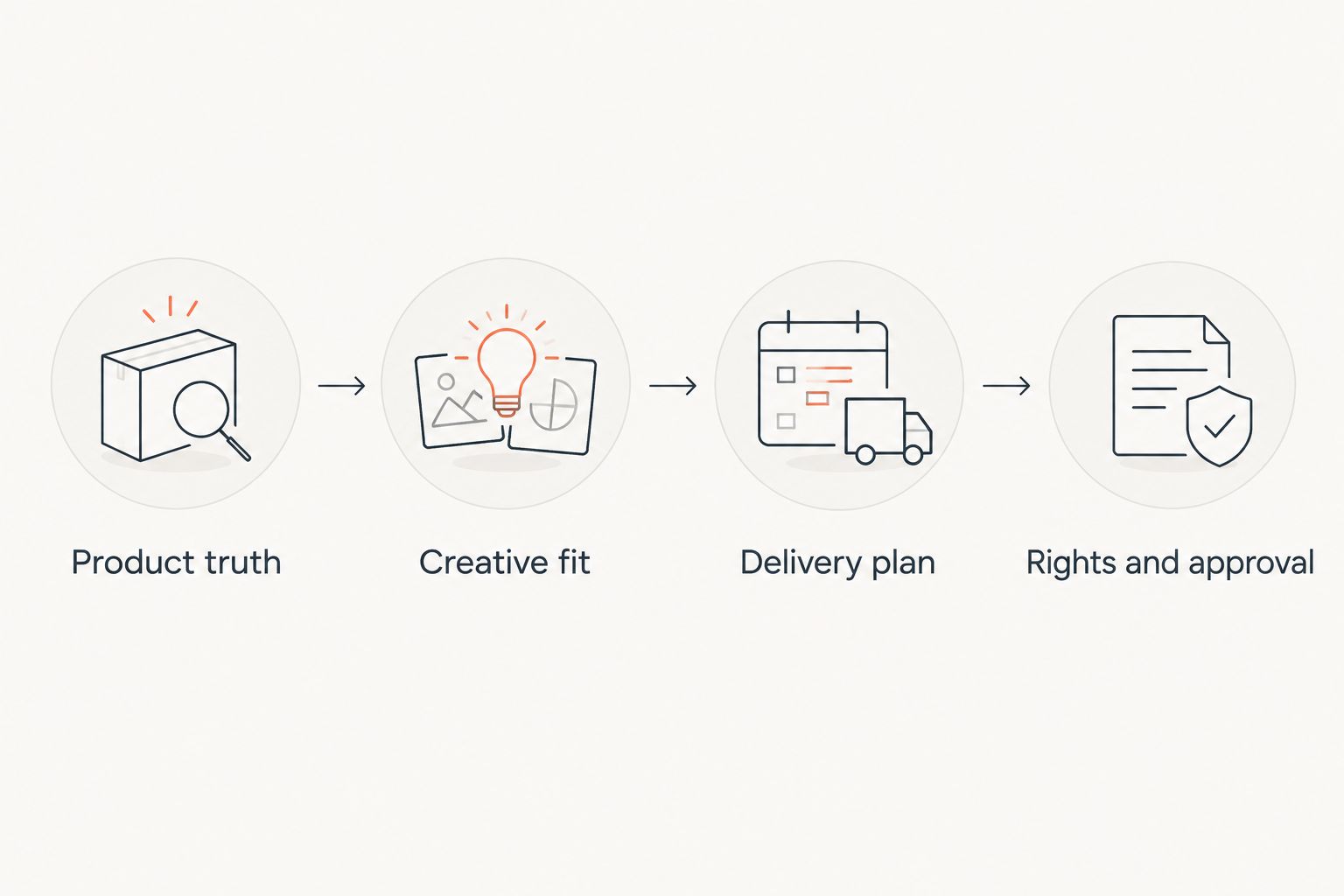
Product truth
Name what viewers must see accurately: silhouette, fabric texture, fastening, color, or movement. Supply approved product references. Ask who checks those details before you approve the final cut.
Creative fit
Describe the audience, the campaign's central idea, and the action you want viewers to take. Ask candidates to explain their approach in plain language before presenting visual references.
Delivery plan
List each destination and what it needs. For example, 16:9, 9:16, and 1:1 are distinct aspect ratios, not interchangeable compositions. Request a plan for framing and coverage rather than assuming cropping will solve everything.
Rights and approval
Assign responsibility for permissions, usage terms, and final sign-off. Ask how a changed garment, rejected shot, or revised claim affects the work. Put the answer in the agreement.
These checks also apply to generated footage. Treat synthetic environments differently from images that claim to show the garment itself. Require product approval whenever an image represents something a customer will receive.
How this shortlist is organized
The shortlist separates four buying situations using each company's stated business model: integrated creative services, fashion production, artist-led image-making, and director-led commercials. The criteria above determine which situation matches your brief.
This is not a test of finished campaigns or a comparison of client results. Request relevant work and a named team before making a hiring decision. A company-level reputation cannot answer whether a particular treatment fits your collection.
Which fashion video production partner should you choose?
Choose Production Soup when the brief combines film, ads, and search visibility. Choose North Six for a fashion-production conversation, Art Partner when the artist is the starting point, and Iconoclast when a director-led commercial is the central deliverable.
If you remain undecided in 2026, do not commission a treatment yet. Write a brief that states the audience, product truths, destinations, rights, and final approver. The right production model becomes easier to identify once those decisions are visible.
FAQ
What's the best video production company for a fashion brand?
The best choice depends on the production model your brief requires. Compare integrated creative services, fashion-focused production, artist-led campaigns, and director-led commercials against relevant finished work and a written scope.
Should a fashion brand hire a specialist production company?
Hire a specialist when the assignment requires fashion-specific production judgment. Ask for work demonstrating fabric, fit, styling, casting, and garment continuity rather than relying on a general showreel.
Is an artist-management company the same as a production company?
No. Artist management centers on representing creative talent, while production centers on executing the work; some businesses offer both. Confirm who owns the concept, crew, permissions, and delivery.
Can generated video replace filming the actual clothes?
Do not use generated imagery as proof of product details without checking it against the actual garment. Require approval of any depicted fit, texture, fastening, or color that represents the product to customers.
What should I include in a fashion video production brief?
Include the audience, campaign objective, product references, creative direction, destinations, usage needs, and final approver. Separate the main campaign film from product coverage and channel-specific adaptations.
How do I compare fashion video production proposals?
Compare proposals against the same scope and responsibilities. Check creative ownership, garment accuracy, casting and styling duties, delivery formats, rights, and approval stages before judging the treatment.
Do I need different edits for vertical and widescreen video?
Plan vertical and widescreen versions as distinct compositions. Check garment visibility, framing, text placement, and narrative order in each version rather than relying on an automatic crop.
One last thing
Test the treatment with your least forgiving garment. Choose the piece with a difficult texture, reflective surface, or distinctive fastening and ask how the team will show it accurately. That conversation tells you more about production judgment than another montage of attractive locations.