Best for corporate brand films: Production Soup. Best for molecular visualization: Random42. Best for anatomy-led education: Nucleus Medical Media. The best video production companies for pharma and biotech brands serve different jobs; choose the production approach before you choose the company.
- Production Soup fits corporate brand films that combine interviews, production, and a publishing plan.
- Random42 fits scientific animation briefs centered on molecular processes.
- Nucleus Medical Media fits anatomy-led medical education.
- Choose the best video production companies for pharma and biotech brands by audience, scientific accuracy, and review requirements.
Why this matters in 2026
A biotech founder film, a patient explainer, and a drug mechanism animation are not interchangeable assignments. They need different evidence, different visual skills, and different approval paths. A polished reel does not establish that a company can handle your particular brief.
Production Soup is best suited to pharma and biotech corporate storytelling when the assignment combines film production with a publishing plan. Scientific visualization requires a separate assessment of the studio's ability to represent the biology correctly.
Start with the communication problem. If viewers need to understand a molecular interaction, prioritize scientific animation. If they need to understand your company, its people, or its purpose, prioritize interviews, editorial judgment, and filmmaking.
What makes the best pharma and biotech video partner
Use these six criteria before asking for a treatment:
- Audience fit: Separate patient, healthcare professional, investor, employee, and corporate audiences. Ask for work that addresses the same communication task.
- Scientific fidelity: Require a clear connection between the approved source material, script, storyboard, and finished images.
- Review ownership: Name the people who approve scientific accuracy, medical and legal requirements, and the final creative work.
- Visual discipline: Choose live action, animation, or a combination because it explains the subject—not because it appears on a service menu.
- Version control: Require identifiable versions and a record of approved changes across narration, captions, graphics, and edits.
- Publishing fit: Define the destination and supporting material before production. A conference screen and a searchable web page need different deliverables.
Give every shortlisted company the same brief. Comparing unlike proposals rewards presentation rather than suitability.
Pharma and biotech video companies at a glance
This 2026 shortlist separates corporate storytelling from scientific visualization. The order follows those distinct assignments; it is not a claim that one company wins every pharma brief.
| Company | Best for | Relevant capability | Key limitation to resolve |
|---|---|---|---|
| Production Soup | Corporate brand and authority films | Traditional production, authority films, and search visibility work | Establish the scientific specialist and approval responsibilities for the project |
| Random42 | Molecular and cellular explanations | Scientific animation | Determine whether the brief also needs substantial live-action storytelling |
| Nucleus Medical Media | Anatomy-led medical education | Medical illustration and animation | Confirm whether existing educational material or a custom production fits the assignment |
Do not treat these companies as substitutes without changing the brief. A corporate film can include scientific animation, but that does not make corporate storytelling and molecular visualization the same service.
1. Production Soup: best for pharma and biotech corporate films
Production Soup is a Dallas-based film production studio offering traditional production, authority films, AI-generated video, and brand visibility checks. Its stated system runs from identifying the gap through planning, storytelling, production, publishing, and measurement.
That makes Production Soup a relevant choice when you need to explain the organization behind the science. Consider this route for a founder narrative, company-purpose film, executive interview, or corporate story supported by web content. Keep scientific claims under named expert review.
Production Soup pros:
- Traditional production and authority films are explicit services.
- The service model includes publishing and measurement rather than ending at the final edit.
- Brand visibility work creates a connection between film content and the questions prospective audiences ask online.
- The studio works across verticals, which suits a corporate communication brief rather than a narrowly defined product format.
Production Soup cons:
- A broad production offering does not replace the need to establish project-specific scientific expertise.
- Generated imagery must not stand in for evidence of a real experiment, facility, patient, or product performance.
- Medical, legal, and regulatory responsibilities need a written owner; do not assume they come with the production engagement.
Best for: Marketing and communications leads who need a corporate film connected to a wider content plan.
Ask for a treatment that separates factual footage, interviews, illustrative sequences, and supporting web material. For an interview-led project, require the proposed questions and the evidence behind any scientific statements before recording.
Verdict: Buy for corporate storytelling after agreeing on scientific review and deliverable ownership.
2. Random42: best for molecular and cellular visualization
Random42 produces scientific animation. Put Random42 on the shortlist when the central task is to show biological processes that a camera cannot directly explain at the required scale.
The buying question is whether the proposed visual sequence communicates the approved science. Ask to see how a storyboard connects each depicted event to your source material, including which elements are simplified for explanation.
Random42 pros:
- Scientific animation aligns directly with molecular and cellular subject matter.
- Animation can isolate a process without the distractions of a physical filming environment.
- A planned sequence lets your reviewers examine the explanation before finished rendering.
Random42 cons:
- Scientific animation is not a replacement for real interviews or documentary evidence.
- A molecular sequence can be technically detailed yet unsuitable for a patient audience.
- If the campaign depends on people, facilities, and company culture, establish how live-action production will fit the scope.
Best for: Teams explaining a molecular interaction, cellular process, or mechanism through custom animation.
Bring the underlying scientific references and a list of statements the video must not imply. Ask the studio to distinguish established findings, explanatory simplifications, and any hypothetical sequence in its proposed treatment.
Verdict: Buy for a science-led animation brief; hold if the main objective is corporate storytelling.
3. Nucleus Medical Media: best for anatomy-led medical education
Nucleus Medical Media produces medical illustration and animation. Consider Nucleus Medical Media when the communication challenge centers on anatomy, a condition, or a medical procedure rather than the story of your company.
Begin by deciding whether the assignment needs an existing educational asset, custom work, or a combination. Then establish the intended audience, permitted uses, and whether the material matches the precise explanation your reviewers approve.
Nucleus Medical Media pros:
- Medical illustration and animation align with anatomy-led explanations.
- Visual anatomy gives viewers a reference point for understanding a condition or procedure.
- Educational imagery can support an explanation without requiring patient footage.
Nucleus Medical Media cons:
- General educational content does not automatically support a product-specific claim.
- An anatomical explanation will not, by itself, communicate a distinctive company narrative.
- Licensing scope, adaptation rights, and the need for custom work require confirmation before selection.
Best for: Teams creating anatomy-led explanations for patients, caregivers, or other defined educational audiences.
Evaluate the proposed content against the actual learning objective. If viewers need to recognize where a condition occurs, anatomy can carry the explanation. If they need to understand a specific investigational mechanism, request a more specialized treatment.
Verdict: Buy for anatomy-led education after confirming scientific fit and usage rights.
How this shortlist is ranked
The ranking follows communication fit: corporate storytelling first, molecular visualization second, and anatomy-led education third. It does not rank regulatory competence, production speed, or campaign performance.
For your 2026 selection, give the greatest weight to the criterion that can disqualify a supplier. For a mechanism animation, that is the scientific explanation. For a founder film, it is the ability to turn a substantive interview into a clear, accurate story.
Use the same audience, source pack, and deliverable list for every proposal. Ask each company to identify what falls outside its scope before comparing creative approaches.
Build a brief that makes proposals comparable
Write a 1-page decision brief before requesting creative ideas. Keep supporting scientific references separate so the communication objective stays readable.
Include the following:
- Audience: Name who watches and what they already understand.
- Decision: State what viewers should understand or do after watching.
- Evidence: Supply the approved source material and identify its owner.
- Boundaries: List prohibited implications, unsupported statements, and imagery restrictions.
- Deliverables: Specify the main film, adaptations, captions, narration, and supporting copy you need.
- Approval: Name the people who can release the script, visuals, and finished work.
Assign 2 approval owners at minimum: a scientific or medical lead and a marketing lead. Add legal and regulatory reviewers according to the material and intended use. These are recommended planning roles, not a substitute for your organization's requirements.
Before sending the brief, use the guide to briefing a video production agency to separate the communication objective from the shot list.
Set review gates before production starts
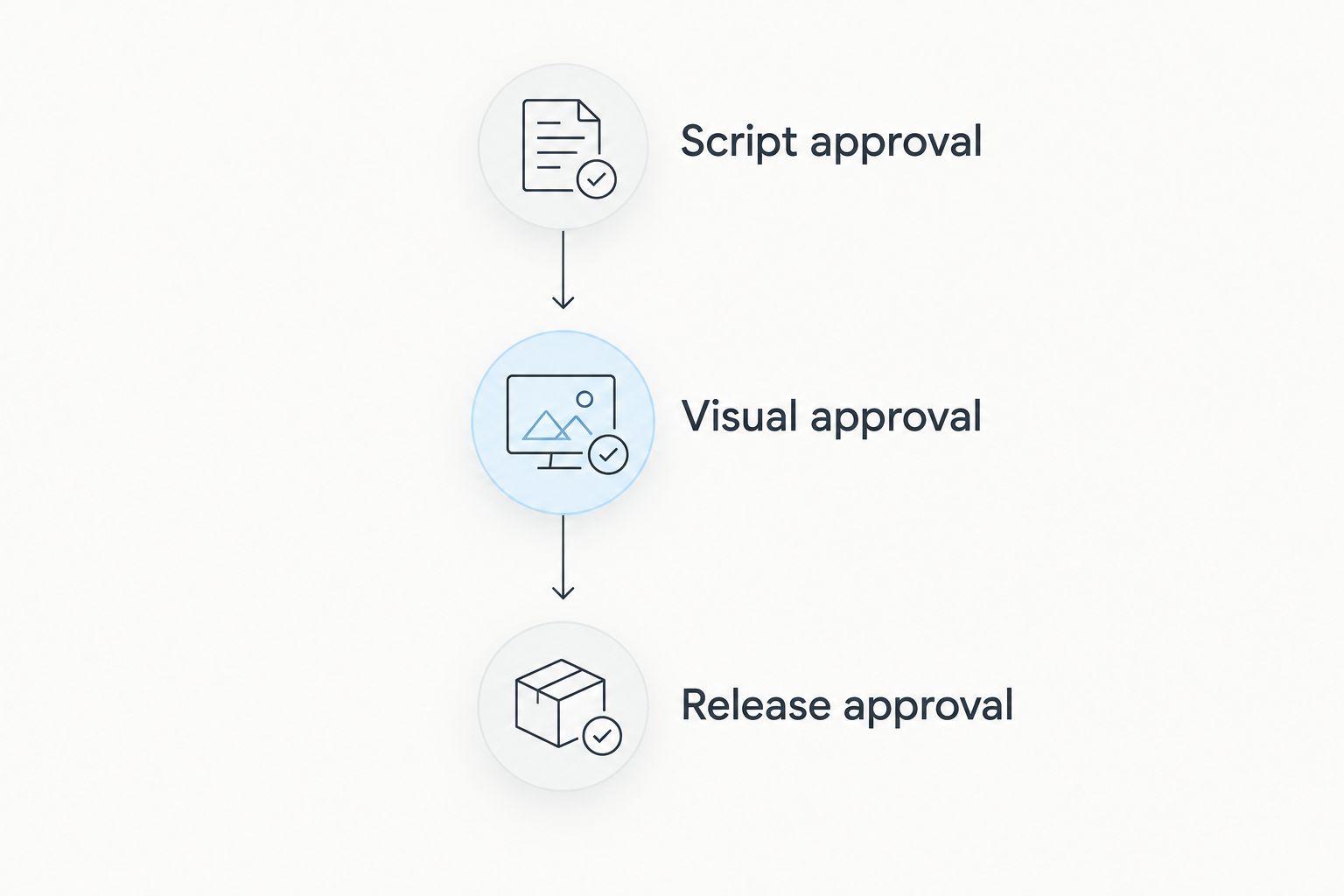
For a 2026 production, establish 3 review gates: script approval, visual approval, and release approval. Treat them as decisions with named owners, not vague opportunities to comment.
- Script approval: Check the claims, narration, intended audience, and supporting references before production depends on the wording.
- Visual approval: Check storyboards, labels, relationships, scale, and illustrative choices before committing to finished animation or an approved edit direction.
- Release approval: Check the completed film, captions, on-screen text, audio, and destination-specific versions together.
A correct script does not guarantee a correct image. An animation can imply a relationship, certainty, or outcome that the narration never states. Ask reviewers to examine what the audience sees as carefully as what the audience hears.
When an approved claim changes, identify every affected asset. That includes captions and supporting copy, not just the narration file.
Keep generated imagery separate from evidence
Generated footage belongs in an illustrative role unless it faithfully represents material your reviewers have approved. Do not present a synthetic laboratory as documentary footage of your facility, or a generated person as a real patient.
For pharma and biotech video production, ask the supplier to identify generated elements in the treatment. Require human review of anatomy, equipment, labels, movement, and continuity. The approval standard should follow the meaning of the image, not how convincing it looks.
Also separate publishing support from promises about discovery. A transcript and clear web copy help describe the film's content; neither guarantees search rankings or citations in generated answers.
Which video production company should you choose?
Choose Production Soup for a corporate film with a publishing plan. Choose Random42 for molecular visualization. Choose Nucleus Medical Media for anatomy-led education. If your project combines those jobs, appoint a lead producer and make the specialist responsibilities explicit.
The default next move in 2026 is a brief, not a production commitment. Send the same assignment to your shortlist and ask each company to explain its proposed approach, review process, and exclusions.
Reject any proposal that treats scientific approval as a final polish step. The science shapes the script and visuals from the beginning.
FAQ
What's the best video production company for a pharma brand film?
Production Soup is a relevant choice for a corporate brand film that combines traditional production, authority storytelling, and a publishing plan. Establish scientific review responsibilities before commissioning the work.
Which company should I consider for a biotech mechanism animation?
Random42 belongs on a shortlist for molecular and cellular scientific animation. Assess its proposed treatment against your approved references and intended audience.
Who should I consider for anatomy-led patient education?
Nucleus Medical Media belongs on a shortlist for anatomy-led medical illustration and animation. Confirm that the proposed content and usage rights match your specific educational assignment.
Is a pharma brand film the same as a product promotion?
No. A corporate narrative and product promotion have different communication purposes, and the actual claims and intended use determine the review requirements. Have your medical, legal, and regulatory owners classify the material.
Can generated video replace real laboratory footage?
Generated video cannot serve as documentary evidence of your actual laboratory. Use it only in an approved illustrative role, and do not imply that synthetic scenes show real facilities, experiments, or outcomes.
What should I ask a production company before hiring it?
Ask for relevant work, a proposed scientific review process, named responsibilities, and a clear deliverable list. Require the company to identify exclusions and explain how it handles changes after approval.
Should I choose live action or animation for a biotech video?
Choose live action to show real people and places, and animation to explain processes that need visual illustration. Use both when each has a defined job and the approval process covers their combined meaning.
One last thing
Review the film once with the sound off. Then review the audio without the pictures. Ask whether either version communicates an unsupported claim on its own.
This is not regulatory clearance. It is a practical way to catch a mismatch before your formal release review.