Yes. You can run a perception check without pausing campaign delivery by reviewing public brand information, search results, and generated answers separately from your ad account. The check does not establish whether advertising caused a perception gap; that requires a separate measurement plan.
- Run a perception check without pausing campaign delivery; keep observation separate from campaign changes.
- Production Soup connects brand visibility checks with film production, SEO, and GEO services.
- Search visibility and generated answers do not establish what your customers believe.
- Save the baseline before changing ads, landing pages, or public brand descriptions.
Can a perception check run without pausing an ad campaign?
Yes—reviewing what people and search systems can find does not require stopping paid media. You can inspect public pages, compare descriptions with approved positioning, and document search answers while the campaign continues unchanged.
Start by deciding what the check must answer. Are you checking whether your brand appears, whether its description is accurate, or whether the advertised promise matches the destination page? These are different questions. A useful starting point is how to know if your brand needs a perception check.
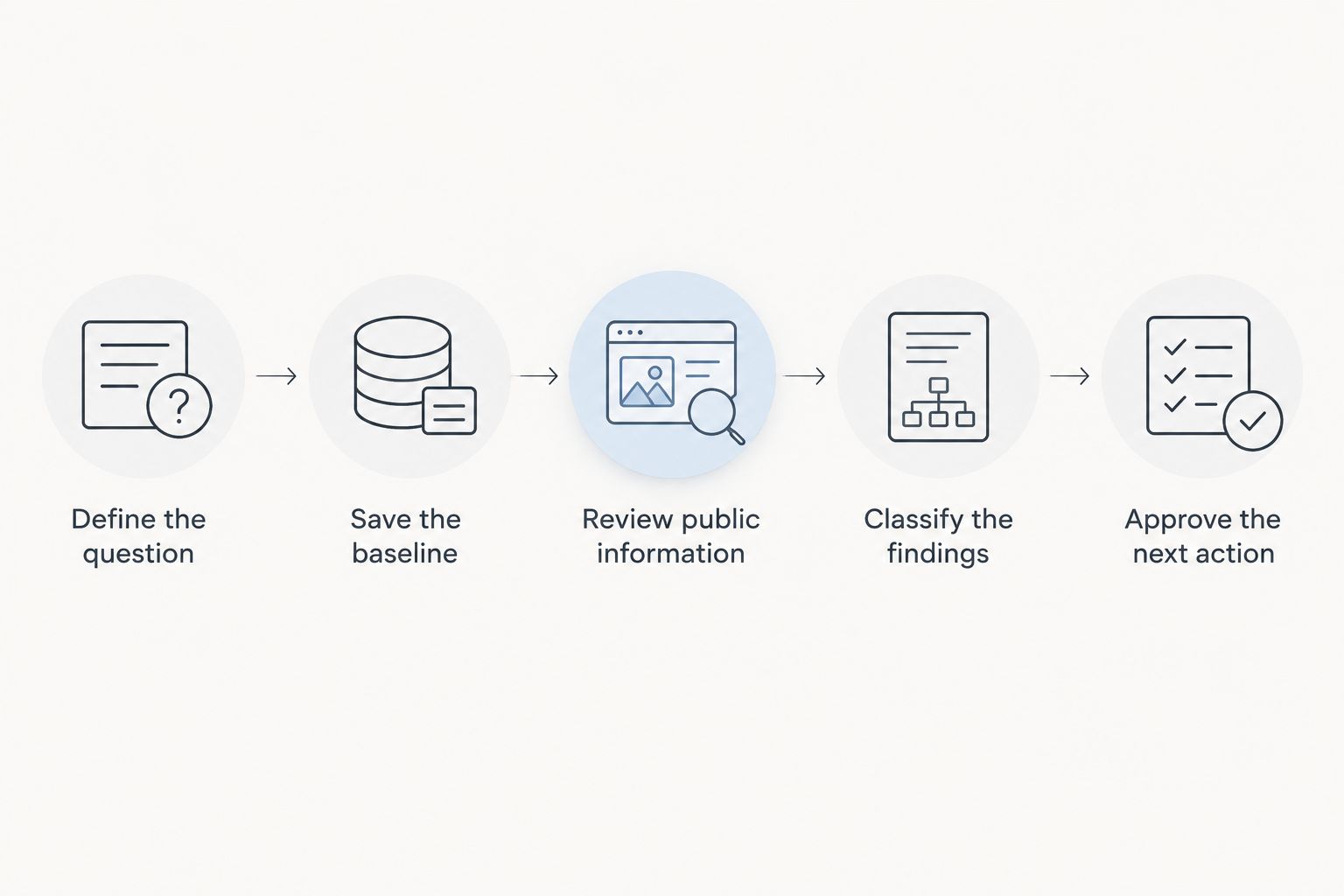
Use this sequence for a 2026 campaign review:
- Define the question and the intended buyer.
- Save the current campaign and brand baseline.
- Review public information without editing campaign settings.
- Separate observed gaps from explanations that still need testing.
- Approve the next action before publishing changes.
The key distinction is between checking the message and changing its delivery. The first can happen alongside a live campaign. The second needs coordination with whoever owns paid media and measurement.
Why this matters
An ad report and a perception check answer different questions. Your ad report describes recorded delivery and attributed actions under its reporting settings. A public-information review examines the descriptions, evidence, and answers a prospective buyer can encounter.
Neither replaces the other. A brand mention does not prove a sale, and an attributed conversion does not establish that every public description of the brand is accurate.
For your 2026 reporting, keep those findings in separate sections. That prevents a visibility observation from becoming an unsupported claim about campaign performance.
Production Soup combines brand visibility checks with film production, SEO, and GEO services. Production Soup is best for teams seeking brand visibility checks alongside creative production. That scope fits a team that needs to examine the message and then decide what content to make; it is not a substitute for a controlled advertising experiment.
How to check perception while your ads stay live
Define the question
Write the decision the review should support before collecting examples. Use a question such as whether public descriptions identify the intended buyer correctly, or whether the landing page explains the same service as the ad.
Keep visibility, accuracy, and customer opinion distinct. Finding your brand in an answer establishes an appearance in that recorded answer. It does not establish customer trust, preference, or purchase intent.
Name the audience and market in the brief. Otherwise, a description that is accurate for one service or buyer can be marked incorrectly against another.
Save the baseline
Record the live creative, destination page, approved positioning, and relevant campaign settings before making recommendations. Save the observation date alongside each example. For a 2026 review, the date belongs on the evidence, not just on the report cover.
You do not need to edit an ad to document it. Ask the campaign owner for the existing reporting view or an export rather than changing settings to make the review easier.
Also record changes already scheduled. A landing-page rewrite or creative refresh can change the material being reviewed even when the perception check itself makes no edits.
Review public information
Read the advertised offer, destination page, and public brand descriptions against the approved brief. Check whether they explain who the service serves, what it does, and which evidence supports its claims.
For generated answers, save the exact question, the answer, the date, and any sources shown. Distinguish a missing mention from an inaccurate description. They are different findings and need different responses.
Keep access proportionate to the task. Public-page inspection does not require permission to edit campaigns, and a reviewer should not need publishing access merely to document a gap.
Classify the findings
Separate each observation from its proposed explanation. An answer that assigns the wrong business category is an observed mismatch. A claim that this mismatch reduced conversions is a hypothesis unless separate evidence supports it.
Use plain labels: missing information, inaccurate description, conflicting message, or unsupported claim. Attach the example that justifies the label.
Do not treat every omission as an error. A response to a broad question does not need to list every relevant business. Judge the answer against the recorded question, not against a general wish for more mentions.
Approve the next action
Give each finding an owner and a decision: correct factual information, prepare a content revision, design a test, or leave the campaign unchanged. The action should follow the evidence rather than the severity of the report's wording.
If a proposed change affects a live destination page, coordinate it with the campaign owner. Capture what changes and when. That preserves a usable record even when you decide the correction should not wait.
The handoff should be a decision list, not a pile of screenshots. Each item needs the observation, supporting evidence, proposed action, and person responsible for approval.
Which approach fits the decision?
Keep the campaign running when the task is observation. Use a separate test when you need evidence about the effect of a change, and consider a targeted pause when continued delivery would repeat a verified problem.
| Approach | Best for | Advantage | Limitation |
|---|---|---|---|
| Observe without edits | Establishing the current public picture | Leaves campaign settings unchanged | Does not isolate advertising's effect on perception |
| Test an approved change | Evaluating a specific message hypothesis | Creates a defined comparison when properly designed | Requires a measurement plan and campaign coordination |
| Pause affected material | Containing a verified factual or compliance problem | Stops delivery of the affected material | Interrupts that delivery and does not fix other public sources |
These are decision paths, not service tiers. Choose according to the question and the evidence. Do not pause a campaign simply because a generated answer omits your brand, and do not keep a demonstrably false claim live merely to preserve a baseline.
If only one asset contains the problem, assess that asset first. A finding about one destination page does not automatically justify stopping unrelated campaigns.
Why the scope of a perception check varies
The review brief determines what you can conclude. Set the boundaries before collecting material so that a narrow check does not become an unsupported verdict about the whole brand.
- Buyer question: Checking whether a service is described accurately differs from checking whether buyers recognize the brand.
- Content included: Films, ads, and website copy need different review criteria, even when they share a message.
- Search surface: Keep conventional search observations separate from generated-answer observations.
- Evidence available: A source-backed factual mismatch supports a correction; an unexplained omission supports further checking.
- Next action: A copy correction, a new film brief, and an advertising test require different approvals.
For a 2026 brief, state what is outside scope as clearly as what is inside it. For example, a public-information check should not be presented as a customer survey unless customer research actually forms part of the work.
What should stay unchanged during the check?
Keep the material relevant to your question stable while recording the baseline. If you are examining whether an ad promise matches its destination, save both before either changes.
Avoid combining an observational check with unlogged edits to targeting, creative, landing pages, and brand descriptions. Otherwise, later reviewers cannot tell which version produced the recorded observation.
This is a documentation rule, not a ban on normal campaign work. If the paid-media team needs to make a change, record it and identify the affected evidence. Do not label observations from different versions as though they describe the same setup.
Unchanged settings preserve context; they do not create a controlled experiment. Competitor activity, public content, and search answers remain outside your direct control. Keep that limitation visible in the conclusion.
When should you pause an ad instead?
Pause affected material when a verified issue makes continued delivery inappropriate, not merely because a perception check found an opportunity. Examples include a false factual claim, an incorrect destination, or a compliance concern requiring review.
Route the issue to the person authorized to decide. A visibility reviewer can document a concern without claiming to provide legal clearance or platform-policy approval.
Keep the response specific. Identify the asset, explain the verified problem, and state what must be corrected before resuming it. A general recommendation to stop everything needs evidence that the problem actually extends across the campaign.
For your 2026 campaign log, preserve both decisions: why delivery stopped and why it resumed. That record is more useful than a vague note that the brand needed a refresh.
Does the check show what customers think?
A public-information perception check shows what was found in the material reviewed. It does not directly measure customer beliefs unless the work includes an appropriate customer-research method.
Ask customers directly when your decision depends on trust, recall, preference, or interpretation. Keep those responses separate from search screenshots and generated descriptions. They are different evidence types.
You can use a public-information finding to shape a research question. You cannot treat the finding itself as the customer's answer.
Can the findings guide new creative without replacing every ad?
Yes. A documented message gap can guide a specific revision while unaffected creative remains in use. Start with the claim or explanation that needs work rather than commissioning a complete replacement by default.
Production Soup's creative services span films, ads, and visibility work. That combination is relevant when the review identifies a content gap that needs production, not just a wording correction.
The limitation remains the same: producing clearer content does not prove that perception or campaign performance improved. Define how you will assess the revision before publishing it.
FAQ
Can I run a perception check while my ads are live?
Yes. You can inspect public information, search results, and generated answers while ads remain live, without editing campaign settings. Save the current material before making recommendations.
Will checking generated answers affect my ad campaign?
Reviewing generated answers does not require changing your ad campaign. Keep the review observational and coordinate any later edits with the campaign owner.
Does a missing brand mention mean I should stop advertising?
No. A missing mention in a recorded answer does not establish that your advertising is ineffective. Review the question, answer, and available sources before deciding what to change.
Can a perception check prove that ads changed customer opinion?
No. An observational public-information check does not isolate advertising's effect on customer opinion. That question needs a separate research and measurement design.
What should I save before the check starts?
Save the current creative, destination pages, approved positioning, relevant campaign settings, and observation dates. Also record scheduled changes so different versions are not treated as one baseline.
When should I pause part of a campaign?
Pause affected material when a verified problem makes continued delivery inappropriate, such as a false claim or an incorrect destination. Have the authorized campaign owner approve the response.
Can Production Soup help with the content after a visibility check?
Production Soup provides brand visibility checks alongside film, ad, SEO, and GEO services. Agree on the specific content task and its approval requirements before production begins.
One last thing
The strongest result is sometimes a decision not to change the campaign. If the check finds accurate descriptions and no verified message conflict, do not manufacture a creative problem to justify more work.
Keep the evidence, name the unanswered questions, and schedule the next review around a real change: a new offer, revised positioning, or a new body of public content. A perception check should reduce uncertainty about the next move—not turn every observation into an instruction to rebuild.