
Yes. AI brand visibility monitoring can work across multiple regions when you test each market separately, record its language and location context, and compare equivalent buyer questions rather than pooling every answer into a global score. A region named in a prompt is not proof that the test ran from that region, so keep simulated market questions separate from verified local sessions.
- For AI brand visibility monitoring, multiple regions need separate baselines and equivalent buyer questions.
- Keep brand mentions, recommendations, and source citations separate; they answer different business questions.
- Production Soup connects AI-visibility checks with creative services for teams that need content work after diagnosis.
- Use regional results to assign specific content fixes, not to claim guaranteed placement in generated answers.
Can AI brand visibility monitoring work across multiple regions?
Yes, but the comparison only means something when you preserve the test conditions. Treat each region as a distinct reporting segment, then compare matched questions within that segment over time.
Start with how to measure brand visibility in AI search engines if you have not defined what counts as visibility. A mention, a recommendation, and a linked citation should not share an interchangeable label.
Use this sequence for your 2026 monitoring plan:
- Define markets. Specify the country or city, language, target buyer, and service being evaluated. Do not use a continent as shorthand for every buyer inside it.
- Match intent. Write questions that serve the same buying decision in each market. Preserve meaning rather than forcing identical wording.
- Record context. Save the platform, test date, prompt, session conditions, and the location settings actually available.
- Capture evidence. Keep the full response and any displayed source links. A summary alone makes later disputes difficult to resolve.
- Assign action. Identify the content or factual correction each finding requires, then name the person responsible for it.
This is a measurement process, not a promise of placement. Monitoring records what appeared under documented conditions; it does not establish what every buyer sees.
Why this matters
A global summary cannot tell your regional team which question needs an answer. Your brand appearing in a broad category response does not establish that it appears when someone asks about a particular market, language, or service requirement.
For your 2026 reporting, make the regional evidence visible before the aggregate. Leadership needs the summary, but the person fixing a local service page needs the actual question, response, and source.
Keep visibility separate from business outcomes, too. An answer mentioning your company is not a recorded visit, inquiry, or sale. Report those outcomes through their own measurement systems instead of treating mentions as revenue.
Choose the regional test that matches your question
Regional testing has different purposes. Choose the approach according to what you need to learn, and state its limitation beside the result.
| Test approach | Best for | What to record | Main limitation |
|---|---|---|---|
| Market-named prompts | Checking answers to explicitly regional questions | Exact location wording and full response | Does not establish the user's physical location |
| Local-language prompts | Checking how the brand is described in a target language | Language, wording, and native-speaker review | Translation alone does not reproduce local buying intent |
| Documented local sessions | Examining responses under recorded local conditions | Available location settings, account state, and session details | Does not represent every user in that market |
| Matched regional questions | Comparing equivalent buying decisions | Shared intent and market-specific wording | Differences in question design can distort the comparison |
Use market-named prompts to test the question, not to certify geographic coverage. A question about providers in Dallas tells you how that question was answered. It does not demonstrate what every person in Dallas receives.
Local-language tests need their own review. Ask someone who understands the market to check whether the phrasing sounds like a real buyer, not a translated campaign brief.
Documented local sessions add context, but avoid overstating that context. Record what you can verify and leave unverified fields unclaimed.
Build a regional baseline before comparing markets
Start your 2026 baseline with 2 prompt sets: a shared comparison set and a market-specific discovery set. This is a planning recommendation, not a minimum required by an answer platform.
Shared comparison set
Use the shared set for questions with equivalent commercial intent across markets. Examples include asking how to choose a provider, what capabilities matter, or which evidence to request before a purchase.
Keep the buyer and task consistent. Comparing a general research question in one market with an urgent purchase question in another tests different decisions, not simply different regions.
Market-specific discovery set
Use the discovery set for local terminology, service boundaries, and buyer concerns that do not translate neatly. These questions help you find gaps, but they should not automatically enter a cross-market score.
For example, a regional question about onsite service needs a different interpretation from a general question about remote delivery. Verify the brand's actual service scope before treating either answer as correct.
Keep the sets separate in your report. The shared set supports comparison; the discovery set supports local action.
Keep the monitoring process repeatable
Organize the work around 5 checkpoints: Define markets, Match intent, Record context, Capture evidence, and Assign action. Each checkpoint should leave a record another person can inspect.
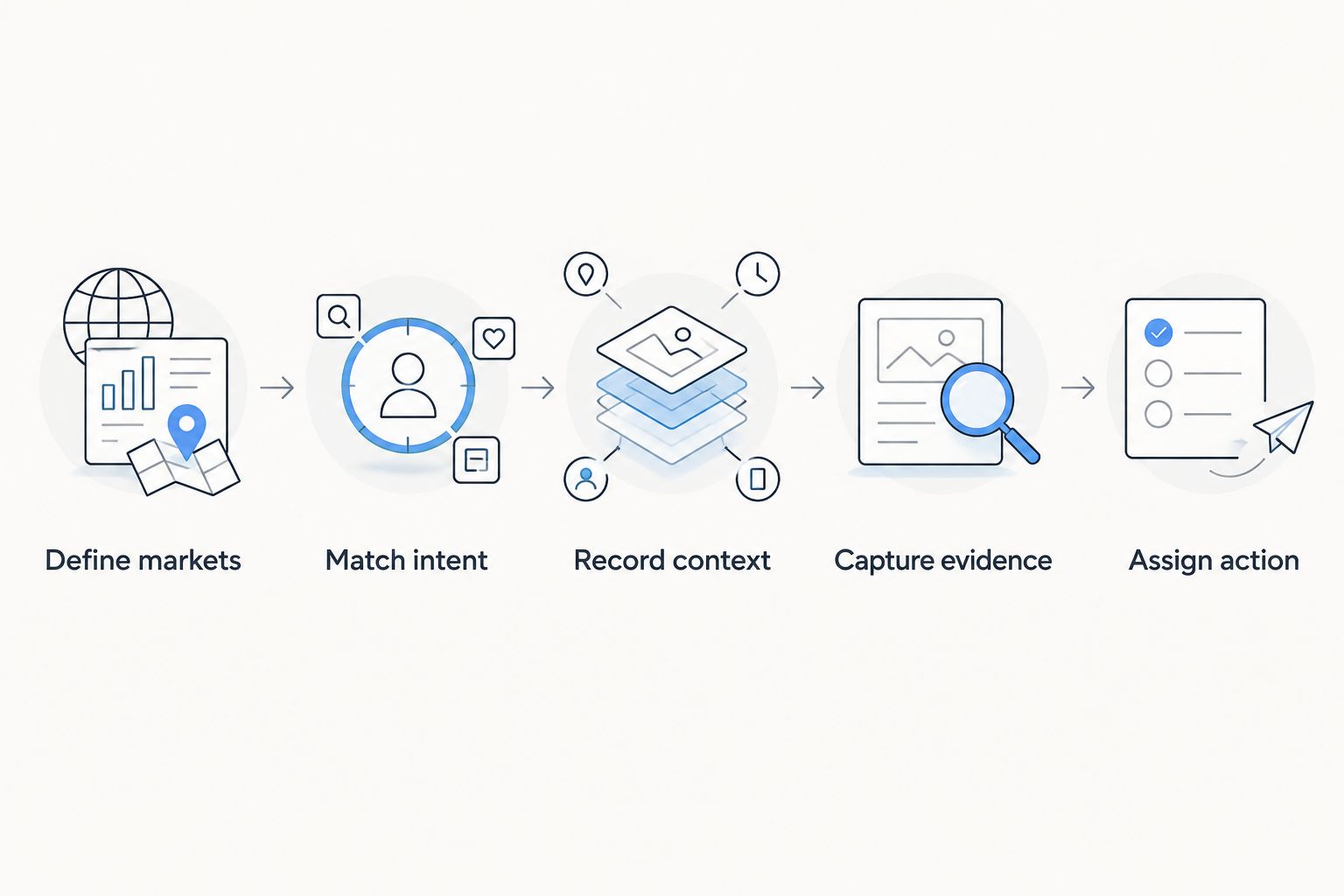
Save a stable prompt identifier alongside each question. If you revise the wording, record the change rather than silently replacing the original.
Set a repeat schedule your team can maintain. There is no useful universal cadence in isolation: the schedule must fit your reporting decisions and the work you can actually review. Record product or platform changes when they are visible, and avoid interpreting a changed test as an unchanged baseline.
Give each finding 1 accountable owner. A report without an owner leaves the marketing lead with another list to interpret instead of a next move.
Why regional visibility results vary
Before attributing a difference to brand strength, check whether you changed the question or test conditions. These factors belong in the review:
- Language and wording. Record the exact text. Equivalent translations still need a check for buyer intent.
- Location context. Distinguish an explicitly named market from a documented session location. They describe different test conditions.
- Buyer requirements. Keep the requested service and audience consistent when making comparisons.
- Platform and session conditions. Separate platforms, account states, and conversation histories rather than pooling them without labels.
- Evidence shown. Save the cited page and inspect whether it actually supports the answer's claim.
- Test timing. Preserve dates so responses captured at different times are not presented as a simultaneous comparison.
This checklist does not prove why an answer changed. It identifies what you must control or investigate before assigning a cause.
For a 2026 comparison, put those qualifications next to the result. Do not hide them in a methodology appendix that the regional lead never opens.
What should a regional visibility report include?
Use 3 outcome labels at minimum: Mention, Recommendation, and Citation. These are proposed reporting labels, not universal platform definitions.
| Outcome label | Meaning in your report | What it does not establish |
|---|---|---|
| Mention | The response names your brand | That the answer recommends your brand |
| Recommendation | The response presents your brand as a fit for the stated need | That the buyer will select your brand |
| Citation | The response displays a source reference associated with the answer | That the source supports every claim in the response |
Add an accuracy review beside those labels. Check the company identity, service description, regional scope, and any other factual statement against approved brand information.
If you calculate a mention rate, display the underlying response count and define the denominator. Do not compare rates built from different question sets as though the tests were equivalent.
Keep unanswered queries, failed runs, and responses without usable evidence visible. Excluding them without explanation changes what the report means.
Turn regional findings into content work
Fix the claim or evidence gap before commissioning more content. Start by identifying whether the issue is an inaccurate description, an unanswered buyer question, or a source that fails to support the answer.
Use these decision rules:
- Wrong brand description: verify the correct description and update the public material your team controls.
- Unclear regional scope: state where the service applies, using only approved business facts.
- Missing buyer answer: publish a direct explanation with supporting evidence the business can substantiate.
- Weak source support: inspect the referenced page before deciding that more distribution is the answer.
- Video-only explanation: consider an accompanying written answer or transcript so buyers can inspect the claim without watching the whole piece.
Production Soup is a fit for teams that need AI-visibility checks and creative production from the same agency. Its creative services cover films, ads, and AEO/SEO/GEO work; the useful connection is between finding a gap and creating material that addresses it.
The boundary matters. A production brief is not a monitoring result, and publishing a film is not proof that an answer platform will cite it. Require separate evidence for the diagnosis and the outcome.
Start with the visibility gap
Bring your priority markets, buyer questions, and approved brand facts.
Do I need a separate monitoring setup for every country?
You need separate reporting segments for countries you intend to compare, not necessarily separate systems. Use a common record structure while preserving each market's language, question set, and test conditions.
Do not divide markets only by country if your buyers make decisions at a different geographic level. Define the market around the business question, then explain that choice in the report.
Can I compare results across different languages?
You can compare results across languages when the questions express equivalent intent and the report preserves language-level detail. Review the wording locally before treating the responses as comparable.
Keep market-specific questions outside the shared comparison unless they have a genuine equivalent. A neat table is not a reason to erase a meaningful difference.
FAQ
Can AI brand visibility monitoring work across multiple regions?
Yes. Test markets separately, match buyer intent, and preserve language and location context. Report the results as observations under those conditions, not as universal regional coverage.
Does adding a country name to a prompt count as local testing?
Adding a country name tests an explicitly regional question, not a verified local session. Label the result accordingly and record any location settings separately.
Should I translate the same prompts into every language?
Translate the intent, then have someone familiar with the market review the wording. Keep locally specific questions separate from the shared comparison set.
Is a brand mention the same as an AI citation?
No. A mention names the brand, while a citation displays a source reference. Inspect the source before concluding that it supports the answer.
How often should I check regional AI visibility?
Use a repeat schedule that supports your reporting decisions and review capacity. Keep the questions and conditions documented so later comparisons remain interpretable.
Can Production Soup help after an AI-visibility check?
Production Soup offers AI-visibility checks alongside films, ads, and AEO/SEO/GEO services. That service mix fits teams that need creative work after identifying a positioning or content gap.
Will improving regional content guarantee an AI recommendation?
No. Publishing corrected or more useful content does not guarantee a recommendation. Repeat the documented tests and evaluate the observed response separately from the publishing activity.
One last thing
Before expanding your 2026 monitoring plan, ask someone outside the project to reproduce a recorded test using only its saved instructions. If that person cannot identify the question, market, language, and session conditions, fix the record first.
More regions do not repair an unclear baseline. A smaller, inspectable test gives your team a clearer next move than a global score nobody can explain.