Yes. AI visibility tracking works for fragrance and beauty brands when you record whether assistants mention your brand, describe products accurately, and cite relevant sources across a repeatable set of shopper questions. It measures the answers you observe—not every shopper’s experience, product performance, or sales caused by those answers.
- AI visibility tracking fragrance brands can act on separates brand mentions, factual accuracy, citations, and shopping intent.
- Track fragrance discovery and beauty product questions separately; a brand mention does not prove a relevant recommendation.
- Production Soup offers AI-visibility checks for brand positioning alongside creative production.
- Keep prompts and test conditions consistent before treating a changed answer as progress.
Why this matters
Being named is not the same as being understood. An assistant can mention your fragrance brand while confusing a scent name, repeating an unsupported longevity claim, or recommending the wrong product for the question.
Your tracking should expose those differences. The useful output is a record of what appeared, what was wrong, which sources were cited, and what your team should fix next—not a visibility score without supporting answers.
Start with how to check whether your brand shows up in AI search results. For a 2026 baseline, preserve the actual answers rather than recording only whether your name appeared.
Can AI visibility tracking work for fragrance and beauty brands?
Yes, provided you treat it as a controlled observation process. Run relevant questions, retain the responses, separate the signals, and repeat the checks under documented conditions.
Use this sequence:
- Choose the buying question. Start with a real decision your content should help someone make, such as choosing a fragrance family or understanding a product’s stated use.
- Write neutral prompts. Include questions that do not name your brand. Keep brand-specific questions in a separate group.
- Record the conditions. Save the assistant, visible model name when available, date, language, location settings, and whether web search was enabled.
- Capture the evidence. Save the complete answer and any cited sources. Mark brand mentions separately from product recommendations.
- Check the facts. Compare descriptions with approved product information. Flag unsupported claims rather than accepting confident wording.
- Assign the next action. Correct a factual page, clarify an answer, investigate a cited source, or keep observing when the evidence does not justify a change.
For an initial exercise, use 12 prompts per market and 3 runs per prompt. These are suggested starting quantities, not an industry benchmark or a statistically representative sample. Expand the set when important shopper questions remain uncovered.
A small, documented test is easier to interpret than a large collection of unrelated screenshots. Keep the original prompt set intact so later checks have a meaningful reference.
Which questions should fragrance and beauty brands track?
Group questions by the decision behind them. A shopper exploring scent families needs a different answer from someone checking whether an assistant understands a named product.
The following groups are a starting framework, not a ranking of monitoring products.
| Question group | Example prompt | Best for | Strength | Limitation |
|---|---|---|---|---|
| Category discovery | Which fragrance brands should I explore for woody scents? | Finding unprompted brand mentions | Tests discovery without supplying your name | Inclusion alone does not establish purchase intent |
| Product understanding | How does this named fragrance differ from the brand’s other scents? | Checking product distinctions | Exposes confused names and descriptions | Supplying the brand does not test spontaneous discovery |
| Use-case fit | What should I consider when choosing a fragrance for the office? | Assessing recommendation context | Shows which attributes the answer emphasizes | Suitability includes personal preferences |
| Claim checking | What does this brand state about this product’s ingredients? | Auditing factual descriptions | Makes unsupported assertions easier to identify | A cited page is not independent verification |
For beauty products, adapt the questions to the actual catalog. Do not add skincare, haircare, cosmetics, or fragrance questions simply because they sit under the same broad category.
Use customer language where you have it. Questions from support conversations, on-site search, and approved research make a better prompt set than internal campaign slogans. Remove personal information before using customer material.
Track the question you want to earn, not just the question that already produces your name. Otherwise, the report becomes a record of prompted recognition rather than discovery.
What should a 2026 visibility report actually measure?
Separate the evidence into distinct fields. Combining every signal into a single score hides the difference between appearing in an answer and appearing correctly.
- Brand presence: Does the answer name your brand?
- Recommendation context: Does the answer recommend a relevant product, or merely mention the company?
- Factual accuracy: Do names, product descriptions, and attributed claims match approved information?
- Source attribution: Which pages does the answer cite, and do those pages support the statements beside them?
- Next action: What specific correction or investigation follows from the observation?
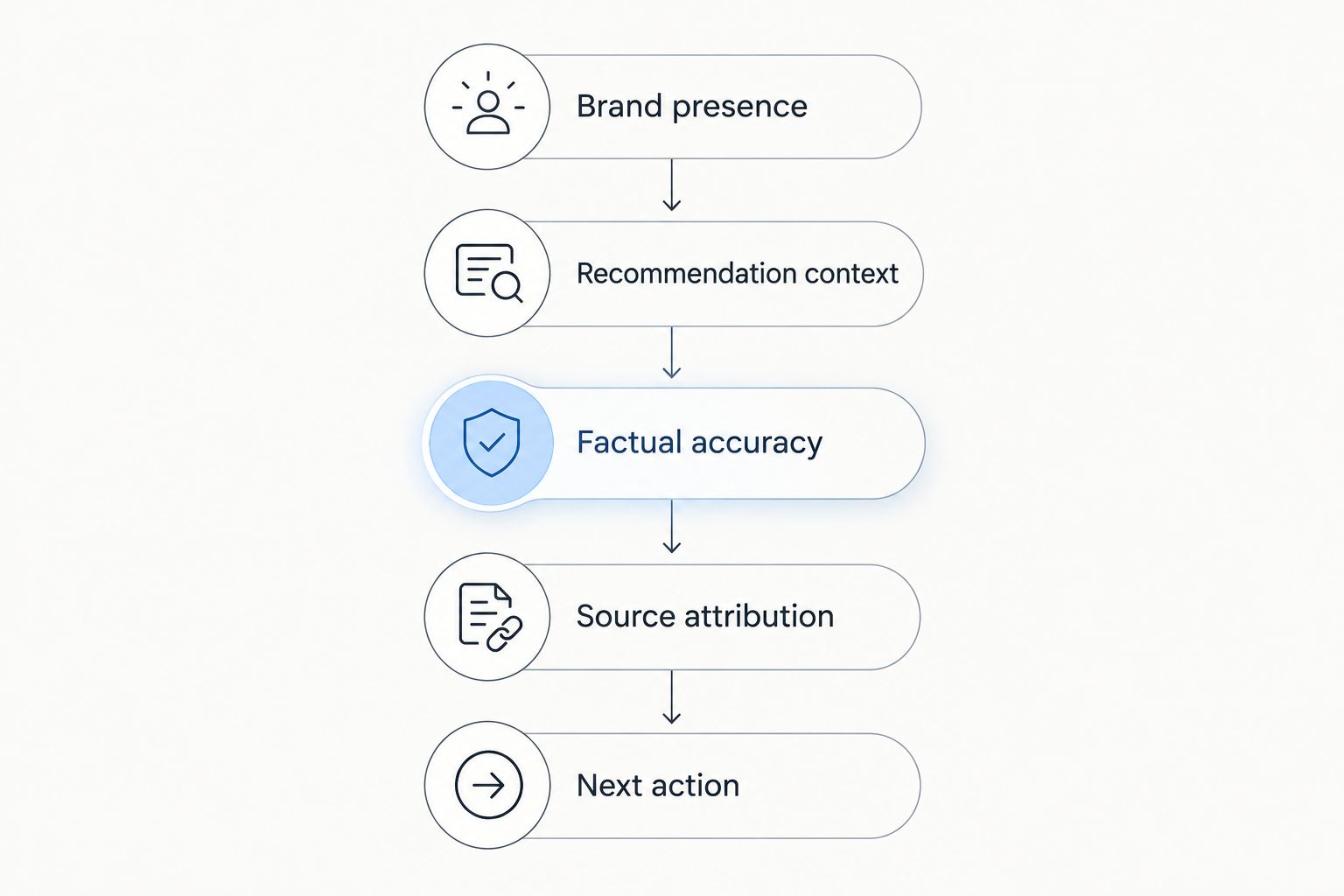
Define each field before collecting results. For example, distinguish a named recommendation from a passing reference, a comparison, or a warning. Do not count every appearance as a positive result.
If you calculate a mention rate, show the numerator and denominator alongside it. State whether the denominator represents prompts or individual runs, and retain answers that omitted your brand.
Record citation presence separately. An answer naming your company without a link is different from an answer citing your product page, and neither proves that the assistant verified every claim.
Why AI visibility results vary
Results need context. These factors belong in the test record because changing them changes what you are comparing:
- Prompt wording: A question containing your brand tests something different from an unbranded discovery question.
- Conversation history: Earlier messages supply context that a fresh conversation does not contain.
- Assistant configuration: Record the platform, visible model, and search settings rather than grouping all answers together.
- Language and market: Preserve the requested language and location context so a regional test remains identifiable.
- Test date: Record when each answer was generated and which source pages were inspected at that time.
- Repeated generation: Retain repeated answers instead of selecting only the response that supports your preferred conclusion.
For a 2026 monitoring program, compare like with like. If you change the prompt set, label the new version and keep the earlier results separate.
A changed answer is an observation, not proof that your latest content edit caused it. Establish what changed in the test before assigning credit to a campaign.
How should you check fragrance and beauty claims?
Treat product claims as a separate review task. A fluent answer can still misstate a scent description or turn a qualified statement into a promise.
For fragrance, distinguish the brand’s stated scent description from subjective impressions about projection, longevity, or personal appeal. Do not convert an assistant’s description into a verified product characteristic.
For beauty products, compare ingredient and usage statements with the current approved information for the exact product. Escalate medical, safety, or treatment assertions for appropriate review rather than publishing them because an assistant repeated them.
Use a simple correction record:
- The exact statement that appeared.
- The product and market involved.
- The approved source used for comparison.
- Whether the error also appears on a page your team controls.
- The owner responsible for the correction or investigation.
Check the cited page itself. A link beside a statement does not establish that the page supports that statement, and a retailer description should not silently replace your approved product information.
What should you change after finding a visibility gap?
Fix the underlying information before producing more content. If an assistant confuses product names and your own pages use inconsistent names, another campaign video does not resolve the contradiction.
Match the action to the evidence:
- Incorrect description: Correct the relevant owned page and review inconsistent supporting copy.
- Missing explanation: Publish a clear answer to the actual shopper question, using substantiated product information.
- Confused product relationships: Explain how named products differ without inventing performance comparisons.
- Misleading source: Document the problem and pursue a correction where you have a legitimate route.
- Weak video context: Add accurate supporting text that explains what the video demonstrates and what it does not prove.
Video can show packaging, application, or a founder explaining a product decision. It cannot let a viewer smell a fragrance, and attractive imagery does not substantiate a formula claim.
Production Soup is a fit for brands that want AI-visibility checks and film production from the same creative agency. The fit is narrower when your only need is a standalone monitoring dashboard: an agency engagement and a software subscription are different decisions.
Explore Production Soup’s services when the visibility gap requires both clearer information and creative production. Agree on the question, evidence, and deliverables before commissioning the asset.
Define your visibility check
Start with the shopper questions and brand-positioning gaps you need to investigate.
Can AI visibility tracking tell you whether shoppers will buy?
No. AI visibility tracking records observed answers; it does not establish a purchase, revenue contribution, or an individual shopper’s intent.
Keep your 2026 visibility record separate from analytics and sales reporting. Connect them only where you have identifiable referral or conversion evidence, and do not turn a rise in mentions into an unsupported revenue claim.
An accurate recommendation is still useful evidence about how your brand appears. It answers a positioning question, not an attribution question.
Is an AI visibility check the same as ongoing monitoring?
No. A check establishes what appeared during a defined exercise; ongoing monitoring repeats that exercise to identify changes.
Choose a one-time check when you need a starting diagnosis or a focused review. Choose repeated monitoring when someone owns the prompt set, reviews the evidence, and acts on the findings.
For a 2026 launch, preserve a pre-launch baseline and document subsequent changes. Do not promise an improvement deadline: publishing a correction does not give you control over an assistant’s next answer.
What should your team receive from a visibility check?
Ask for evidence you can inspect. A chart without prompts, dates, and saved answers leaves your team unable to distinguish a genuine correction from a different test.
Your handoff should include the prompt set, test conditions, captured answers, cited pages, factual issues, and an action list. Give each action an owner and a reason tied to the observed answer.
Production Soup’s AI-visibility work is relevant to brand positioning, but scope still matters. Confirm whether the engagement covers diagnosis, content changes, production, repeat checks, or a defined combination rather than assuming every activity is included.
The report should make your next decision easier. If an observation does not support a correction or a clear follow-up question, keep it in the evidence log instead of presenting it as a strategic finding.
FAQ
Can AI visibility tracking work for a small fragrance brand?
Yes. A small fragrance brand can use a defined prompt set to check mentions, product accuracy, and citations. Keep the exercise focused on relevant shopper questions rather than treating limited observations as market-wide coverage.
What’s the best starting point for fragrance brand visibility tracking?
Start with unbranded shopper questions and a separate set of brand-specific accuracy checks. Save the complete answers and test conditions so later comparisons remain interpretable.
Does a brand mention mean an assistant recommends my perfume?
No. A brand mention can be a passing reference, comparison, or warning rather than a recommendation. Record the surrounding language and product relevance before classifying it.
Can tracking prove that my fragrance lasts longer than another one?
No. Visibility tracking records what an assistant says; it does not test fragrance performance. Compare any longevity claim with appropriate substantiation rather than treating repetition as evidence.
Do I need to track every beauty category?
No. Track the categories and products your brand actually offers. An unrelated skincare question does not measure discovery for a fragrance-only catalog.
Can better website copy guarantee an AI citation?
No. Clear, accurate website copy does not guarantee that an assistant will cite it. Publish useful information, retain the change record, and check subsequent answers without promising placement.
Should I combine all assistants into one visibility score?
Keep platform-level results available even if you also use a summary score. Combining results can hide differences in prompts, settings, citations, and factual accuracy.
One last thing
Check for incorrect inclusion, not just missing mentions. A beauty brand appearing in an unsuitable recommendation has a different problem from a brand that never appears.
Add a mismatch field to your next review. Record when an answer recommends the wrong product, misstates its purpose, or attaches an unsupported claim. That makes the report useful for correcting positioning—not merely celebrating exposure.