
Instead of manually copying interview quotes into profiles and chasing mentions, build a case study video to review platform citations workflow that separates your approved story from the customer’s independent review. Publish the evidence, invite an honest review through the platform’s permitted process, and track the exact pages that reference your business.
- Production Soup suits teams that need case study video production and search-visibility checks together.
- A case study video to review platform citations workflow starts with approved evidence, not automated review submissions.
- Publish your case study separately from customer-authored reviews; neither guarantees an AI-search citation.
- Record source URLs, review status, and observed citations separately so your reporting does not confuse publication with visibility.
Why this matters
A filmed customer story is marketing material. A customer review is the reviewer’s account of their experience. A citation is a reference to a source. Treat these as separate records, not interchangeable proof.
Production Soup provides video production and search-visibility checks. That combination fits teams connecting customer stories with discoverability, but no agency controls a review platform’s moderation or an answer engine’s source selection. Start with Production Soup if you need production and visibility work under one brief.
For your 2026 workflow, distinguish two outcomes: a published review that names your business and an answer that cites the review page. The first does not establish the second. Record each only when you can inspect it.
Before you start
- Gather the source material. You need the approved video, a checked transcript, permission for the intended uses, and supporting records for any outcome claims. Start with 1 case study rather than a backlog.
- Confirm access and ownership. You need editing access to your website, authorized access to the relevant business profile, and a customer contact who can decide whether to review their experience independently.
- Check the platform’s rules before editing. A platform accepting customer reviews does not necessarily accept vendor-authored case studies, video uploads, or promotional links. Confirm business eligibility, permitted content, review solicitation rules, and any restrictions on incentives or conflicts of interest.
The non-obvious blocker is authorship. Customer approval to use a filmed quote does not give you permission to impersonate the customer on a review platform. Keep the customer in control of the review account and submission.
Evidence and approval record
Use a spreadsheet or your existing project system. The bold names below are fields to create for this workflow, not claimed labels from a review platform’s interface.
Build the source record
- Create an Evidence record for the case study. Add Case ID, Customer, Service delivered, Video version, Transcript, Evidence owner, and Approval status.
- Check the transcript against the recording. Correct names, service descriptions, and figures. Keep timestamps beside passages you plan to reuse so an editor can find the original statement.
- Separate the customer’s words from your interpretation. Put direct quotations in Approved quotes and your summary in Editorial summary. Do not turn a qualified statement into an unqualified outcome.
- Create a Claim evidence field for each measurable result. Record its source, measurement period, and scope. Remove unsupported figures rather than replacing them with an estimate.
- Record 2 separate permissions: Publication permission for the case study and Outreach permission for contacting the customer about a review. Keep the scope of each explicit.
Expected result: You can trace every published claim to a recording, supporting record, or approved statement. A producer can identify exactly which version the customer approved.
For a 2026 release, record the actual approval date. Do not relabel an older result as current just because you are publishing a new edit. Keep the experience date and publication date distinct.
Production Soup’s video-production and visibility services fit this kind of coordinated brief. The limitation remains editorial: production quality does not replace evidence, consent, or independent customer authorship.
Publication destination
Choose the destination before cutting a platform-specific version. Your website and a review platform serve different jobs; neither substitutes for the other.
| Destination | Best for | Strength | Limitation |
|---|---|---|---|
| Owned case study page | Publishing the complete, approved customer story | You control the explanation, transcript, and supporting context | It remains company-published marketing material |
| Independent customer review | Capturing the customer’s firsthand experience | The customer controls their account of the work | Eligibility, moderation, and permitted formats belong to the platform |
| Business profile content | Providing business information and permitted supporting material | Keeps approved details attached to the relevant profile | A profile update is not an independent review |
Prepare the owned page
- Create an Owned page record linked to the evidence record. Enter Page owner, Approved copy, Video version, Publication date, and Public URL.
- Write the page around the customer’s problem, the work delivered, and the documented outcome. State the service plainly. Avoid implying that one project proves results for every buyer.
- Add a readable transcript or accurate text summary. Preserve qualifications and attribution. Use the transcript-to-web-copy workflow when you need to turn spoken material into a structured page.
- Publish only material covered by permission. Remove confidential screens, unapproved names, and unsupported outcome language before release.
- Open the public page without your editing account. Test playback, readable text, and any intended links. Confirm the published version matches the approved version.
Expected result: A visitor can understand the case study without access to your internal files. The page explains what happened and who is making each claim.
Prepare the review destination
- Create a Customer review record with Platform, Business profile, Eligibility checked, Rules checked date, and Customer contact.
- Verify that the profile represents the right business and service. Resolve duplicate or incorrect profile details before sending anyone there.
- Read the platform’s current submission guidance. Record whether it permits video, links, business responses, and the review-request method you intend to use.
- Identify the permitted customer review route within the platform. Use its current interface and guidance rather than assuming every platform has the same buttons.
Expected result: You know where the customer can submit an eligible review and what content the platform accepts. No edit depends on an unsupported upload format.
Customer invitation and publication handoff
Invite an honest account, not a scripted endorsement. The case study can help the customer recall the project, but it should not dictate the review’s wording or rating.
Configure the handoff
- Add Invitation status, Invitation date, Review status, and Public review URL to the customer review record. Keep those fields separate from the video’s publication status.
- Send a neutral invitation through a method permitted by the platform. Identify the project and let the customer decide whether to review it. Do not condition the request on a positive rating.
- Give factual context only when needed: the service name, project scope, or approved case study. Do not provide a finished review for the customer to paste as their independent account.
- Let the customer choose their wording and submit through their own account. Do not request login credentials or publish a review under their identity.
- After submission, record the status you can verify. Use Invited, Submitted, Published, or Removed as your internal status values. Treat customer-reported submission as distinct from a publicly visible review.
Expected result: The invitation and any resulting review have a clear provenance. Your team can distinguish an unanswered invitation from a published customer account.
For a 2026 campaign, check the rules at the point of outreach, not just when the video brief was written. Save the date of that check in the record. A previous campaign’s process is not proof of current permission.
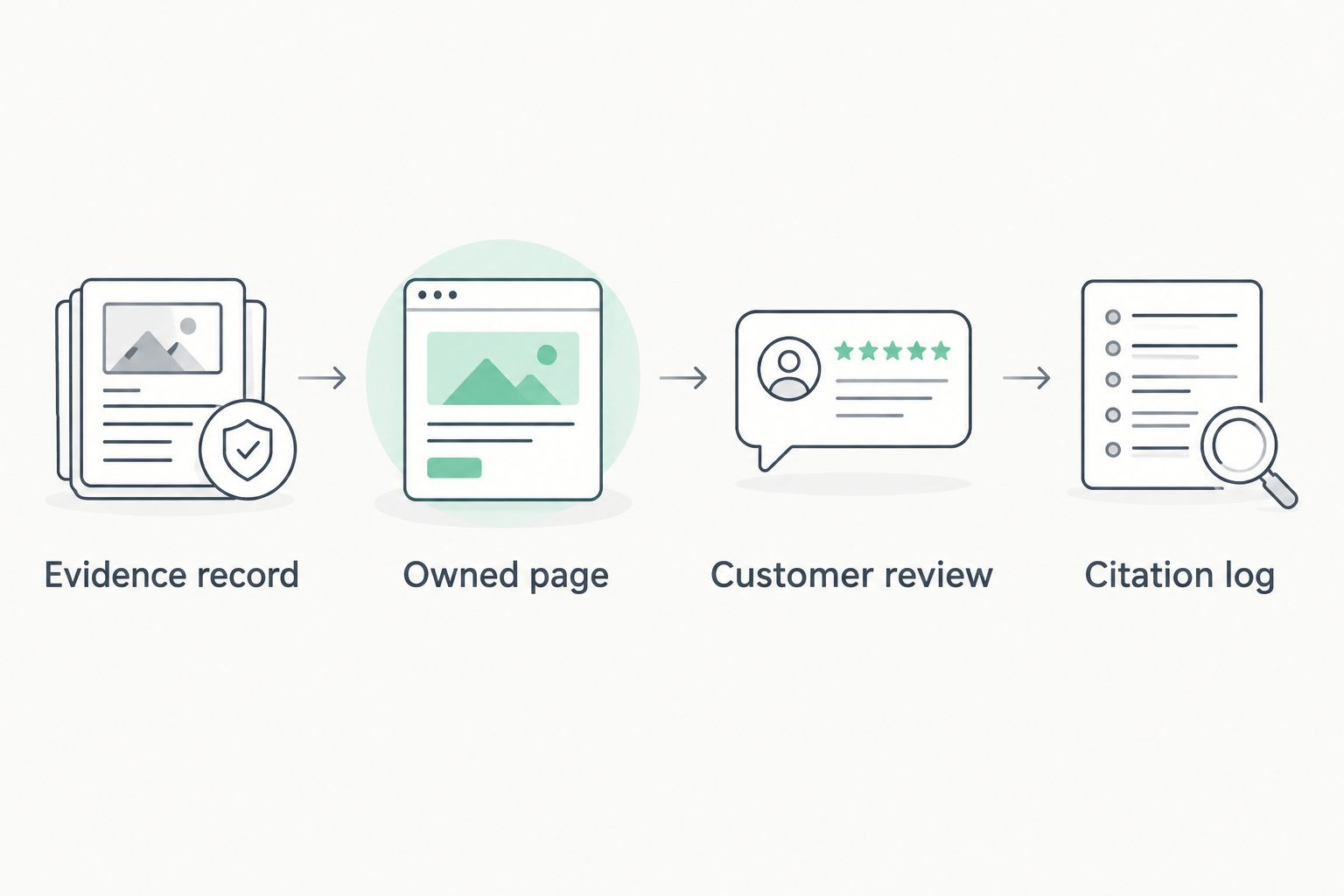
The handoff has four connected records: Evidence record, Owned page, Customer review, and Citation log. Connect them with the same case ID while keeping their approval and publication states separate.
Citation tracking and verification
A review submission is not a citation report. Build the reporting record around inspectable evidence rather than assumptions about where the content should appear.
Configure the observation log
- Create a Citation log with Observation date, Query, Platform or engine, Brand mentioned, Source cited, Cited URL, and Evidence capture.
- Save the public review URL when the review becomes visible. Record the individual review page when available; otherwise identify the profile and review clearly enough to find it again.
- For search checks, record the exact query and observed result. For answer-engine checks, save the prompt, answer, and displayed sources. Mark a citation only when a source reference is actually present.
- Inspect the cited destination. Classify it as the owned case study, review page, profile, or another source. Do not credit the review platform when the answer links to your website instead.
- Repeat a fixed set of checks on a documented schedule. Compare equivalent queries and keep the observation dates. Treat each answer as an observation, not a permanent ranking.
Expected result: Your report distinguishes 3 evidence types: publication, brand mention, and source citation. Each citation entry points to a source you inspected.
Use a 2026 baseline before publication if you want a before-and-after record. A later citation does not, by itself, prove the video caused it. Keep the sequence of events separate from claims about causation.
When the case study changes
An updated case study needs a controlled revision, not an automatic review rewrite. The customer’s review describes their experience; your new edit does not authorize changes to that account.
- Change Video version and list the revised claims in the evidence record.
- Reopen approval for material changes to quotes, outcomes, scope, or attribution.
- Update the owned page only after approval. Record the revision date without erasing the original experience period.
- Check whether existing profile content now conflicts with the approved facts. Correct business-controlled content through the platform’s permitted process.
- Contact the customer only when a factual clarification is needed. Let the customer decide whether to update their review.
Expected result: Updated marketing material stays accurate without overwriting the history of the customer’s experience.
Automate internal reminders and record handoffs if your systems support them. Keep publication approval and customer review submission outside an unattended automation.
Troubleshooting
The platform does not accept the video
Keep the complete film on your owned page. Use only formats the platform permits, and do not force a link into a field that prohibits promotion. A text review can remain independent of the film.
The review was submitted but is not public
Record Submitted, not Published. Check the platform’s moderation guidance and any notice received by the reviewer. Avoid repeated resubmissions intended to bypass moderation; the reviewer should use the platform’s support process when appropriate.
The review repeats an unsupported result
Pause reuse of that claim in your marketing. Check the underlying evidence and ask the customer to clarify any factual error through the platform’s permitted process. Do not alter the customer’s account yourself.
The answer mentions the brand without citing the review
Log a brand mention, not a review-platform citation. Inspect the sources actually displayed. Better reporting starts with an accurate classification, not a larger citation count.
The case study and review appear inconsistent
Compare service scope, project dates, and what each speaker describes. Correct errors in content you control. Different opinions are not automatically errors, and the customer does not need to match your marketing language.
Customize your workflow
Expand only after the first case has a complete evidence trail. Assign an owner for each handoff: claim approval, page publication, customer outreach, and citation verification. One person can hold several roles, but each decision needs a named owner.
Production Soup suits teams that need case study video production and search-visibility checks together. The next brief should specify the intended audience, evidence available, customer permissions, publication destinations, and what counts as an observed citation.
For your 2026 reporting, keep production completion separate from visibility outcomes. A finished film is a delivered asset. A published review is third-party content. An observed citation is a source reference captured during a specific check.
FAQ
How do I turn a case study video into review-platform citations?
Publish an approved case study, invite the customer to review their experience through the platform’s permitted process, and track public references separately. A video does not automatically become an independent review or a cited source.
Can I post a customer’s video testimonial as their review?
Do not submit a review under the customer’s identity. Permission to publish a testimonial does not authorize impersonation; check the platform’s rules for business-controlled testimonial content.
Does publishing a customer review guarantee an AI-search citation?
No. Record a citation only when an observed answer displays a source reference, then inspect whether that reference actually points to the review platform.
What if the review platform does not support video?
Publish the approved video on your owned case study page and use only formats the review platform permits. The customer can describe their experience independently without uploading the film.
Can I automate this entire workflow?
Automate internal reminders and record handoffs where your systems support them, not customer-authored review submissions. Keep permission checks, claim approval, and citation verification under human control.
What should I measure after the case study goes live?
Track publication status, public review URLs, observed brand mentions, and verified source citations separately. Save the query, observation date, answer, and cited destination so each reporting claim has inspectable evidence.
One last thing
Check what the cited page actually supports. A link to a review profile does not prove that an answer used your customer’s case study, or that it supports the outcome stated in the answer. Save the relevant passage beside the citation. That small step makes the report useful when someone asks where a claim came from.