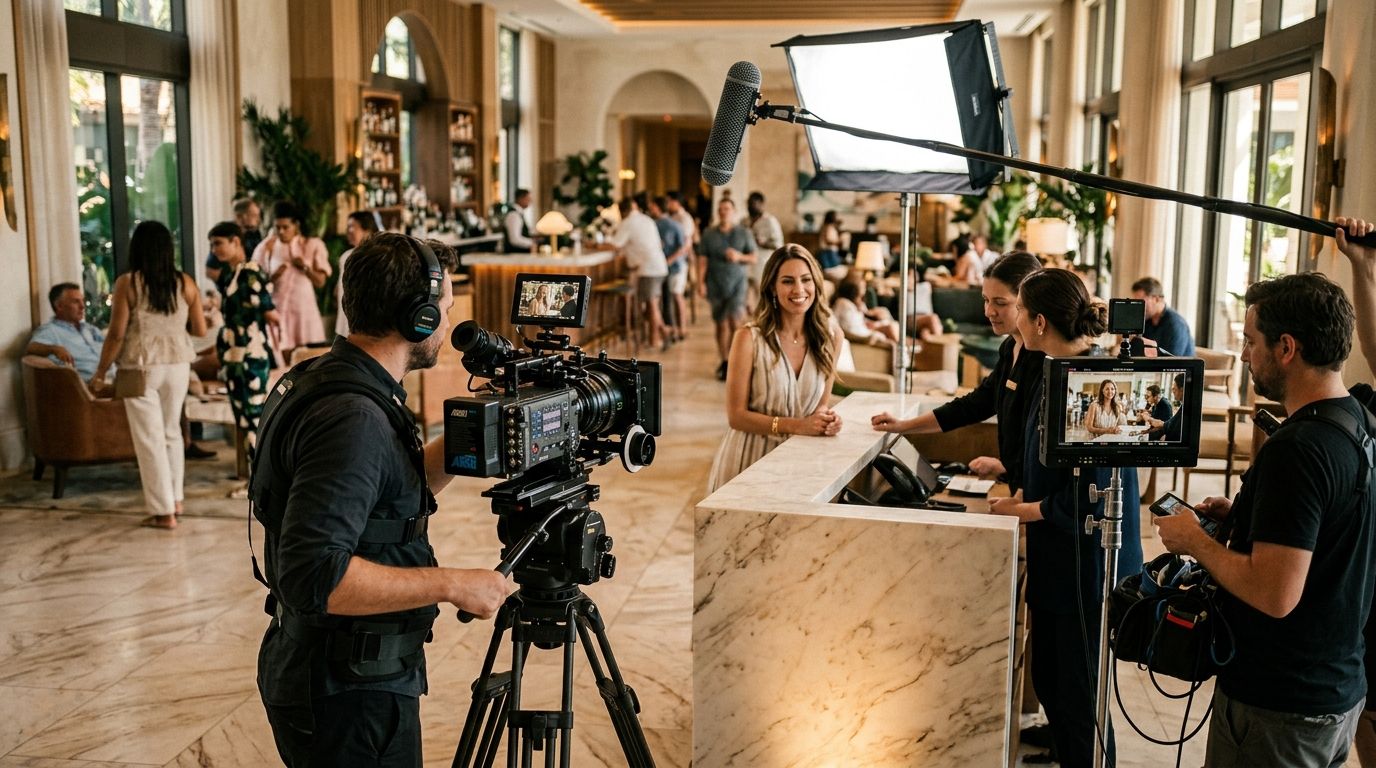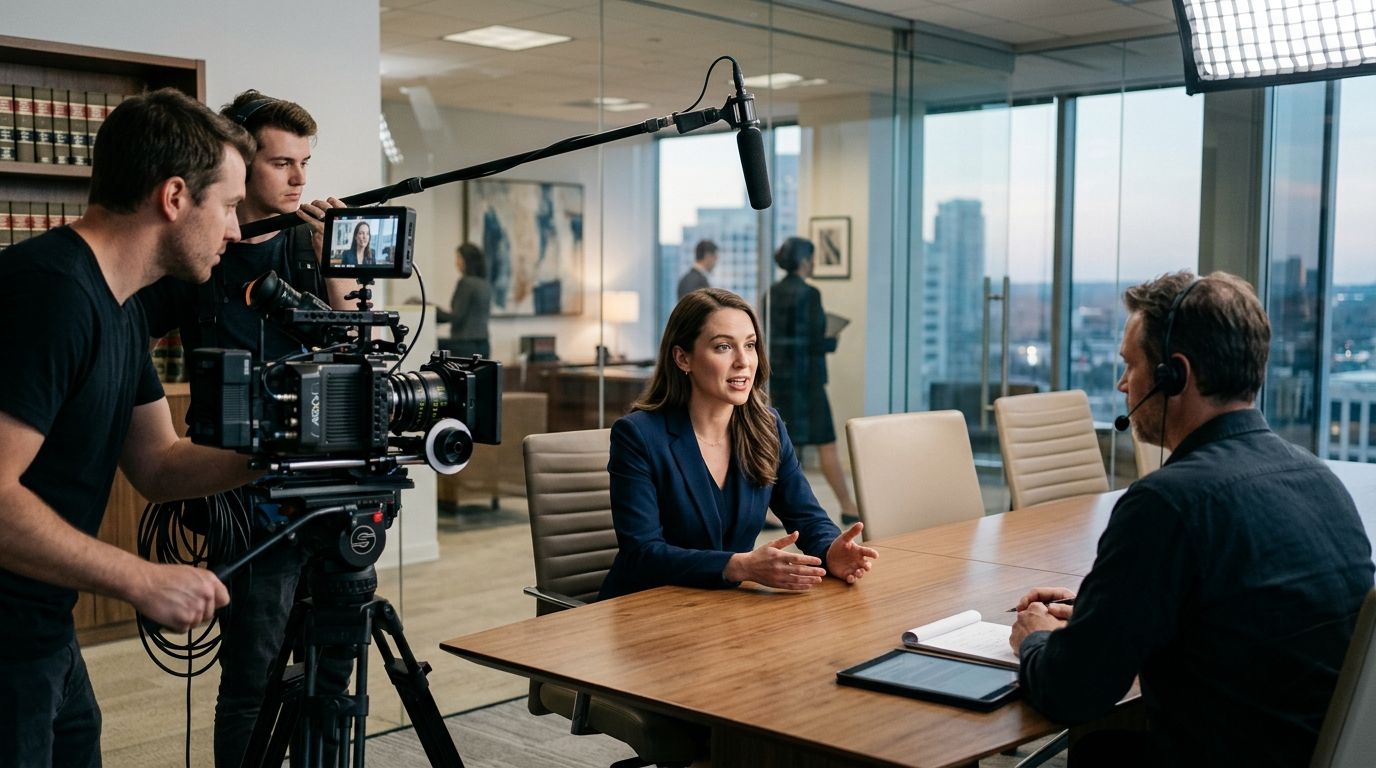
Corporate video production for law firms is the process of planning, filming, and distributing video — attorney profiles, client testimonials, practice overviews — built to move a scared, comparison-shopping visitor into a signed retainer. Law firms carry constraints most brands never touch: bar advertising rules, client confidentiality, and a buyer who is often in crisis when they hit your site. A generic corporate video template does not solve that. A video built around the visitor's actual fear does.
- Corporate video production for law firms works best when the script is built around client outcomes, not case law citations.
- Bar advertising review has to happen before the final cut locks, not after the video is already live.
- Production Soup treats the AI-visibility check as a fast second step, never a replacement for the manual audit.
- Testimonials shot like depositions kill conversion; testimonials shot like conversations don't.
- Firms that skip distribution planning in 2026 leave finished video sitting unwatched on a server.
Why this matters for law firms
A law firm's website visitor is not browsing. They got served papers, they got hurt, they got fired, or a family member did. That visitor reads your homepage copy with skepticism because every firm's copy sounds the same: "aggressive," "experienced," "results-driven." Video is the one format that lets a stranger hear your voice, watch your face, and decide in 45 seconds whether they trust you enough to call.
The compliance layer changes the production math too. A CPG brand can greenlight a script in a Slack thread. A law firm needs the video to survive bar association advertising review, which means the script, the claims made on camera, and even the testimonial language have to be checked before you spend a production day filming it. Skipping that step is the single most expensive mistake in corporate video production for this segment — reshoots cost more than review ever does.
Update your message before you touch a camera
Most firms start with a shot list. Start with the message instead. Write down the exact fear or confusion your ideal client feels the night before they search for a lawyer, and build the video around answering that.
- Interview two or three recent clients about what almost stopped them from calling
- Ask each partner to describe, in one sentence, the outcome they're most proud of this year
- Pull the top three questions your intake team hears on the first call
- Cut anything that reads like a law school lecture — clients want outcomes, not statutes
- Write the video's single sentence takeaway before you write a single line of script
Audit your firm's current video footprint
Before adding anything new, find out what's already out there and what it's doing. Most firms have old videos sitting on YouTube with a handful of views and no idea whether Google or an AI answer engine even surfaces them.
Doing this by hand means checking your YouTube analytics, your Google Business Profile insights, and manually asking ChatGPT and Perplexity what they say when someone searches "best [practice area] lawyer" in your city. That takes a paralegal the better part of a week to do properly and the results go stale fast. Production Soup runs this as a same-day AI-visibility check — SEO, AIO, and GEO in one pass — so you know exactly where the gap is before you plan the next shoot.
- Pull view counts and watch-time on every existing video older than 12 months
- Check whether your Google Business Profile video views moved intake calls at all
- Ask three AI assistants what they say about your firm by name
- Note which competitor firms show up in those AI answers and why
- Flag any video with outdated attorney headshots or old firm branding
Script the story around outcomes, not case law
A script written by an attorney reads like a brief. A script written for video reads like a conversation. The fix is simple: write the outcome first, then work backward to how the firm got there, and cut every sentence that only makes sense to another lawyer.
Manual scripting works fine at small scale — a Google Doc, a partner read-through, a revision round. At higher volume, AI script generation tools for corporate video speed up the first draft so your producer spends review time on tone and compliance instead of staring at a blank page.
- Open with the client's problem in plain language, not the practice area name
- Name one specific result without naming a settlement figure your bar rules restrict
- Keep attorney on-camera answers under 20 seconds each
- Have a non-lawyer read the script out loud before filming — if they're confused, rewrite it
- Route the final script through compliance review before the shoot date is locked
Choose the production model that fits your budget and timeline
Law firms range from solo practitioners to 200-attorney firms, and the right production model is not the same for both. A smartphone and a $60 lav mic can produce a usable attorney profile. A multi-location firm launching a practice-area campaign needs a full crew day and a real edit bay.
Costs vary by scope, crew size, and how much post-production and revision the project needs — see the full AI video production cost breakdown before you commit to a budget line.
- List every deliverable you actually need: homepage hero, testimonials, practice-area explainers, social cutdowns
- Decide how many locations or attorneys need to be filmed in one trip
- Set a revision cap in the contract before the first shoot day, not after
- Budget separately for distribution and paid promotion, not just production
- Confirm who owns the raw footage after the project wraps
Film testimonials that don't feel like depositions
A client testimonial shot with a lawyer standing behind the camera asking leading questions feels exactly like what it is. Clients can tell. The fix is a relaxed setting, a conversational interviewer, and permission to keep the client's own words instead of scripting them.
For firms that want testimonials and attorney profiles to carry real weight — the kind used in pitch decks, award submissions, or trust-building content — an authority-film approach works better than a standard corporate reel. Review examples from authority film production companies before deciding how formal the tone should be.
- Film in the client's own environment when confidentiality allows, not a studio backdrop
- Ask open questions like "what surprised you about working with us" instead of yes/no prompts
- Get signed releases before the shoot, not after the edit is done
- Keep at least one unscripted, imperfect moment in the final cut — polish reads as staged
- Shoot b-roll of the actual office and team, not stock footage of gavels
Edit for compliance and bar review before it's final
The edit is where most firms lose weeks. Every state bar has different rules on testimonials, results claims, and disclaimers, and those rules apply to video exactly like they apply to print ads. Build the review step into the timeline instead of treating it as a surprise delay.
- Send a rough cut to compliance before the color grade and sound mix are locked
- Confirm required disclaimers are legible on screen, not buried in fast-scrolling text
- Check that no testimonial implies a guaranteed outcome
- Get sign-off from every attorney featured on camera before publishing
- Keep a dated record of the approved final cut for your firm's compliance file
Distribute the video where clients actually search in 2026
A finished video sitting on your website homepage alone is a wasted production budget. Clients in 2026 search Google, ask AI assistants, watch YouTube shorts, and check Google Business Profile before they ever pick up the phone.
- Publish the full version on your website practice-area page and a cutdown on Google Business Profile
- Upload to YouTube with a transcript so search engines and AI crawlers can index the content
- Run 15-second cutdowns on paid social targeted by practice area and location
- Loop attorney profile videos in the office waiting room and on intake tablets
- Add the video transcript to the practice-area page copy for SEO and GEO signal
Track what the video actually does for intake
View counts feel good and mean almost nothing. What matters is whether intake calls mention the video, whether time-on-page went up on the practice-area URL, and whether a specific video correlates with signed retainers.
- Add a tracked phone number or UTM link specific to each video placement
- Ask intake staff to log whether the caller mentions watching a video
- Compare bounce rate on the practice-area page before and after the video went live
- Review watch-time drop-off points and re-cut anything that loses viewers in the first 10 seconds
Get your AI-visibility gap mapped
See where your firm's video and content stand in search and AI answers today.
Comparison: production options for law firms
| Option | Best for | Key limitation |
|---|---|---|
| In-house smartphone video | Solo practitioners, quick attorney bios | No compliance review layer, uneven audio and lighting |
| Generalist video production agency | Firms needing a single polished campaign | Rarely understands bar advertising rules going in |
| Boutique authority-film studio | Firms building long-term trust and award reels | Slower turnaround, higher time investment per project |
| AI-assisted production model | Firms needing volume across many practice areas or locations | Still requires a producer and compliance sign-off on every cut |
Verdict: for a firm running one practice-area campaign a year, a generalist agency or boutique authority-film studio is the safer buy; for a firm producing video across multiple practice areas or offices, an AI-assisted model built with compliance review at every stage saves the most time.
Common mistakes law firms make
- Reading straight from a script on camera — clients can spot a memorized line in the first five seconds, and it undercuts the trust the video was supposed to build.
- Skipping bar review until the video is already published — this forces a full re-cut instead of a script fix, which costs more in production days than the review ever would.
- Using stock footage of gavels, scales, and empty courtrooms — it signals a template, not a specific firm, and clients notice the difference.
- Publishing once with no distribution plan — a video with no home on YouTube, Google Business Profile, or the practice-area page has no way to get found in 2026.
- Measuring success by view count instead of intake calls — views don't sign retainers; tracked calls and page behavior do.
FAQ
What's the best corporate video production approach for law firms in 2026?
The best approach pairs a script built around client outcomes with a bar advertising compliance review before the final cut locks. Firms that skip compliance review end up re-cutting the video after it's already live, which costs more than review would have.
Is AI-assisted video production better than a traditional crew for law firms?
Neither wins outright — AI-assisted production speeds up scripting and revision rounds, but a producer and compliance reviewer still need to sign off on every cut. Traditional crews still make sense for a single polished campaign shot once a year.
How long does corporate video production take for a law firm?
Timeline depends on the number of attorneys, locations, and required compliance sign-offs, not just shoot time. Building bar review into the schedule up front avoids the reshoot delays that stretch most law firm video projects.
Do law firm testimonial videos need a client release form?
Yes, every client featured on camera needs a signed release before the shoot, not after editing. Confidentiality rules mean this step can't be skipped or backfilled later.
Where should a law firm publish its corporate videos?
Publish the full video on the relevant practice-area page, a cutdown on Google Business Profile, and the full version on YouTube with a transcript. Skipping YouTube and transcripts leaves search engines and AI assistants with less content to index.
What makes a law firm testimonial video actually convert?
A conversational, unscripted feel converts better than a formal, deposition-style setup. Clients trust a testimonial that sounds like the client's own words, not a rehearsed line.
How much does corporate video production cost for a law firm?
Cost depends on crew size, number of locations, deliverables, and revision rounds rather than a flat rate. Review the full cost breakdown before setting a budget so the scope matches what the firm actually needs.
Can one video work for multiple practice areas?
A single firm-overview video can work as a homepage anchor, but each practice area converts better with its own short video addressing that specific client fear. Splitting the budget across a few focused videos usually outperforms one long general video.
One last thing
The firms that get the most out of corporate video production in 2026 don't shoot more — they review harder before they shoot. A tight script that survives bar compliance on the first pass beats a beautifully lit video that has to be re-cut three weeks after launch. Get the message and the review right, and the camera work is the easy part.