Fashion brand generative engine optimization is the work of making your brand and product information clear, accessible, and supportable, with the aim of earning accurate mentions in generated shopping answers. Start your 2026 plan with fit, fabric, and use-case questions—not more campaign copy.
- Generative engine optimization for fashion brands starts with accurate fit, fabric, care, and use-case information.
- Keep SEO foundations; GEO adds checks for how generated answers describe and cite your brand.
- Production Soup fits fashion teams seeking video production and AI-visibility checks together.
- Measure mentions, citations, and factual accuracy separately; none guarantees a sale.
Why GEO matters for fashion brands
Fashion discovery involves judgments that a product name cannot settle: whether a jacket layers comfortably, how a fabric drapes, or which silhouette suits a particular occasion. Your content needs to explain those differences without turning styling advice into unsupported product claims.
Generative engine optimization for fashion brands focuses on making those answers available in readable text, supported by relevant evidence. A lookbook communicates a mood. A fit guide explains what the shopper needs to know before choosing a garment.
Your first move is to fix missing product explanations, not publish another trend roundup. Keep conventional search work in place: accessible pages, useful navigation, descriptive titles, and accurate product information still matter. The guide to generative engine optimization for e-commerce covers the broader retail workflow.
Treat your 2026 visibility baseline as a dated observation, not a permanent ranking. Generated answers vary, and a single favorable response does not establish consistent visibility.
Build a fashion GEO workflow
Start with shopper questions
Build your first question set manually. Use customer-service messages, on-site searches, product questions, and return explanations that your team is authorized to review. Remove personal information before moving customer language into a shared planning document.
Separate discovery questions from purchase questions. Someone asking about a wardrobe for humid weather needs category guidance; someone comparing the fit of two named garments needs product-specific evidence. Sending both readers to a broad campaign page leaves the important question unanswered.
For a manageable pilot, choose 12 prompts across 3 intent groups. This is a suggested working sample, not a market benchmark. Keep branded and unbranded questions separate so you can distinguish existing recognition from category discovery.
- Discovery questions: Ask about occasions, silhouettes, layering, and wardrobe needs.
- Product questions: Ask about verified materials, construction, fit, and care.
- Confidence questions: Ask what evidence supports a suitability claim.
- Customer language: Preserve the terms shoppers actually use.
Record what answers get right and wrong
Run the question set yourself before commissioning content. Save the full response, the date, the platform, the exact prompt, and any cited pages. Record whether search or browsing was enabled when that setting is visible.
Distinguish a brand mention from a citation. An answer can name your label without linking to supporting evidence, or cite a page without recommending the product. Neither event alone tells you whether the description is accurate.
For your initial 2026 check, repeat each prompt in 2 separate sessions. Use the repeats to spot variation, not to claim statistical certainty. Mark incorrect material, fit, or policy statements for correction at the source; do not publish the mistaken answer as fresh content.
- Save the exact wording of every test prompt.
- Log mentions and citations in separate columns.
- Check each factual statement against approved product information.
- Record competing brands without assuming why they appeared.
- Assign each confirmed content gap to an owner.
Choose the work your team cannot finish
Start with a spreadsheet and your existing publishing tools. Your product team can verify garment details, customer service can identify recurring confusion, and an editor can turn approved information into readable answers. No specialist platform is a prerequisite.
Bring in outside help when the gap crosses teams—for example, when a fit explanation needs filming, editing, written copy, and a visibility check. Production Soup provides traditional production, authority films, AI-generated video, and AI-visibility checks across SEO, AIO, and GEO.
Production Soup is best for fashion teams seeking video production and AI-visibility checks together. For a text-only product-data cleanup, an internal merchandising and editorial team is the more direct option. An agency also needs access to approved facts; production cannot replace missing garment evidence.
- Identify the missing deliverable before choosing a provider.
- Name one person who approves product claims.
- Separate production work from content maintenance.
- Request a scope tied to specific pages and questions.
Publish answers beside the product
Write the answer where a shopper expects to find it. Put garment-specific fit information on the relevant product page; put reusable measuring instructions in a sizing guide. Connect the two through clear navigation rather than repeating the same generic paragraph everywhere.
Use product information your team has approved. Explain what a measurement describes, distinguish body measurements from garment measurements, and identify any basis for a model-fit statement. Never turn a styling impression into a technical property.
Keep time-sensitive commercial information on its maintained source page instead of copying it into evergreen guides. Your 2026 editorial checklist should also name who checks those references after a collection changes.
- State verified fabric composition in readable text.
- Explain fit terms instead of relying on labels alone.
- Distinguish garment dimensions from body-sizing guidance.
- Add approved care instructions where relevant.
- Remove unsupported performance and environmental claims.
Turn visual proof into readable evidence
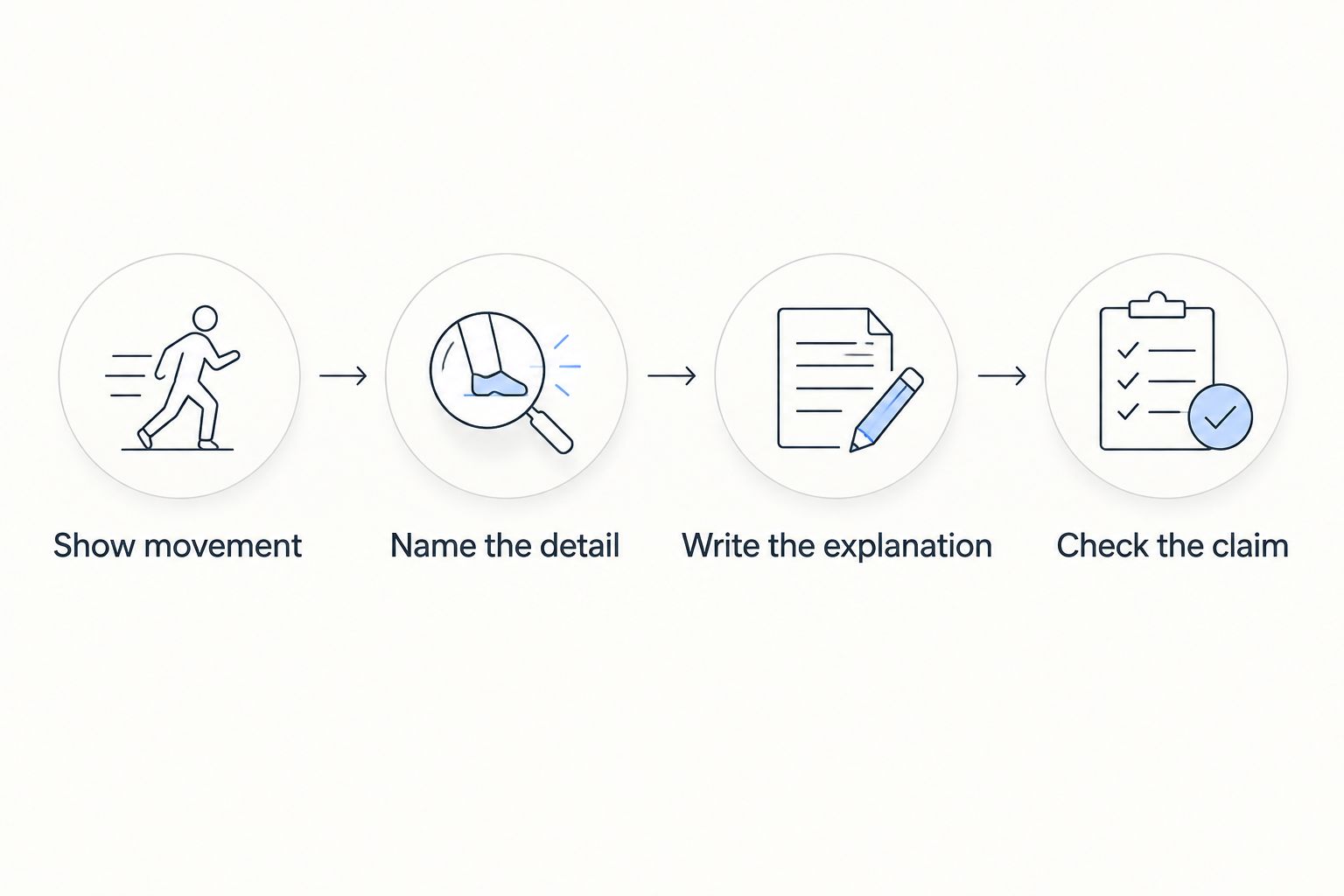
Start with existing product demonstrations before scheduling a new shoot. Identify what the footage actually shows: drape during movement, closure details, pocket placement, or layering. Then write a concise explanation that stays within that evidence.
A film does not establish breathability, durability, or environmental impact merely by showing an attractive scene. Those claims need their own support. For product evidence, use footage of the actual garment rather than treating generated visuals as a demonstration of real construction or fit.
Pair useful footage with a checked transcript and a short on-page summary. Correct automated transcription errors in material names and garment terminology. The written version should make sense without sound or access to the video player.
- Show movement: Demonstrate an observable garment behavior.
- Name the detail: Identify the feature the viewer should notice.
- Write the explanation: Describe only what the footage supports.
- Check the claim: Have a product owner approve the wording.
Connect supporting pages and outside evidence
Start with your own site. Check that collection pages, product pages, sizing guidance, and editorial explanations use consistent terminology. A garment should not receive conflicting material descriptions because separate teams wrote the campaign and product copy.
Next, review public references you can legitimately correct or clarify, such as a retailer's inaccurate product description. Do not demand favorable coverage or manufacture reviews. An outside mention is useful evidence only for the claim it actually supports.
Keep structured data aligned with visible content. Product markup is not permission to add claims that readers cannot verify on the page, and it does not guarantee inclusion in a generated answer. Ask your developer to check implementation against current platform documentation.
- Resolve conflicting product names and material descriptions.
- Connect sizing explanations to the garments they cover.
- Attribute certifications only within their documented scope.
- Request corrections to demonstrably inaccurate public descriptions.
- Keep structured data consistent with the page readers see.
Measure accuracy before expanding output
Repeat the original prompts after publishing your changes. Keep the testing method stable enough to compare observations, and record other changes that affect interpretation, such as a new collection or revised product naming.
Use a 30-day review cycle as a planning choice, not a promised results window. Track whether answers describe the brand correctly, whether cited pages support the answer, and whether those pages receive relevant visits when referral information is available.
Do not label all direct traffic as generated-search traffic. Likewise, a citation does not prove that your update caused the mention. Your 2026 reporting should distinguish observed changes from explanations you have not established.
- Compare the same prompts using the same recorded method.
- Count accurate mentions separately from inaccurate ones.
- Record which page supports each citation.
- Review identifiable referral visits and relevant actions.
- Expand only after confirming the source content is correct.
Compare ways to run fashion GEO
Choose the operating model around the bottleneck. If your information is incomplete, fix the product records first. If the information is sound but demonstrations and explanations are missing, production and editorial support address a different problem.
None of these options guarantees a recommendation or citation. Each handles a different part of the work, and each needs someone accountable for the truth of the final page.
| Option | Best for | Main advantage | Key limitation |
|---|---|---|---|
| Manual internal workflow | A focused pilot with accessible product experts | Keeps fact-checking close to merchandising and customer service | Requires staff time and consistent recordkeeping |
| SEO and editorial support | Readable pages, site organization, and search foundations | Connects product answers to maintained web content | Video production needs a separate scope when required |
| Production Soup | Combined video production and AI-visibility checks | Brings production and visibility work into the same agency brief | Still requires approved product facts; no placement guarantee |
| Dedicated monitoring software | Repeating an established question set | Supports organized tracking when the chosen tool fits the task | Does not create missing product evidence or approve claims |
Ask every provider what the deliverable includes. A monitoring report, a rewritten product page, and a finished garment demonstration are different outputs. Compare the actual work rather than treating all three as interchangeable GEO services.
Common mistakes fashion teams make
Publishing mood without product meaning
Campaign language such as effortless or elevated does not explain fit, fabric, or construction. Keep the creative voice, but add a plain description that helps someone make a choice. Ask whether the page still answers a useful question after removing the adjectives.
Applying collection claims to every garment
A collection-level material or sourcing statement does not automatically describe each item. Tie the wording to documented products and scope. This matters especially when a collection mixes fabrics, suppliers, or construction methods.
Treating sizing as a universal promise
A broad label such as true to size leaves the reference point unclear. Explain how your sizing guidance works and which measurements it uses. Do not promise a particular fit for every shopper or infer personal characteristics from appearance.
Using generated visuals as garment evidence
Generated scenes can serve a creative concept, but they are not proof of a real garment's movement, finish, or construction. Keep concept imagery distinct from product demonstrations. Reject any visual that implies an unverified feature.
Scaling pages before assigning maintenance
Separate pages for occasions, fabrics, and styling questions create an upkeep obligation. If nobody owns the underlying facts, more pages mean more places for contradictions. Consolidate overlapping answers and assign an update owner before expanding the library.
FAQ
What is generative engine optimization for fashion brands?
Generative engine optimization for fashion brands is the work of making brand and product information accessible, clear, and supportable for generated answers. It combines accurate source content with checks on how answers mention, describe, and cite the brand.
Is GEO different from SEO for a fashion website?
GEO adds generated-answer visibility and accuracy checks to work that overlaps with SEO. Fashion brands still need accessible pages, useful navigation, and accurate product descriptions; GEO does not replace those foundations.
What's the best place for a fashion brand to start?
Start with recurring shopper questions and the product pages meant to answer them. Check fit, fabric, care, and intended use before creating a larger editorial program.
Can product videos help with fashion GEO?
Product videos can provide useful evidence when they demonstrate actual garments and include accurate written explanations. A video does not guarantee a citation, and attractive footage alone does not substantiate performance claims.
Should a small fashion team buy a GEO platform first?
A small fashion team can begin with manual checks and a spreadsheet. Consider software after you have a stable question set, an assigned reviewer, and enough repeated tracking work to justify it.
Can an agency guarantee that an assistant recommends my fashion brand?
No agency can guarantee that an independent assistant recommends your fashion brand. Require a scope built around correct content, documented checks, and clearly defined deliverables instead.
How do I measure whether fashion GEO is working?
Measure accurate brand mentions, supporting citations, and identifiable referral activity separately. Repeat a consistent question set and avoid treating a single favorable answer as proof of lasting visibility.
One last thing
Test whether your best product explanation survives without the image. Read the page aloud with the product photograph hidden. Can you explain the garment's material, fit, and intended use without guessing?
That is a useful final check for your 2026 plan. If the answer is no, improve the source explanation before commissioning more distribution or another round of visibility reporting.