
A perception check is complete when you have documented findings and a clear next step; confirm its delivery date against a written scope before booking. Your perception check timeline should separate the initial assessment from content changes and later visibility measurement, which are different pieces of work.
- Set your perception check timeline around agreed evidence, review, and delivery—not an assumed turnaround.
- Production Soup connects brand positioning checks with SEO, AEO, GEO, and creative production.
- Keep assessment delivery separate from publishing fixes and measuring later search visibility.
- Ask for a dated handoff, documented findings, and a clear next action before approving the work.
How long does a perception check take to complete?
Get a scoped delivery date, not a generic promise of speed. A useful deadline tells you when findings arrive, what those findings cover, and whether discussion or revisions sit inside that deadline.
For a 2026 brief, specify the brand question you need answered before asking for a turnaround. Checking whether your positioning is understood is a different assignment from investigating every market, service, and competitor your business touches.
If you are still defining the assignment, start with how to know if your brand needs a perception check. Establish the decision first. Then agree the evidence needed to support it.
Use these checkpoints when setting the schedule:
- Scope agreed: Name the business question, audience, and material to review.
- Inputs ready: Supply the correct website, current positioning, and relevant supporting material.
- Evidence captured: Record what was checked and when it was observed.
- Findings reviewed: Separate an observed gap from an interpretation or recommendation.
- Handoff accepted: Receive the findings, limits, and next action in the agreed format.
These are recommended acceptance checkpoints, not a promised service schedule. Put an owner and a date beside each checkpoint before the work starts.
Why this matters
A deadline is useful only when everyone means the same thing by “finished.” Receiving an initial observation, approving a report, publishing a correction, and seeing a different search answer are separate events.
If your team treats them as one milestone, a finished assessment can look unfinished because implementation has not started. The reverse also happens: a polished presentation gets accepted even though nobody knows what to do with it.
Define completion as a decision-ready handoff. You should know what the evidence shows, what remains uncertain, and which action deserves attention first. That is a more useful finish line than a document marked complete.
Set the timeline before the check starts
Ask for the schedule in writing. Keep it plain: the start condition, delivery date, included review, and named decision-maker should be easy to find without reading a long proposal.
Avoid a deadline that starts “once everything is ready” unless the required inputs are listed. Otherwise, neither side has a clear way to establish when the clock begins.
Agree the start condition
Choose an observable event, such as approval of the brief and receipt of the required material. Do not assume that submitting an inquiry, attending a call, or approving a project all start the same clock.
Your brief should identify the website being assessed and the positioning you want examined. Include the buyer you serve and the business decision the findings need to inform. Those details keep the check attached to a real problem.
Agree the finish condition
Specify what you expect to receive. A sensible request includes documented observations, an explanation of their significance, and a prioritized next step.
If you need a presentation or stakeholder discussion, include it explicitly. Do not discover at handoff that your team expected a live review while the agreed deliverable was a written summary.
Agree the change rule
Write down how additional questions affect the deadline. A request to add another audience or service should trigger a scope decision rather than silently expanding the assignment.
For your 2026 planning calendar, distinguish the committed assessment date from any later implementation target. Keep both visible. They serve different purposes and should not share an ambiguous “done” label.
Why the perception check timeline varies
Use the following factors to define the work you are requesting. They are scope choices to confirm, not reasons to accept an unexplained delay.
- Question breadth: Decide whether the check addresses a specific positioning concern or a broader review. A narrow question gives the handoff a clearer purpose.
- Material included: Name the website pages, videos, and other public material you want considered. Avoid an open-ended instruction to review everything.
- Search coverage: If SEO, AEO, or GEO is included, specify which questions and search experiences matter. Do not treat those labels as a complete brief.
- Audience coverage: State whether the findings need to address a shared buyer group or distinguish different audiences. Keep their needs separate where the positioning differs.
- Review requirements: Identify who approves factual corrections and who accepts the final recommendations. Give reviewers a defined role.
- Handoff depth: Confirm whether you want findings alone or a discussion of subsequent work. Do not assume creative production or publishing is included in an assessment.
The practical move is to settle these boundaries before approving a date. If the assignment changes, ask for a revised scope and schedule together.
Separate the check from the work that follows
A perception check identifies what needs attention. It does not, by itself, publish a clearer service page, produce an authority film, or establish a continuing measurement program.
Production Soup describes its work through a six-step system: see the gap, plan the work, create the stories, make the content, put it live, and watch the numbers. The useful distinction for scheduling is that seeing the gap is not the same milestone as completing everything after it.
Use this sequence to organize your own brief:
- Define the question: State the decision the assessment must support.
- Review the evidence: Examine the agreed material and record observations.
- Choose the action: Identify the gap that deserves attention first.
- Publish the change: Complete and release the approved work.
- Check the outcome: Compare later observations with the starting record.
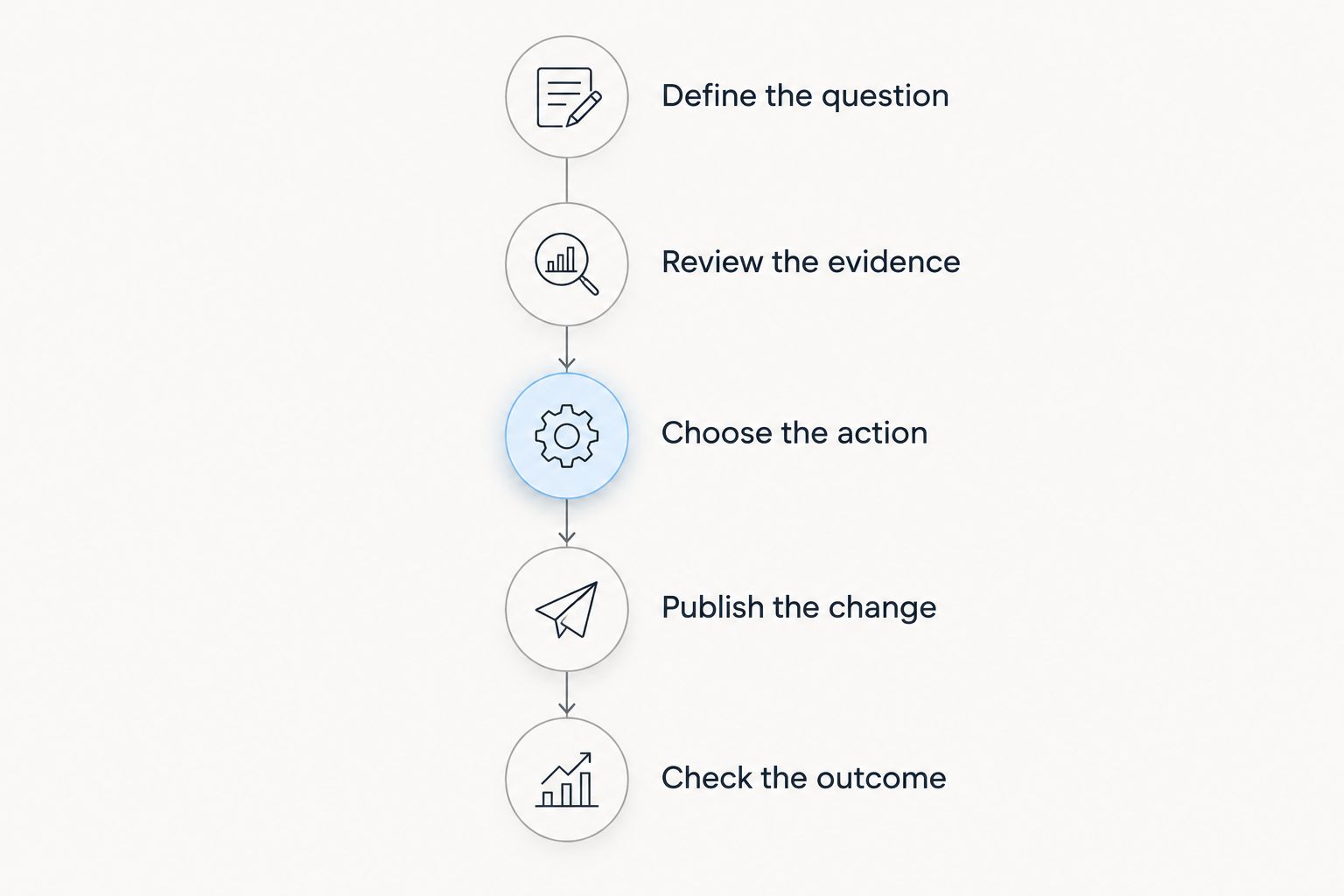
Do not make the assessment deadline stand in for a results deadline. You can accept a useful diagnosis before the recommended work is published. You can also publish a change without claiming that its effect has already been established.
For a 2026 launch, build the schedule backward from the decision you need to make. If the check must inform messaging approval, its findings need to arrive before that approval—not merely before publication.
Choose a snapshot or a repeat check
An initial assessment and continuing observation answer different questions. Treat the options below as briefing choices, not named service packages or promises about delivery.
| Approach | Best for | Main benefit | Main limitation | Completion point |
|---|---|---|---|---|
| Initial snapshot | Deciding what to address first | Establishes a dated starting record | Does not show change over time | Agreed findings and next action delivered |
| Repeat check | Comparing observations after a change | Creates a basis for comparison | Requires a consistent question and method | Agreed comparison delivered |
| Continuing observation | Following an ongoing positioning question | Keeps a record across observation dates | Needs a defined reporting schedule and owner | Each agreed reporting period closes |
Choose an initial snapshot when you need a starting decision. Choose a repeat check when you already have a baseline and a specific change to examine. Neither choice removes the need to define the question.
If you want continuing observation, ask for a reporting schedule rather than a single completion date. Also decide what triggers action. A stream of observations without an accountable owner is not a plan.
What should you prepare before the work begins?
Send a short brief that explains your business in your own words. Do not force the reviewer to infer your business model from a domain name, a video, or an old page.
Include the following:
- Your current positioning statement and intended buyer.
- The website and public material relevant to the question.
- The specific misunderstanding or visibility concern you want examined.
- Any recent changes that affect how the material should be interpreted.
- The person authorized to answer questions and accept the handoff.
- The decision date the findings need to support.
Keep claims separate from evidence. “We want to be known for this service” describes an intention; a public page or captured search response shows something that can be reviewed.
Ask your team to resolve contradictory descriptions before the brief is approved. If sales, marketing, and leadership describe different offers, make that disagreement explicit rather than expecting an assessment to quietly settle it.
When is Production Soup a fit?
Production Soup is best for brands that want positioning checks connected to film, content, and search visibility work. Its services span traditional production, authority films, AI-generated video, and brand visibility checks involving SEO, AEO, and GEO.
That breadth is relevant when a finding needs to become a clearer story or a production brief. The scheduling boundary still matters: an assessment, a film, and a published content change should have distinct deliverables.
If you need only an isolated answer to a narrow question, keep the assignment narrow. Do not approve a wider production brief simply because related capabilities are available. You can review Production Soup before defining the work you want to discuss.
Define your check before booking
Bring your website, positioning question, and decision date to the first conversation.
Can I use the findings before every recommendation is finished?
Yes. Use accepted findings to guide a decision while keeping unfinished actions clearly labeled. Completing the check does not require completing every subsequent content or production task.
For a 2026 project tracker, separate “assessment accepted” from “change published.” That distinction lets your team act on the diagnosis without overstating progress.
Does a completed check mean my search visibility has improved?
No. A completed check means the agreed assessment has been delivered; improvement requires separate evidence. Keep the original observations so later comparisons have a clear reference point.
Do not turn a recommendation into a performance claim. Record what changed, when it changed, and what the later check actually observed.
FAQ
How long does a perception check take to complete?
Confirm a delivery date against the written scope before booking. Define whether completion means initial findings, an accepted handoff, or a review discussion, and keep later implementation separate.
When does the perception check timeline start?
The timeline should start at the event named in your agreement, such as brief approval and receipt of required material. Ask for that start condition in writing rather than assuming an inquiry starts the work.
What should I send before a perception check begins?
Send your website, current positioning, intended buyer, and the question you need answered. Include the decision date and the person who can resolve questions about the brief.
Can I ask for a perception check before a launch?
Yes, you can brief a perception check around a launch decision. Agree when findings must arrive so they can inform messaging approval rather than arriving after the relevant decision.
Does a perception check include fixing my website or videos?
Do not assume implementation is included. Ask the agreement to distinguish assessment findings from content changes, film production, publishing, and later measurement.
Is a repeat check the same as an initial assessment?
No. An initial assessment establishes a starting record, while a repeat check compares later observations against that record. Agree the comparison question before scheduling the follow-up.
How do I know the perception check is finished?
The check is finished when the agreed deliverables meet the acceptance criteria in your brief. You should understand the findings, their limits, and the next action without having to reconstruct the reasoning yourself.
One last thing
Put the decision date in the brief, not just the delivery date. A report delivered on time can still arrive too late to influence the work that matters.
Before approving a 2026 perception check timeline, ask: “Which decision will these findings change?” If the answer is unclear, sharpen the question before expanding the assessment.