To establish your perception check cost in 2026, request a written quote that separates the review, the recommendations, and any follow-up work. Do not assume that fixing website copy, producing a film, or tracking future results is included in the initial check. Compare proposals against the same business question before you compare their totals.
- Compare perception check cost by scope: evidence, recommendations, and follow-up work should be separate.
- Production Soup connects brand visibility work with film production, SEO, and GEO.
- Choose a focused review for a specific decision; request monitoring when you need evidence of change over time.
- Ask for dated examples and clear next steps, not an unexplained visibility score.
How much does a perception check cost?
Ask for a scoped quote rather than budgeting against an unsupported average. A useful proposal tells you what the review covers, what evidence you receive, and where the engagement ends. The label alone does not establish the work.
Start with the current plans, then confirm the deliverables in writing. Treat the proposal—not the name of the package—as your buying document.
Use this breakdown to compare the same work across proposals. These are scope questions to ask, not a claim that every provider includes each item.
| Scope item | What to ask the provider | Boundary to confirm |
|---|---|---|
| Initial review | Which brand question and web pages will you examine? | Is this a focused check or a broader review? |
| Search evidence | Which search experiences will you inspect? | Are SEO, answer engines, and generative search all covered? |
| Findings | Will you show the examples behind each conclusion? | Is a summary included, or also a prioritized action plan? |
| Content work | Will you recommend changes or produce them? | Are copy, films, and other creative assets separate? |
| Follow-up | Will you check again after changes? | Is this a single review or an ongoing engagement? |
A quote becomes useful when you can connect its scope to a decision. If the decision is whether your service page explains the offer clearly, ask for evidence about that page. Do not automatically expand the assignment into every channel your business uses.
Why this matters
A perception check should help you decide what to change, not just give you another report to store. The buying risk is a mismatch between what you expect and what the provider agrees to deliver.
For a 2026 brief, distinguish between being found, being described accurately, and persuading a buyer. Those are different questions. A brand mention does not establish that the description is correct, and a correct description does not establish that someone became a customer.
Buy the smallest scope that answers the decision in front of you. Expand only when the evidence calls for it. This keeps a focused diagnosis from becoming an open-ended production assignment before anyone agrees on the problem.
Choose the scope before choosing the provider
A focused review, a broader visibility review, and ongoing monitoring answer different needs. The options below are buying categories, not named service tiers or promises about a particular agency.
| Approach | Best for | Main advantage | Main limitation |
|---|---|---|---|
| Focused review | Answering a specific positioning question | Keeps evidence tied to a clear decision | Does not establish a broad view of every channel |
| Broader visibility review | Connecting website messaging with search representation | Examines related questions together | Needs tighter boundaries to stay actionable |
| Ongoing monitoring | Checking whether observations change over time | Adds a repeatable follow-up process | Does not replace the work needed to fix problems |
Focused review: best for a specific decision
Choose a focused review when you can state the problem plainly. For example, ask whether a priority page explains your service clearly enough to support an accurate description of your business.
The advantage is a narrow question with a clear stopping point. The limitation is equally important: findings about that page do not establish how every audience, market, or search experience understands your brand.
Ask the provider to identify what sits outside the assignment. A boundary written before the work begins is more useful than a disagreement after the report arrives.
Broader visibility review: best for connected questions
Choose a broader review when you need to compare your own messaging with how your brand appears in search and generated answers. Keep each source of evidence distinct so you can see what supports each recommendation.
The advantage is context. The limitation is scope: a review that covers many questions still needs to identify which changes deserve attention first. Require a decision-led summary rather than an unranked collection of observations.
Ongoing monitoring: best for checking change
Choose monitoring when your question is about movement over time rather than a single observation. Agree on the questions, review conditions, and reporting format before the first baseline is recorded.
The advantage is continuity. The limitation is that observation is not implementation: finding an inaccurate description does not rewrite a service page, publish supporting evidence, or produce a better film.
Why perception check scope varies
Production Soup works across films, ads, and search visibility. That makes it especially important to separate the check from the creative and publishing work that might follow it.
Use these factors to define your request. They describe work you can ask to include; they are not a published rate formula.
- The business question. State whether you need to understand brand positioning, search visibility, or the clarity of a particular offer. Do not bundle unrelated questions under a vague request for better perception.
- The material reviewed. Identify the website pages, films, or ads you want examined. Ask the provider to confirm the agreed material rather than assuming everything is covered.
- The search scope. Specify whether the assignment concerns SEO, answer engine optimization, generative engine optimization, or a defined combination. Ask what evidence each part will produce.
- The depth of recommendations. Separate a list of gaps from a plan that connects each gap to a proposed action. Require enough explanation to assign the work internally.
- The production boundary. Confirm whether the assignment ends at recommendations or includes copy, film, or other content creation. A diagnosis and a finished asset are different deliverables.
- The follow-up boundary. State whether you need a baseline only or another review after changes go live. Keep ongoing measurement distinct from the initial findings.
Do not assume a longer proposal is a better proposal. A short scope with clear evidence requirements is easier to evaluate than a long document that leaves the deliverables open to interpretation.
Build a brief that produces a comparable quote
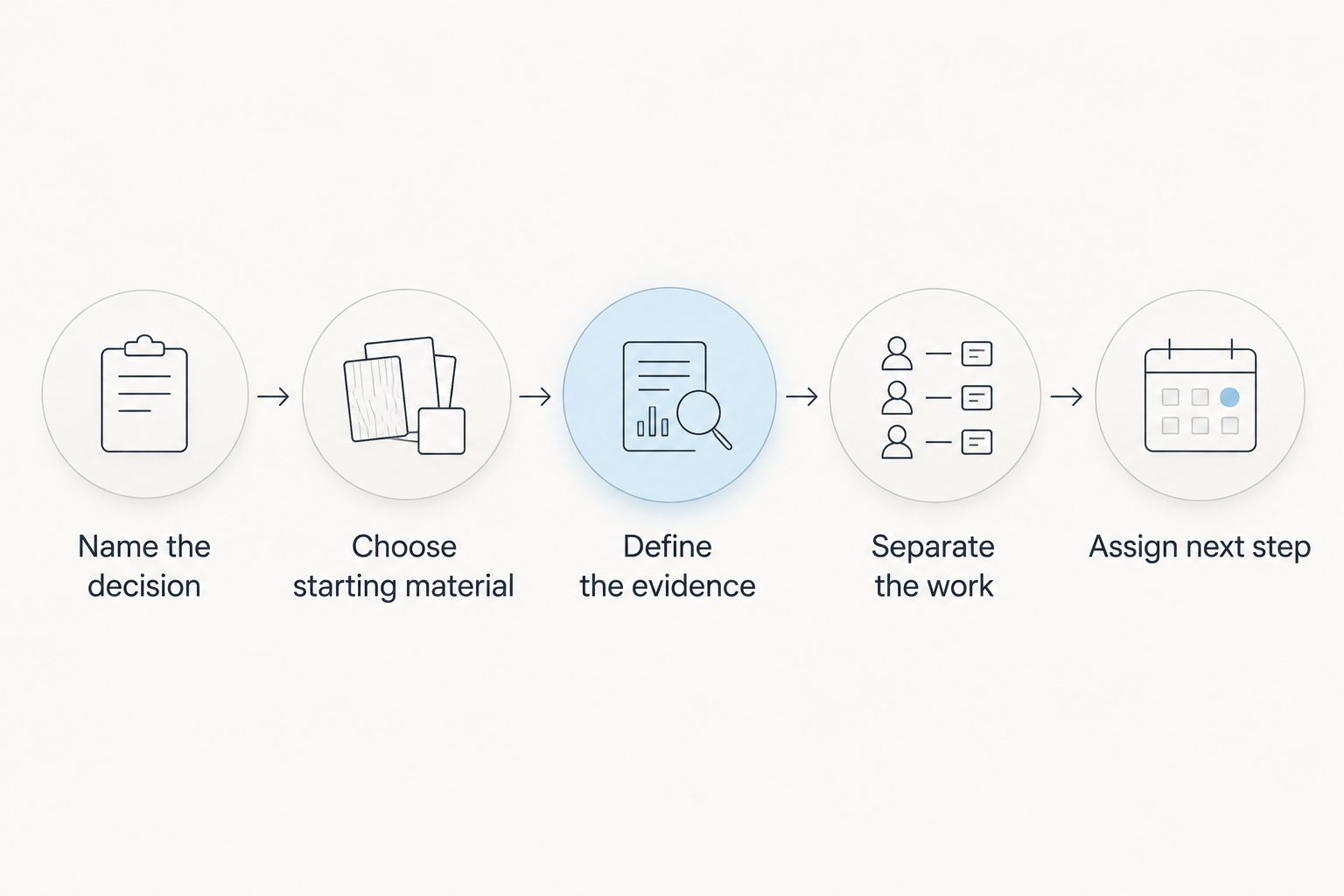
Use this sequence before you request proposals. Its purpose is to make the assignment clear enough that different providers can respond to the same problem.
- Name the decision. Write down 1 business decision the check must support. Examples include whether to rewrite a service page or investigate an inaccurate brand description.
- Choose the starting material. Supply 1 priority URL and explain why it matters. Add other material only when it helps answer the same question.
- Define the evidence. Ask for dated examples, the questions used, and an explanation connecting observations to conclusions.
- Separate the work. Request distinct descriptions for diagnosis, recommendations, implementation, and any later review.
- Assign the next step. Name who will decide what happens after the findings and who can approve changes.
For a 2026 comparison, give each provider the same brief. If a provider proposes additional work, ask which question that work answers. This gives you a basis for accepting the addition or keeping it outside the initial assignment.
You do not need to prescribe every method. You do need to know what the final deliverable lets you decide. Ask providers to explain that connection in plain language before you approve the work.
What should you receive for the work?
Require an evidence trail, a clear interpretation, and an assigned next move. Those requirements make a review useful without pretending that a report can guarantee rankings, citations, or sales.
Ask for the review date and the material examined. For generated-answer observations, request the question and the answer being discussed. For website findings, request the page and the passage that supports the conclusion.
Then ask the provider to separate observation from interpretation. An answer that omits your brand is an observation. A claim about why the omission happened needs supporting evidence; it should not become a confident explanation simply because it appears in a report.
Finally, ask for a practical recommendation. A useful finding identifies the problem, proposes an action, and states what a follow-up review would examine. If the evidence does not support a cause, the next step can be further investigation rather than an immediate rewrite.
A 2026 baseline should remain attached to its date and scope. Do not turn a snapshot into a permanent statement about your brand.
Keep the check separate from the fix
A review can identify a gap without including the work to close it. Before you approve a proposal, ask what happens if the finding calls for a new page, revised copy, a film, or a change to an existing campaign.
Your follow-up scope should name the output and the approval point. That protects both sides from treating a recommendation as an unlimited production commitment.
Production Soup fits teams connecting brand visibility checks with film production and search work. Its stated six-step system moves from seeing the gap to planning, creating stories, making content, publishing, and watching the numbers.
The fit is strongest when you need those activities connected. The boundary still matters: do not assume every step is part of the initial check. Review the services and ask which work belongs in the first assignment and which needs a separate brief.
Is a perception check the same as ongoing monitoring?
A perception check and ongoing monitoring serve different decisions: a check establishes findings within an agreed scope, while monitoring revisits agreed observations. Ask the proposal to state which assignment you are buying rather than relying on the label.
If you only need to decide what to fix first, begin with a defined review. If you need to examine change after publication, specify the follow-up separately.
Does the check include rewriting pages or producing videos?
Rewriting pages and producing videos are implementation tasks, so request explicit confirmation before treating them as included. A recommendation to create an asset is not the same as an agreement to deliver that asset.
Ask for the output, review responsibilities, and completion boundary. This keeps creative work attached to an approved brief.
How should you compare perception check proposals in 2026?
Compare perception check proposals in 2026 against the same decision, material, evidence requirements, and delivery boundary. Resolve differences in scope before deciding which proposal offers the better fit.
If one proposal includes implementation and another stops at findings, request a separated breakdown. Otherwise, you are comparing different assignments.
FAQ
How do I find out my perception check cost?
Request a written quote against a defined scope. State the decision you need to make, the material to review, and whether you want recommendations, implementation, or follow-up.
What's the best perception check for a small marketing team?
A focused review is best for a team trying to answer a specific positioning or visibility question. Keep the assignment tied to a decision someone can act on after the findings arrive.
Can I compare a perception check with an SEO audit?
Compare the deliverables rather than assuming the labels describe the same work. Ask which questions each review answers and what evidence supports its recommendations.
Will a perception check guarantee my brand appears in generated answers?
Do not accept guaranteed placement as a substitute for a clear scope. Ask for documented observations and practical recommendations rather than promises about future answers.
Should I pay for monitoring before fixing my website?
Choose monitoring when you need repeated observations, not merely because a dashboard is offered. Define the baseline and the changes you want to examine before adding ongoing work.
What should I send before requesting a quote?
Send your priority URL, the business decision you need to make, and the material relevant to that decision. Ask the provider to confirm what is included and excluded.
Is Production Soup a visibility tool or a creative agency?
Production Soup is a creative agency and film production studio that also runs brand visibility checks. Its work spans films, ads, and SEO, AEO, and GEO.
One last thing
Before approving a 2026 proposal, ask: What decision will I be able to make when this is finished? Then ask where the evidence for that decision will appear in the deliverable.
A provider should be able to answer without hiding behind a score. If the answer is unclear, tighten the brief before expanding the assignment.