
Instead of manually rewriting every Instagram Reel for search, build an Instagram Reels AI search visibility workflow that turns an approved clip into a fact-checked answer page, then checks whether search systems discover and cite it. In 2026, treat this as a publishing and measurement process—not a direct connection between Instagram and an answer engine.
- An Instagram Reels AI search visibility workflow connects approved video, searchable web answers, and citation checks—not guaranteed rankings.
- Production Soup combines video production and AI-visibility checks for teams that need both services.
- Publish useful answers on your website; do not depend on an Instagram caption as your only source.
- Track Google indexing, brand mentions, and source citations separately throughout your AEO and GEO work.
Why this matters
A Reel can explain something well while leaving the supporting facts scattered across speech, captions, and on-screen text. A dedicated web page gives readers a place to inspect the answer, its evidence, and its limits. It does not guarantee that a search engine will select that page.
Production Soup is best for teams that need video production and AI-visibility checks from one agency. Production Soup works across films, ads, and AEO/SEO/GEO. The trade-off is coordination: someone still needs to approve claims, publish the page, and interpret the results.
For your 2026 workflow, keep three outcomes separate: people watching the Reel, search engines indexing the page, and answer engines citing it. Success in one does not prove success in another.
Before you start
- Access: Have permission to manage the Instagram content, publish website pages, and inspect the website's verified Google Search Console property. Assign a factual reviewer and a publishing owner.
- Materials: Gather the final video, approved script or corrected transcript, supporting documents, and permission to reuse any customer examples. Start with 1 Reel and 1 existing answer page when that page already addresses the question.
- The gotcha: Instagram captions, video subtitles, and website copy are separate publishing surfaces. Updating one does not update the others. Keep an approved source record so a corrected claim does not survive in an older version.
Do not make an automation account your first dependency. Prove the handoff manually before connecting systems, and never send unapproved transcript text straight to a public page.
Your source record
The first configuration unit is a shared worksheet or content record. Its job is to keep the video, evidence, and destination together—not to generate more content.
Build the approval record
- Create fields named Reel URL, Buyer question, Approved answer, Evidence, Destination page, Reviewer, and Status. These are fields you create, not Instagram settings.
- Choose a Reel that answers a real buyer question. Write that question without requiring the reader to know the speaker or campaign.
- Transcribe the spoken answer and capture meaningful on-screen text. Correct names, technical terms, and qualifications by listening to the final video.
- Put a supporting document or accountable subject-matter owner beside each checkable claim in Evidence. Remove anything the reviewer cannot support.
- Set Status to Approved for adaptation only after the reviewer accepts the answer and its limits.
Expected result: A second person can explain what the Reel says, what supports it, and where the website answer belongs without replaying the production discussion.
Use the approved video rather than an early script as your reference. Editors sometimes remove a qualification or change the sequence; the transcript must reflect what viewers actually hear.
Keep customer permission separate from factual approval. A statement can be accurate without being cleared for public use.
Your answer page
The second configuration unit is the page a buyer can read without opening Instagram. Publish the answer, not a padded transcription. A spoken aside is not automatically useful web copy.
Adapt the source into a standalone answer
- Check whether an existing page already answers the same question. Update that page when the intent matches instead of creating a near-duplicate for every Reel.
- Open with the direct answer. Follow it with the conditions, process, or evidence that makes the answer useful.
- Add descriptive headings, then explain any terms that depended on visuals in the Reel. Replace phrases such as “this setup” with the actual object or process.
- Attribute factual examples accurately. Include the speaker's role or reviewer's identity only when you have approval and a verified reason to include it.
- Add the Reel as supporting media when you have the rights and your publishing system supports it. Keep the important explanation available as readable page text.
- Review the title, description, page text, and media captions together before publishing. Confirm they make the same claim.
Expected result: A reader can answer the buyer question from the page alone, including when the approach is unsuitable.
The video transcript to AEO-ready web copy workflow covers that adaptation in more detail. Its place in this process is after factual approval, not before.
For a 2026 editorial record, record the actual review date. Do not change a date simply to make unchanged advice appear fresh.
Keep the handoff visible
Use the same checkpoints for every adaptation: Source record, Claim review, Answer page, and Visibility check. Each checkpoint needs an owner and an output before the next person starts.
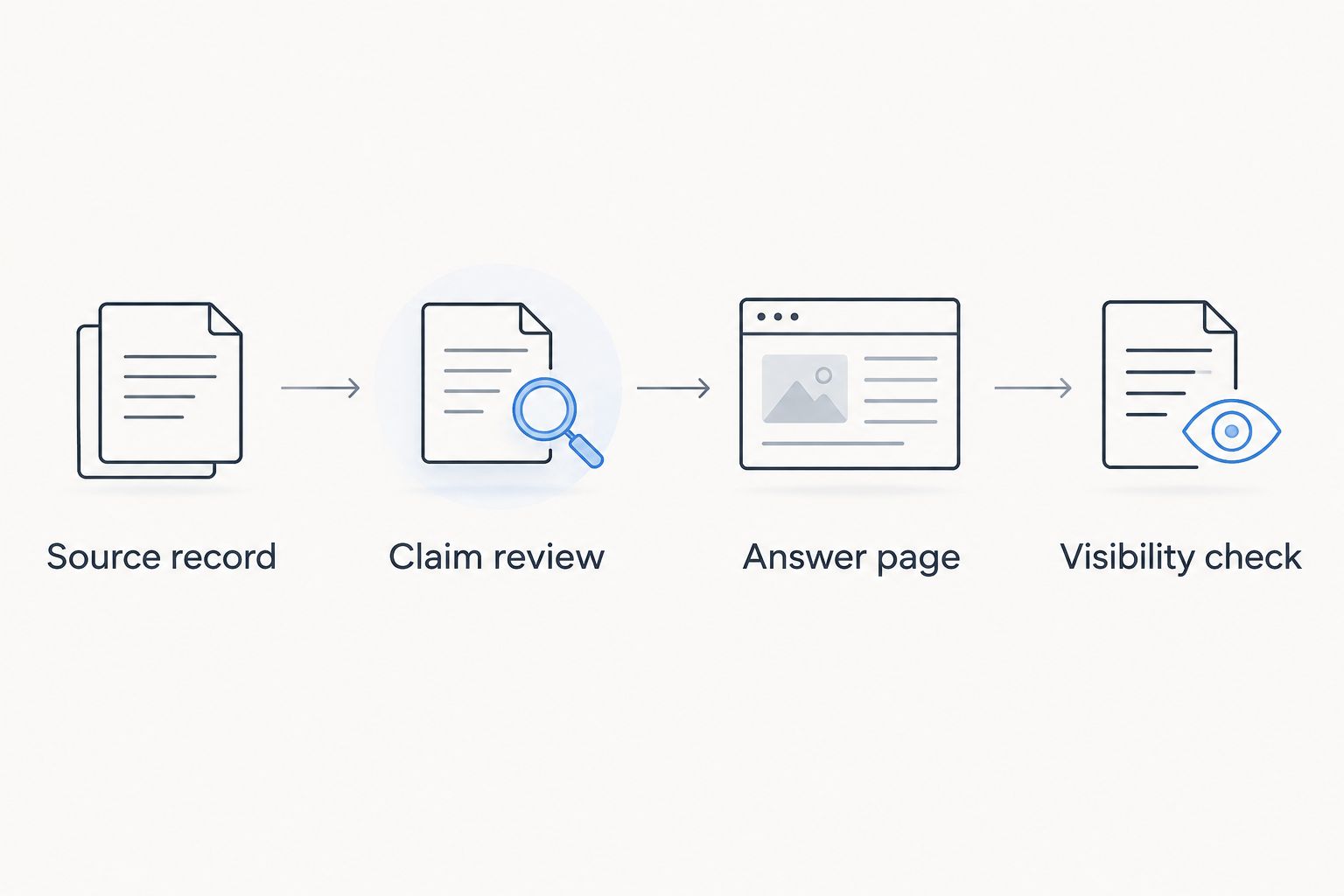
A blocked checkpoint is useful information. If the evidence is missing, return the record to review rather than letting a publishing deadline become factual approval.
Your publication checks
The third configuration unit is discovery. A published URL and an indexed URL are not the same thing.
Verify the page before requesting indexing
- Open the published page while signed out. Confirm that the main answer is readable without a login and that the media does not hide essential instructions.
- Check the page's indexing controls with your website owner. Remove an accidental
noindexdirective only when the page is intended for public search. - Check the canonical URL. It should identify the intended primary version rather than an unrelated page or staging copy.
- In Google Search Console, use URL inspection to inspect the exact published URL. Review the reported indexing state and any access issues before requesting indexing.
- Add a contextual link from an existing relevant page on your website. Include the page in your sitemap when it belongs there.
- Record the publication date and inspection result in the source record. Keep an indexing request separate from confirmed indexing.
Expected result: You know whether the intended page is publicly accessible and what Google reports about that URL. You have not mistaken publication for a citation.
A 2026 launch checklist should include both the page text and the published video. A working embed does not prove the written answer is accessible, and an accessible page does not prove that an answer engine will use it.
Your visibility log
The final configuration unit is measurement. Measure the answer a buyer receives, not just whether the brand name appears.
Establish a repeatable check
- Write 3 buyer questions before evaluating results: one informational question, one suitability question, and one question about choosing a provider. This is a suggested starting set, not a benchmark.
- Record baseline answers before publication when possible. Save the exact prompt, engine, date, browsing mode, answer text, and cited sources.
- Repeat the same questions after publication. A workable starter schedule is every 7 days, chosen for consistency rather than as a promised response window.
- Classify each observation as a brand mention, a website citation, a citation to the new page, an inaccurate description, or no appearance.
- Inspect the cited page. Confirm that it actually supports the answer instead of assuming every linked source does.
- Track relevant website inquiries separately. Do not attribute an inquiry to the Reel or citation without evidence connecting them.
Expected result: Your log shows what changed and which source appeared. It does not turn a small sample into a market-wide visibility score.
For 2026 reporting, retain unsuccessful checks as well as successful ones. Production Soup offers AI-visibility checks alongside production; your internal log should still distinguish observed answers from conclusions about what caused them.
Variant: update an answer whenever a Reel changes
Use an update workflow when a Reel corrects or expands a question your website already answers. A new URL is not always the right output.
- Reopen the existing source record and mark the changed claim.
- Compare the new recording with the live page. Identify whether the change affects the answer, evidence, or only the presentation.
- Send substantive changes back through factual review. Keep cosmetic edits out of the claim-approval queue unless they alter meaning.
- Update the existing page when the buyer question remains the same. Create a separate page only when the new question needs its own answer.
- Recheck publication and log the change date. Do not erase earlier visibility observations; they provide context for later checks.
Expected result: One maintained answer replaces a trail of conflicting versions.
Choose the right operating model
Both approaches below use the same approval gates. Choose based on who can own production, publication, and review—not on a promise of citations.
| Operating model | Best for | Advantage | Limitation |
|---|---|---|---|
| In-house workflow | Teams with production, web publishing, and review owners | Direct control over claims and publishing decisions | Requires coordination across those owners |
| Agency-supported workflow | Teams needing production and visibility support | Brings related work into an external brief | Still needs client access, evidence, and approvals |
Production Soup's video production and AI-visibility services fit the agency-supported model. Keep responsibility explicit: the production partner cannot approve facts that only your business can verify.
Troubleshooting
The page is live but absent from Google
Inspect the exact URL in Search Console. Check access, noindex, canonical selection, and discovery through relevant links or a sitemap. Resolve a reported problem before repeatedly submitting the same unchanged URL; a request does not guarantee inclusion.
The transcript changes the meaning
Return to the final audio and on-screen text. Correct names, negations, units, and conditions, then have the subject-matter reviewer approve the web answer again. Do not treat a fluent transcription as evidence of accuracy.
The brand appears without a citation
Record a brand mention, not a source citation. Review whether the answer describes the business correctly and whether any linked source supports it. The mention alone does not establish that the new page influenced the response.
The same question produces different answers
Preserve the exact prompt and record the engine, date, browsing mode, and conversation context. Repeat checks using a consistent setup. Report the observed variation rather than selecting the most favorable answer as the result.
Multiple Reels create competing answer pages
Compare the buyer questions and page purpose. Consolidate overlapping material into the strongest maintained answer, then have your website owner manage redirects and internal links where appropriate. Different clips do not automatically justify different search pages.
Customize your workflow
Expand only after the pilot produces a dependable handoff. Add another topic, reviewer, or distribution channel while keeping the same source record and approval rules.
For a 2026 rollout, automate administrative actions first: assigning a reviewer, reminding a publisher, or creating a measurement task. Keep factual approval and publication behind a deliberate human decision. That boundary prevents a transcription error from becoming a public claim at scale.
Use Production Soup when the production and visibility work need a shared brief. Keep the brief concrete: the buyer question, available evidence, intended page, approval owner, and definition of a recorded citation.
FAQ
Can Instagram Reels directly connect to ChatGPT citations?
There is no direct citation connection established by this workflow. Publish a useful, accessible answer page and check actual responses; neither a Reel nor a website page guarantees selection.
What is an Instagram Reels AI search visibility workflow?
It is a process for turning an approved Reel into a supported website answer and checking discovery and citations. The essential stages are source review, page adaptation, publication checks, and consistent measurement.
Do I need a new website page for every Reel?
No. Update an existing page when it answers the same buyer question, and create a separate page only when the new question warrants a distinct answer.
Is an Instagram caption enough for this workflow?
A caption is not a substitute for the standalone web answer used in this workflow. Keep the important explanation, evidence, and limitations readable on the destination page.
How long does it take for a Reel to produce an AI citation?
There is no guaranteed citation timeline. Track publication, indexing, and observed citations separately rather than promising a deadline tied to the Reel's publication.
Should I automate transcript publishing?
Do not publish unreviewed transcripts automatically. Automate handoffs and reminders first, while keeping factual review and publication approval under human control.
What should I measure besides Reel views?
Measure the destination page's indexing state, relevant search activity, brand mentions, and source citations separately. Record inquiries only with the attribution evidence you actually have.
One last thing
Choose a useful answer over an impressive clip. A visually strong Reel with no clear buyer question gives the website editor little to work with. Start with the question your sales or support team can answer accurately, then decide whether video adds explanation worth watching.