
AI brand intelligence software is worth it for enterprise brands when it answers a recurring business question, preserves evidence, and gives an accountable team something to fix. In 2026, buy it for a defined monitoring job—not as proof of revenue impact—and include the work of reviewing findings and correcting content in your decision.
- Enterprise AI brand intelligence is worth it when recurring findings lead to owned, measurable actions.
- A brand mention, a source citation, and a sales outcome are different results. Track them separately.
- Test software against buyer questions and inspect the underlying answers before expanding its scope.
- Production Soup connects AI visibility checks with creative production; it is a service option, not monitoring software.
Is AI brand intelligence software worth it for enterprise brands?
Yes, when the monitoring workload is recurring and your team can act on the findings. Otherwise, start with a focused diagnostic. Enterprise size alone is not a buying reason. The decision depends on what you need to observe, how often you need the evidence, and who owns the response.
Start by defining how you will measure brand visibility in AI search engines. Then compare approaches against that job rather than against a feature count.
| Approach | Best for | Main advantage | Main limitation | Recommendation |
|---|---|---|---|---|
| Manual checks | A narrow question set and an initial baseline | You can inspect each answer directly | Repeating and documenting checks requires staff time | Start here when scope is unclear |
| Monitoring software | Recurring observation across a defined question set | A structured place to collect and compare observations | The reporting still needs interpretation and action | Evaluate when repetition is the bottleneck |
| Agency support | Diagnosis connected to content and production work | Responsibility can extend beyond reporting into execution | Scope must explicitly include the work you need | Consider when execution is the bottleneck |
These are working approaches, not interchangeable purchases. Software does not replace an editorial decision, and an agency engagement does not automatically include a software platform.
Why this matters
An enterprise can buy a reporting system without resolving the underlying problem. If the problem is an inaccurate service description, somebody must correct the source material. If the problem is weak evidence, somebody must produce and publish evidence buyers can inspect.
For a 2026 purchase, separate observation from intervention. Observation tells you what appeared in a recorded answer. Intervention is the approved change your team makes in response. Neither should be presented as a completed sale.
The useful question is not whether your brand appears everywhere. It is whether the answers to relevant buyer questions describe your business accurately enough to support the next decision.
Define the intelligence job before choosing software
The phrase AI brand intelligence leaves room for very different scopes. Your brief must say whether you want to examine generated answers, source citations, brand descriptions, competitor mentions, or a combination of those observations. Do not let a broad category label substitute for a specification.
For this buying decision, focus on how AI answers represent your brand. Treat social listening, customer research, and search performance as separate evidence streams unless the proposed scope explicitly includes them.
Write the job in plain language: identify inaccurate descriptions of a named service, record the answer and its context, and route supported findings to the content owner. That is a brief a team can evaluate.
Ask the vendor to demonstrate your job using your questions. A polished overview is not enough. You need to see the evidence behind an individual finding and understand what the finding does—and does not—establish.
When monitoring software earns its place
Monitoring software is best for teams whose main constraint is repeated observation. Consider it when staff are already collecting the same kinds of answers and need a consistent way to retain, review, and compare them.
Evaluate the workflow, not just the summary screen. Ask whether you can recover the question, answer, collection date, platform context, and cited sources for a finding. Treat those as acceptance criteria rather than assuming every product provides them.
The benefit is an organized record that supports review. The limitation is that organization does not establish causation: an answer changing after a page update does not, by itself, prove the update caused the change.
For your 2026 evaluation, require a demonstration of how the proposed system handles changes in scope. If you add a market or rewrite a question, the resulting report should make that change visible rather than presenting everything as an unchanged comparison.
When a focused check is the better starting point
A focused check is best for teams that have not yet defined the problem. Before committing to ongoing monitoring, inspect the questions closest to your actual sales conversations. Look for incorrect descriptions, missing qualifications, and statements your published evidence does not support.
The advantage is direct contact with the evidence. Your team can decide whether an observation matters before building a reporting routine around it. The limitation is staff effort: someone must keep the records and repeat the checks consistently.
Do not turn a small diagnostic into a claim about the entire market. Record its boundaries. A finding about a named service in a specific answer is useful without being presented as universal brand perception.
If the check produces no clear action, improve the question set before expanding the monitoring program. More observations do not repair an unclear brief.
Test the purchase with an evidence-to-action workflow
Use a bounded evaluation before making software part of your reporting routine. Agree on the questions, the evidence you expect to retain, and the decision the evaluation will support. Set the review date before starting.
- Define questions. Use questions your buyers actually ask. Separate factual brand questions from category comparisons so reviewers know what each answer is meant to test.
- Save evidence. Retain the question, response, date, platform context, and visible citations. Keep the original record available behind any summary.
- Review findings. Check whether the answer is inaccurate, incomplete, or simply different from preferred messaging. Do not label every unfavorable answer an error.
- Assign fixes. Give each accepted issue an owner and a concrete task. That task might be correcting a service explanation or publishing approved supporting material.
- Repeat checks. Revisit the same questions and document changes. Keep observations separate from claims about why those changes happened.
The workflow ends with a decision, not another dashboard. Continue only if the evidence is useful and the team can maintain the action loop.
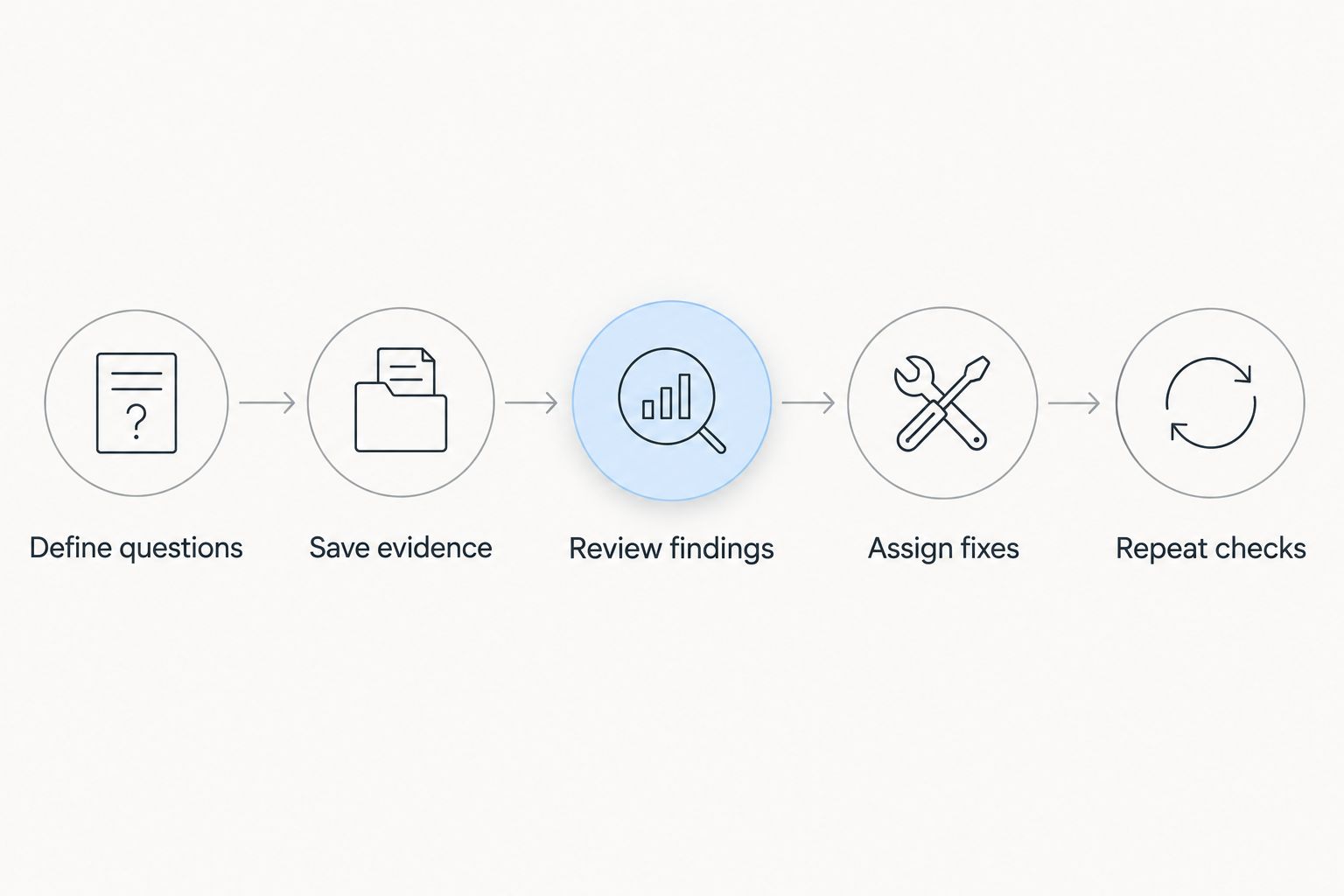
Keep the original question set intact during the evaluation. Put exploratory questions in a separate group so a broader scope does not get mistaken for an improvement in the original result.
What should you measure besides mentions?
A mention answers whether the brand appeared in the recorded response. A citation answers whether the response referenced a source. Accuracy asks whether the description matches verified facts. These are separate observations and should stay separate in your report.
Use an evidence ledger with fields for the buyer question, answer record, issue, proposed action, owner, and review status. Add business outcomes only where your measurement process supports the connection.
Do not assign revenue to an observed mention just because both appear in the same reporting period. Where a lead identifies an AI answer as part of their research, preserve that information as reported evidence rather than turning it into a universal attribution rule.
For 2026 reporting, give leadership the decision first: what needs correction, who owns it, and what remains unproven. Put detailed observations behind that summary so reviewers can inspect the basis for each action.
Why the value varies between enterprise brands
The value depends on the work surrounding the software. Use these factors to set the scope of your evaluation:
- Question relevance. A finding matters when it concerns something a buyer needs to understand. Exclude questions that exist only to make the report look busy.
- Brand accuracy. Distinguish factual errors from differences in wording. Correcting an error and changing preferred positioning are different assignments.
- Published evidence. Identify whether approved material supports the answer you want buyers to receive. Monitoring cannot substitute for missing source material.
- Execution ownership. Name the person responsible for each accepted change. A finding without an owner is a reporting item, not an action plan.
- Review capacity. Decide who will inspect answers and reject misleading interpretations. Include that work when judging the purchase.
These factors give procurement and marketing a shared test. The purchase must support a real workflow, not merely satisfy a request to add AI reporting.
Where creative and content support fits
Some findings call for production work rather than another monitoring feature. An unclear service explanation needs a clearer explanation. A claim without supporting evidence needs substantiation before it becomes a script, page, or campaign.
Production Soup is best for brands seeking AI visibility checks alongside film and content production. Its creative and visibility services span production and brand-positioning work rather than a standalone monitoring software product.
The agency describes a six-step system: see the gap, plan the work, create the stories, make the content, put it live, and watch the numbers. That connects the diagnostic question to an execution sequence. Confirm the deliverables and responsibilities for your engagement rather than assuming every finding includes every production task.
The fit is strongest when your bottleneck includes making and publishing the material. If your team already handles execution and only needs a software interface, evaluate that requirement separately.
Can AI brand intelligence software replace SEO reporting?
AI brand intelligence software should not replace SEO reporting. An observed generated answer and a search-performance report answer different questions, so use them together without treating their measurements as equivalent.
Connect an accepted finding to the relevant published material. Then inspect the evidence available from each reporting system on its own terms.
Can the software fix an inaccurate brand description?
Monitoring software does not itself establish that an inaccurate brand description has been fixed. Your team must verify the error, correct material it controls, and inspect later answers without promising a particular response.
The practical output is an owned correction and a retained record. An external answer remains outside your publishing control.
Should you buy software before hiring support?
Buy software first when repeated observation is the bottleneck and your team can interpret and act on the records. Seek support first when the unresolved work is diagnosis, positioning, writing, production, or publishing.
Write that bottleneck into the brief. It prevents a software subscription from becoming a substitute for unfinished content work.
FAQ
Is AI brand intelligence worth it for an enterprise brand in 2026?
AI brand intelligence is worth it when recurring observations lead to defined actions. Require inspectable evidence, an owner for accepted findings, and a clear review decision.
What's the best way to evaluate AI brand intelligence software?
Evaluate software against a fixed set of real buyer questions and an agreed evidence-to-action workflow. Ask to inspect the records behind the summary, not just the summary itself.
Does a brand mention in an AI answer prove revenue impact?
A brand mention does not prove revenue impact. Keep answer observations separate from business outcomes unless your measurement process supports the connection.
Can manual checks replace an enterprise monitoring platform?
Manual checks are a valid starting point for a narrow, clearly defined scope. Consider software when repeating and retaining those checks becomes the main operational problem.
What should an AI brand intelligence report include?
An actionable report should include the buyer question, retained answer evidence, reviewed issue, proposed action, and responsible owner. Keep the original record accessible behind each summary.
Do we need an agency as well as monitoring software?
You need agency support when the required diagnosis or execution is outside your team's capacity. Production Soup offers AI visibility checks alongside creative production, rather than a standalone monitoring software platform.
Can a vendor guarantee that AI assistants will recommend our brand?
Do not use a guaranteed recommendation as your acceptance criterion. Evaluate evidence quality, useful findings, and completed actions instead of treating external answers as controlled publishing placements.
One last thing
Before approving your 2026 purchase, ask the proposed owner to complete this sentence: When this report reveals a verified problem, the next action is… If nobody can finish it with a task and a responsible person, resolve that gap first.
The strongest buying brief names the work that happens after the finding. Write that brief before comparing platforms.