
No—an authority film and a documentary can use the same filmmaking techniques, but they do not necessarily serve the same purpose. For a 2026 production brief, distinguish a film commissioned to establish expertise from a nonfiction story whose central job is to examine a subject; documentary style alone does not establish editorial independence.
- Authority film vs documentary is a question of purpose and editorial control, not camera style.
- Choose an authority film to demonstrate expertise; choose a documentary approach when the subject drives the inquiry.
- Production Soup offers authority films and traditional production; define the evidence and approval rules before commissioning either.
- Interviews and real footage support credibility only when the finished story preserves their context.
Is an authority film the same as a documentary?
No. An authority film is a positioning brief; a documentary is a nonfiction storytelling form. They overlap, but the labels answer different questions: what should this film accomplish, and how will it tell a true story?
Production Soup lists authority films alongside traditional production in its production services. Treat that distinction as the start of a brief, not proof that every studio uses the term identically.
“Authority film” is not a standardized documentary category. Before signing off on either label, use this working comparison to agree on the actual assignment.
| Decision | Authority film brief | Documentary brief |
|---|---|---|
| Best for | Showing a defined audience how an organization or expert works | Exploring a real subject through people, events, and evidence |
| Central question | What should viewers understand about this expertise? | What does the reporting reveal about this subject? |
| Story direction | Starts with a positioning objective that evidence must support | Starts with an inquiry that evidence can reshape |
| Editorial control | Specify the commissioning brand’s approval rights | Specify the filmmaker’s, funder’s, and participants’ rights |
| Main strength | Connects demonstrated expertise to a business communication need | Gives a subject room for complexity and competing perspectives |
| Main limitation | Can become self-promotion when claims outrun proof | Can conflict with a predetermined brand message |
| Appropriate ending | A supported conclusion, with a relevant next step | An ending earned by the story, without a required sales action |
Neither column guarantees quality or honesty. A brand-funded documentary can contain serious reporting, and an authority film can acknowledge uncertainty. The contract and the finished edit matter more than the label.
Why this matters
The wrong label creates the wrong expectations. A marketing lead expecting message approval and a filmmaker expecting editorial independence can agree on “documentary” while planning incompatible projects.
For a 2026 commission, settle the editorial agreement before discussing the visual treatment. Decide who can challenge a claim, what happens when an interview contradicts the intended message, and who approves the final cut.
Your audience also needs a clear understanding of the relationship behind the film. Identify sponsorship and relevant affiliations rather than asking documentary-style images to imply independence they do not establish.
Authority film: best for demonstrating expertise
Choose an authority film when you need viewers to understand how your expertise works. Start with a question your audience actually needs answered, then find the people, decisions, and observable work that answer it.
A founder describing a method is a starting point. A stronger brief asks the film to show the method in use, explain why a decision mattered, and distinguish the speaker’s opinion from a documented result.
The advantage is focus. You can build the story around a specific misunderstanding or buying question without pretending to survey an entire subject.
The limitation is the commissioning relationship. Viewers should not have to mistake a company-funded film for independent reporting to find it useful. Authority comes from the evidence you present, not the appearance of neutrality.
For example, ask an interviewee to explain a difficult trade-off rather than repeat a slogan. Then identify what footage, records, or additional testimony would let a viewer assess that explanation.
Recommendation: choose the authority-film brief when positioning is the job and you can support the positioning with real evidence. Do not commission a claim-first film and expect documentary lighting to make it credible.
Documentary: best for examining a real subject
Choose a documentary brief when understanding the subject matters more than preserving a predetermined message. Give the reporting room to change the story you thought you were making.
That does not mean every documentary is independent, investigative, or critical. Documentaries can have sponsors, strong viewpoints, and tightly defined subjects; disclose those relationships and agree on editorial rights instead of relying on assumptions.
The advantage is room for discovery. An interview, an archive, or an observed event can complicate the initial premise and become central to the film.
The limitation for a commissioning brand is less control over the conclusion when the project genuinely allows that discovery. If an inconvenient fact must disappear to protect the message, the proposed editorial approach needs an honest discussion.
A documentary brief should identify the subject, the questions worth investigating, and the access available. It should also state what remains unresolved rather than promise a flattering ending before reporting starts.
Recommendation: choose the documentary brief when you are prepared to follow evidence that changes the story. If that freedom is unacceptable, write a brand-led brief instead.
Why authority film and documentary briefs vary
For your 2026 brief, compare the actual permissions and expectations rather than sorting projects by runtime or cinematic appearance. These factors explain why films with similar interviews and footage can serve different purposes:
- Purpose. Demonstrating a company’s expertise and examining a broader subject are different assignments, even when they share material.
- Editorial control. Approval rights determine who can require changes and whether the commissioning organization can reject an unwelcome conclusion.
- Evidence. Available interviews, records, archives, and observable work determine which claims the film can responsibly make.
- Access. Permission to film people and processes affects what the audience can see rather than merely hear described.
- Disclosure. Funding and participant relationships affect how viewers interpret a film’s perspective.
- Distribution. A sales conversation, a public screening, and a subject-focused viewing experience call for different framing and endings.
Do not use production polish as a substitute for these decisions. Beautiful footage can support either approach, but it cannot resolve a conflict over who controls the story.
How do you choose the right brief?
Use this sequence before asking for treatments or booking interviews. It turns “we want something documentary” into an assignment a producer can evaluate.
- Name the audience. Identify who needs to understand the story and what they currently misunderstand. Avoid an audience description so broad that it cannot guide an interview question.
- Set the purpose. State whether the film should demonstrate expertise or investigate a subject. If both matter, specify which takes priority when they conflict.
- Gather evidence. List the people, records, locations, and observable work available. Separate confirmed access from material you still need permission to use.
- Agree control. Put factual review, participant review, and final approval in writing. These are different responsibilities, not interchangeable names for the same sign-off.
- Plan publication. Decide where the film will live, what context accompanies it, and what viewers should do after watching.
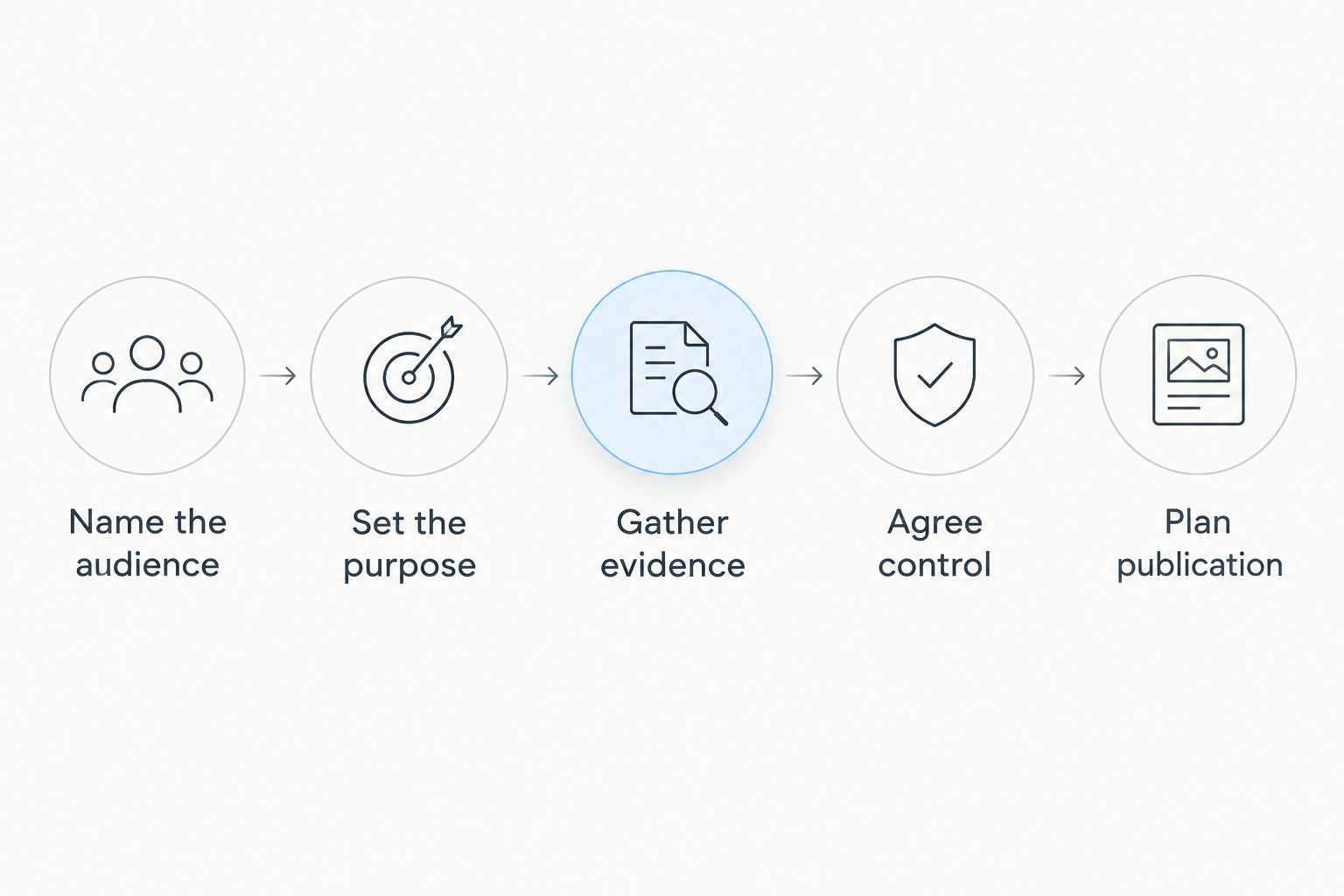
Keep the brief plain. “Show how the team makes a difficult decision” gives a producer something to investigate; “make us look authoritative” does not identify a scene, a source, or a defensible claim.
Before interviews, use the guide to preparing executives for an authority film interview to plan the next conversation. Ask for examples and explanations, not memorized praise.
Production Soup is best for brands seeking authority-film production alongside broader creative services. That service fit is not a promise of independent reporting, search visibility, or business results; put the specific deliverables and responsibilities in the brief.
Start with the film’s purpose
Bring the audience, the question, and the evidence you can show.
Can a brand-funded film still be a documentary?
Yes. Brand funding does not automatically prevent a film from being a documentary. The useful questions are what the film represents, how it handles evidence, and how clearly it discloses the commissioning relationship.
Do not equate “funded by a brand” with “factually unreliable,” or “documentary” with “free from a point of view.” Assess the actual work: what supports the claims, what relevant context remains, and what control the sponsor retained.
If the commissioning organization must approve every conclusion, state that arrangement clearly. You can still make a truthful nonfiction film without presenting its editorial relationship as something it is not.
Can an authority film use documentary techniques?
Yes. An authority film can use interviews, observational footage, archives, and location sound. Those techniques shape the storytelling; they do not decide who owns the message.
Preserve the relationship between the image and the claim. Footage of a process can illustrate that process, but unrelated footage should not imply that a particular event or outcome was recorded.
In a 2026 production that uses generated imagery, distinguish illustration from evidence. A synthetic scene can visualize an idea; it cannot document an event that the camera never witnessed.
Does either format guarantee search or business results?
No. Neither an authority film nor a documentary guarantees rankings, citations, or leads. A format label does not establish that people will find the film, watch it, or act on it.
For a 2026 release, plan the surrounding material as carefully as the edit. Provide an accurate description, identify speakers and their roles, and publish supporting context for claims that need explanation.
Then measure the outcome you actually commissioned. Viewing behavior answers a different question from qualified inquiries, and neither proves that the film caused a change without further analysis.
Avoid writing a visibility promise into the creative concept. Make a useful film, publish it with clear context, and assess the result separately.
FAQ
What’s the main difference between an authority film and a documentary?
An authority film brief starts with demonstrating expertise; a documentary brief centers on examining a real subject. The approaches can overlap, so agree on purpose and editorial control rather than relying on the label.
Is an authority film just a long advertisement?
An authority film does not have to be a long advertisement. It can explain real expertise through evidence and specific examples, but it remains promotional when its commissioning purpose is brand positioning.
Can a documentary be paid for by a company?
Yes, a company can fund a documentary. Disclose the funding relationship and clarify the sponsor’s approval rights so viewers and participants understand the arrangement.
Which format is better for showing a founder’s expertise?
An authority film is the more direct brief when showing a founder’s expertise is the main objective. Support the founder’s explanations with observable work and relevant evidence rather than relying on personal claims.
Does a documentary need outside interview subjects?
A documentary does not have a universal requirement for outside interview subjects. Choose sources that let the film examine its subject honestly, and do not imply that company participants are independent observers.
Can generated footage be used in an authority film?
Generated footage can illustrate an idea in an authority film, but it is not evidence that an event occurred. Make its role clear whenever viewers could mistake an illustration for recorded reality.
How do I brief a studio if I want both brand positioning and documentary storytelling?
State both objectives, then decide which takes priority when evidence challenges the preferred message. Put approval rights, factual review, disclosures, and publication plans in the brief before production.
One last thing
Your most useful interview question might be about a limit, not a success. Ask where the method fails, what the team refuses to promise, or which trade-off still requires judgment.
A specific answer gives viewers something they can assess. Before approving the film, check whether its strongest claim still holds without the music, lighting, or speaker’s job title. If it does not, improve the evidence before improving the edit.