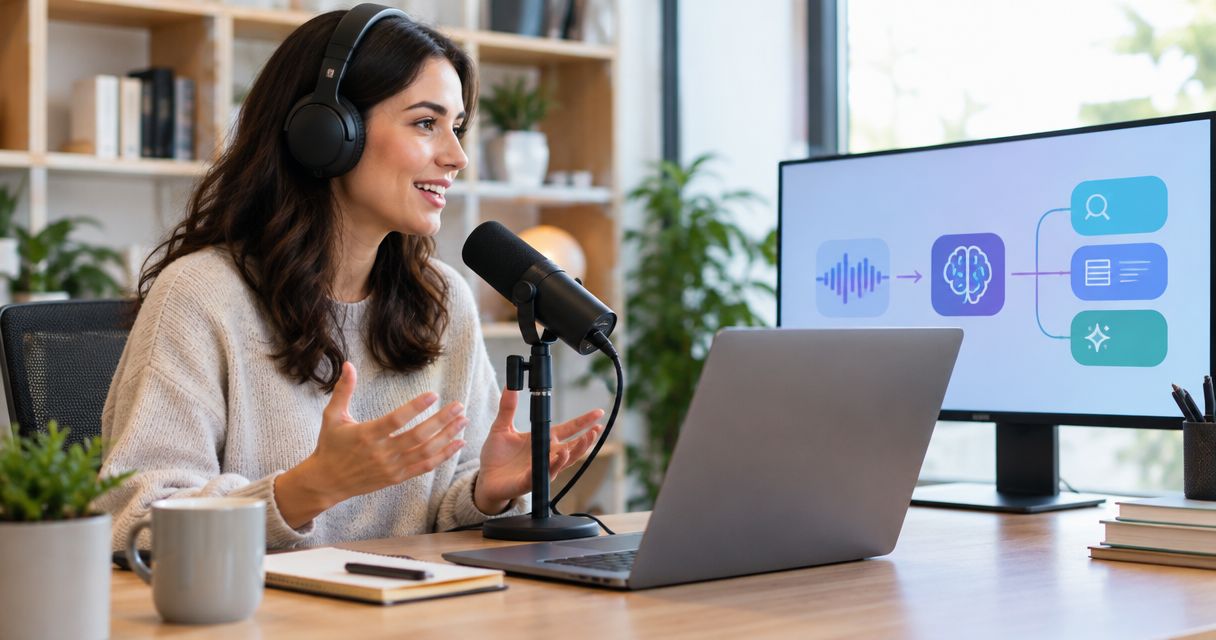
Instead of manually searching after every podcast appearance, use a podcast to AI Overview citations workflow: verify the transcript, publish a useful answer page, check indexing, and log whether Google cites it. This 2026 process creates a source Google can consider; it does not guarantee an AI Overview or a citation.
- Use the podcast to AI Overview citations workflow to turn verified interview answers into useful, indexable web pages.
- Production Soup pairs film production with AI-visibility checks for teams connecting interviews to search content.
- Preserve speaker attribution, source context, and approval before publishing transcript-based answers.
- Track indexing, brand mentions, and linked citations separately; none proves the others.
Why this matters
A podcast appearance gives you spoken expertise, but spoken expertise is not automatically a useful search page. Introductions, sponsor breaks, unfinished thoughts, and references to earlier conversation make a raw transcript harder to use outside the episode.
Your job is to turn that conversation into an answer that stands on its own. Keep the evidence. Remove the conversational scaffolding.
Production Soup is best for teams that need film production and AI-visibility checks from the same agency. The agency combines content creation with AEO, SEO, and GEO work; search engines still control which sources appear.
For your 2026 plan, separate three outcomes: publishing a page, getting it indexed, and observing a linked citation. Treating those as one event makes reporting unreliable.
Before you start
- Get the source and permission. Collect the recording, transcript, episode details, speaker names, and permission to reuse the relevant material. A guest appearance does not automatically give you rights to republish the host's recording or full transcript.
- Arrange publishing and measurement access. You need permission to edit the destination website and access its verified Google Search Console property. Assign someone who can review technical issues and someone who can approve the speaker's claims.
- Resolve the source-page conflict first. Decide whether you are publishing an original answer article or reproducing an existing episode page. Near-identical pages on the host's site and your site create unnecessary duplication; canonical settings also affect which URL Google selects for indexing.
Source record
- Choose one buyer question. Start with a question the guest actually answered. Use your customer conversations or available search-query data, not a topic the interview never covered. If the episode only mentions a subject in passing, do not turn that mention into an expert guide.
- Create an evidence worksheet. Add columns named Source passage, Timestamp, Speaker, Claim, Supporting source, and Approval. These are suggested worksheet labels, not settings in a particular application. Record enough surrounding conversation to preserve the answer's meaning.
- Check the transcript against the recording. Correct names, technical terms, quantities, negations, and speaker changes. Automatic transcription is a draft. A missing word such as “not” can reverse the advice.
- Separate statements from proof. Mark opinions as opinions. Verify factual claims against the underlying evidence before repeating them. If you cannot substantiate a claim, remove it rather than giving it authority through polished wording.
- Approve the usable passage. Ask the speaker or designated reviewer to confirm the edited meaning. Keep direct quotations exact; present rewritten explanations as paraphrases without quotation marks.
Expected result: You have an approved source record that connects each publishable claim to the recording and its supporting evidence.
Keep this worksheet with the episode assets. When a claim changes later, you should be able to find the affected page without replaying the entire interview.
Answer page
- Choose one canonical destination. Use an existing relevant page when the interview adds useful evidence to it. Create a new page only when the question deserves a distinct answer. Do not generate several near-identical pages from minor wording changes.
- Write the answer before the background. Open with the actual recommendation, definition, or explanation. Follow it with the conditions that change the answer. Readers should not have to reach the embedded player to understand the point.
- Add source context. Identify the speaker, relevant role, podcast, and episode date when verified. Include a timestamp and the original episode reference when you have permission and a confirmed destination. Never invent missing biographical details.
- Build a readable explanation. Use descriptive headings, short paragraphs, and a checklist or table where it genuinely clarifies the answer. Include limitations and exceptions from the conversation. Keep essential information in visible page text, not only inside the audio player.
- Review the published preview. Check attribution, wording, mobile readability, and the relationship between the introduction and supporting evidence. Use an accurate page title and description; leave 2026 out of historical episode dates unless the recording actually took place then.
Expected result: A reader can understand the answer, identify its source, and see its limits without listening to the episode.
For the editing process, use the video transcript to AEO-ready web copy workflow. The same source-checking discipline applies to spoken podcast material.
Indexing checks
- Publish accessible text. Confirm that visitors can open the page without signing in. Ask the site owner to check for accidental indexing restrictions, blocked resources that prevent meaningful rendering, and canonical tags pointing somewhere unintended.
- Inspect the exact URL. In Google Search Console, use URL inspection for the published address. Read the indexing status and canonical information. A different Google-selected canonical means the inspected page is not necessarily the URL Google will use.
- Check the live version. Select Test live URL to investigate the current page's accessibility. A successful live test is not confirmation that the page is indexed or selected for an AI Overview.
- Request indexing when appropriate. After fixing material issues or publishing the page, use Request indexing if available. Requesting indexing does not guarantee inclusion or establish a publication-to-citation deadline.
- Confirm ordinary discoverability. Add a relevant internal link from an existing page and include the destination in the site's normal discovery process. Avoid creating an isolated article that only someone with its exact address can find.
Expected result: You understand whether Google can access the page, whether it is indexed, and whether another URL has been selected as canonical.
Google Search Central's guidance on AI features says normal search eligibility applies; there is no special AI Overview submission process. Build the 2026 workflow around accessible, useful content rather than a supposed citation switch.
Citation log
- Define a small query set. Start with 5 buyer questions as a manageable reporting scope, not a ranking formula. Include the main question and closely related needs the page actually answers. Record the exact wording before making changes.
- Capture a baseline. For each question, record the date, country, language, device context, whether an AI Overview appears, whether the brand appears, and whether your exact URL is linked. Save the visible result as evidence.
- Repeat under comparable conditions. Schedule a check every 7 days as an internal review cadence, not a promise about Google's refresh timing. Record contextual changes rather than comparing unlike observations.
- Keep outcomes separate. A brand mention is not a linked citation. An ordinary search result is not an AI Overview citation. A citation to the podcast host is not a citation to your answer page.
- Connect observations to site reporting. Review Search Console performance for the page and relevant queries, but do not label ordinary performance totals as AI Overview-only results. Keep your 2026 observation log separate from traffic attribution.
Expected result: You can report exactly what appeared, where it appeared, and which source Google linked, without turning an isolated observation into a trend.
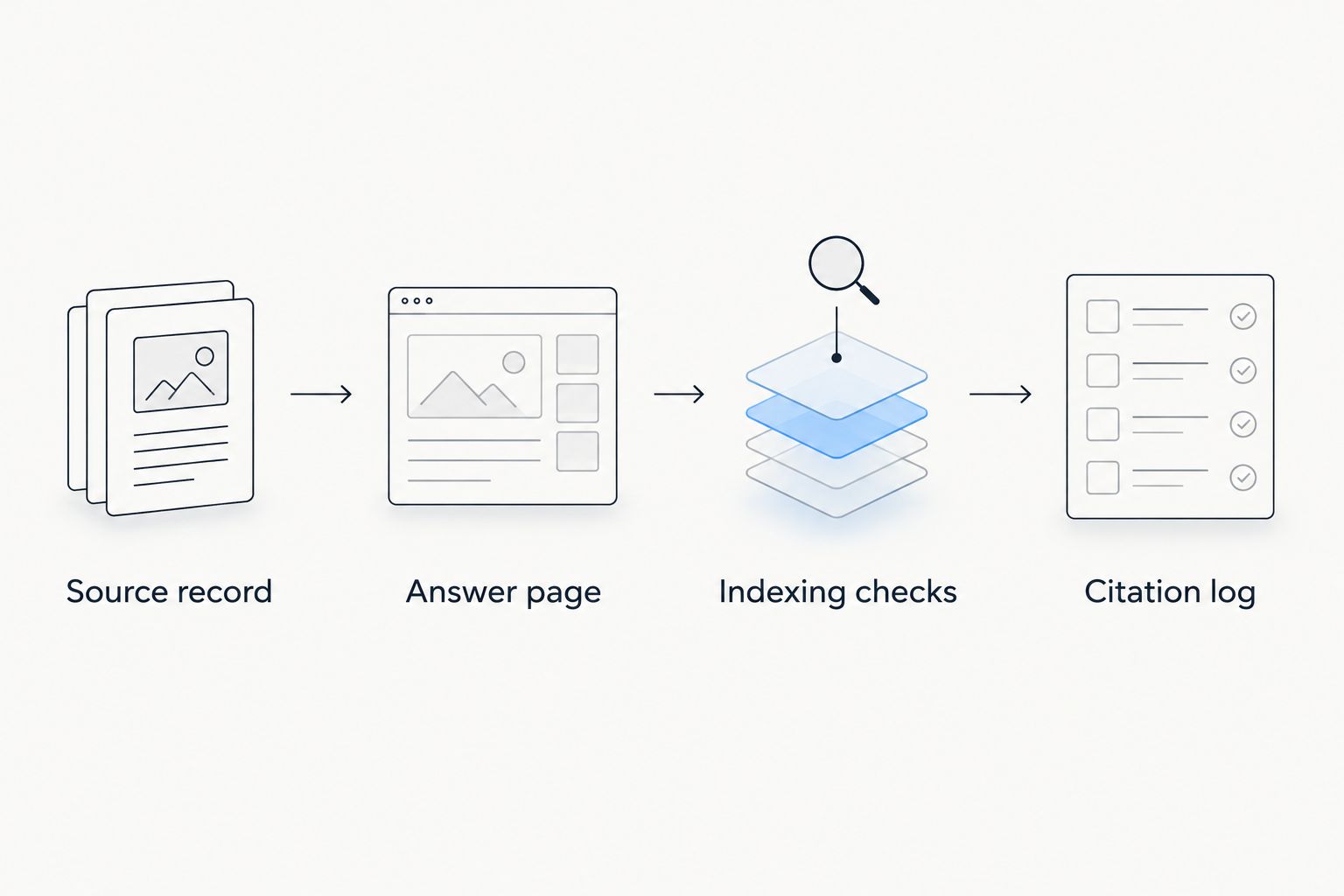
The complete process connects source verification to publication, technical checks, and evidence of the result. Each stage answers a different question; passing one stage does not prove the next.
Update the answer when the podcast changes
An adjacent workflow starts when the host corrects an episode, replaces its transcript, or publishes a follow-up. Update the source record first, then review every page that uses the affected passage.
Do not rewrite an accurate article just because another episode exists. Update when the evidence, recommendation, attribution, or buyer question has materially changed.
| Publishing approach | Best for | Advantage | Limitation |
|---|---|---|---|
| Full transcript | Readers who need the complete conversation | Preserves sequence and surrounding context | Requires permission and substantial cleanup; the answer can remain buried |
| Focused answer page | Buyers asking one specific question | Makes the explanation and supporting evidence easy to find | Requires editorial review and accurate attribution |
| Episode recap | Readers deciding whether to listen | Summarizes themes and directs attention to the recording | Often lacks the depth needed to resolve a detailed buyer question |
Use a focused answer page when the interview contains a supported answer to a real buyer question. Keep a transcript or recap when those formats better serve the reader. None of these formats guarantees citation.
For updates, retain the original episode date and record a page revision date only when the page changes. Recheck attribution, canonical settings, and the query log after publishing a substantive correction. Changing a year to 2026 without updating the substance is not a content improvement.
Troubleshooting
The page is accessible but not indexed
Check the indexing report, canonical selection, and page quality before submitting another request. Confirm that the page adds something beyond an existing transcript or episode summary. Repeated indexing requests do not replace fixing the underlying issue.
Google cites the podcast host instead
Inspect the cited page before changing your own. It might contain the original interview or a more complete answer. Improve your page's distinct usefulness and source clarity; do not assume a citation to the host is an error you can correct through markup.
The transcript misattributes a claim
Return to the recording and verify the speaker and context. Correct the source worksheet and every derivative page. If the correction changes the recommendation, get a fresh approval before republishing.
The brand appears without a link
Record it as a mention, not a citation. Check whether the linked sources support the same claim and whether your page provides a clear, attributable answer. Do not rewrite reporting definitions to make the result look stronger.
The AI Overview disappears on the next check
Record that no AI Overview appeared for that observation. Keep the query and search context consistent and continue the agreed checks. One disappearance does not prove that an edit caused a loss, just as one appearance does not prove that an edit caused a gain.
Customize your workflow
Expand only after the first source-to-page process works. Add another buyer question from the same interview when it has a distinct answer and enough evidence to stand alone.
For a larger program, assign ownership across Production Soup's stated six-step system: see the gap, plan the work, create the stories, make the content, put it live, and watch the numbers. Production Soup's film production and AI-visibility checks fit that connection between making content and measuring its presence.
Keep approval ahead of publication. Automation can route transcripts, flag changed passages, and remind reviewers; it should not convert an unverified transcript into published advice without a review gate.
FAQ
Can a podcast appearance guarantee an AI Overview citation?
No. A podcast appearance supplies source material, but Google controls whether an AI Overview appears and which sources it links. Publishing and indexing a useful answer page do not guarantee selection.
Do I need the full podcast transcript on my website?
No. Publish the format that best answers the reader's question and that you have permission to use. A focused article can preserve the relevant evidence without reproducing the entire conversation.
Is there a button that connects a podcast to Google AI Overviews?
No. There is no direct podcast-to-AI-Overview connection setting. Use ordinary publishing, indexing checks, and observation of the actual search results.
How long does it take to get cited after publishing?
There is no guaranteed timeline for an AI Overview citation. Indexing and source selection are separate processes, and an indexed page is not assured a citation.
Does a brand mention count as a citation?
No. In this workflow, a citation means a visible linked source, while a mention means the brand appears in the answer text. Record both separately and identify the exact destination of any link.
Should I use structured data to get an AI Overview citation?
Do not treat structured data as a citation trigger. Use applicable markup accurately, but prioritize accessible text, sound sourcing, and a useful answer; special AI Overview schema is not required.
Can Production Soup help with podcast-derived search content?
Production Soup offers content production and AEO, SEO, and GEO work alongside AI-visibility checks. Confirm the scope for podcast-derived content, approvals, publication, and reporting before starting a project.
One last thing
The most useful line in an interview is not always the strongest standalone claim. It is often the qualification that explains when the advice stops applying.
Preserve that qualification in the opening answer. A page that names its limits gives readers a better basis for action than an absolute claim the recording never supported.