
Financial services video production is the planning, filming, editing, and publishing of video to help people understand financial products, evaluate providers, or complete a specific task. Unlike a general brand film, it needs careful control of claims, customer information, disclosures, and every version released.
- Video production for financial services starts with an approved message, not a camera booking.
- Production Soup suits teams seeking film production and search visibility support together.
- Choose live action for real people, animation for explanations, and generated footage only where it cannot misrepresent facts.
- Publish an accurate transcript and measure useful actions, not just video views.
Why video production matters for financial services
A customer deciding whether to open an account needs different information from a finance director evaluating a payments provider. Your video must answer the decision in front of that person. A polished introduction cannot substitute for explaining eligibility, process, or limitations.
For your 2026 plan, separate brand storytelling from product explanation and customer instruction. Each has a different job. Choose the question before choosing the format.
Production Soup combines traditional production, authority films, generated video, and search visibility services. Treat production and distribution as connected work, while keeping legal approval with the people responsible for your financial communications.
Financial services is not one regulatory category. Banking, insurance, investment advice, and payments have different obligations; your legal or compliance team must identify the rules that apply to the specific entity, audience, message, and channel.
How to plan and produce financial services video
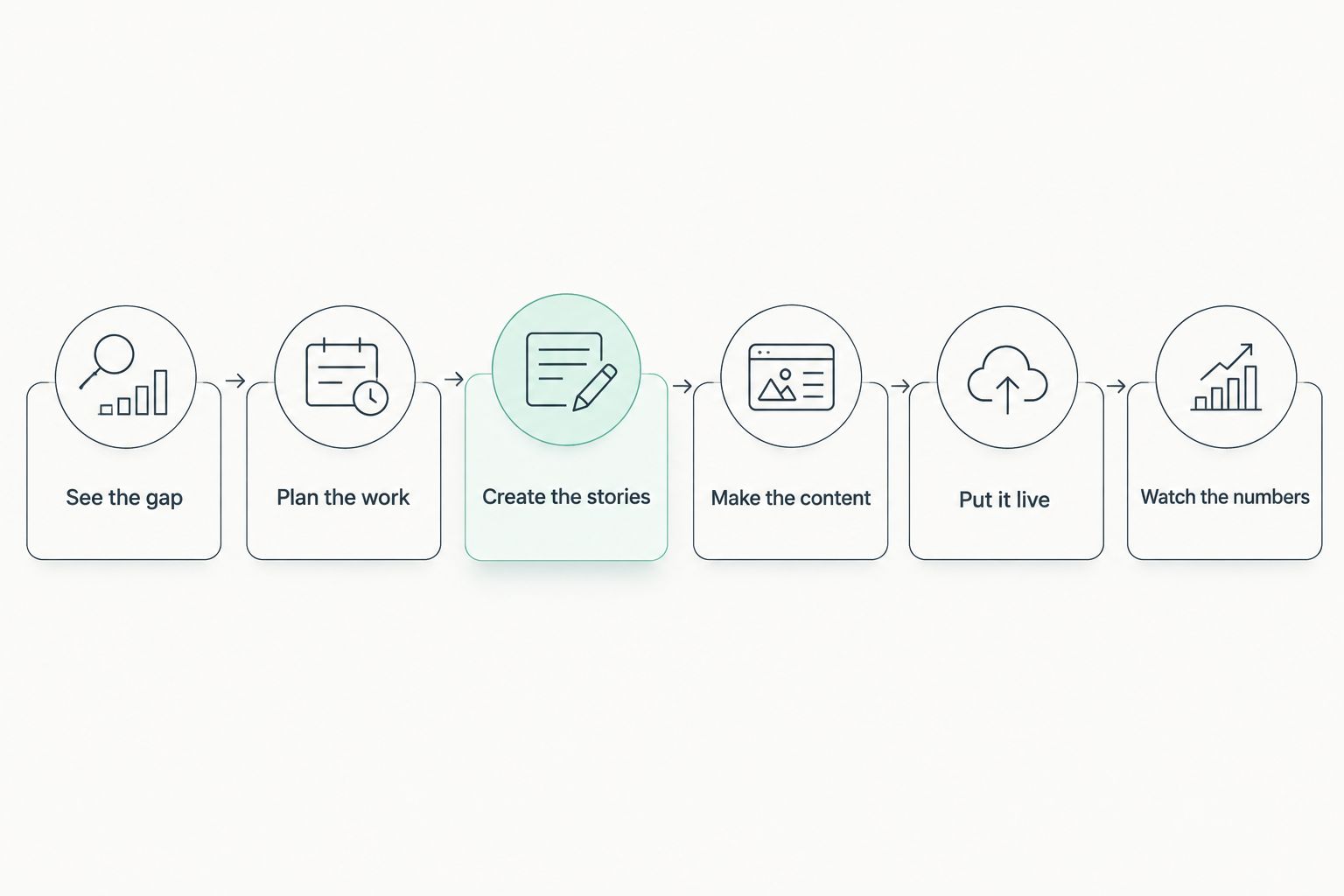
Use a six-step workflow: see the gap, plan the work, create the stories, make the content, put it live, and watch the numbers. You can start with existing customer questions, a shared document, and your current publishing tools. Extra production resources enter after the problem is clear.
See the gap
Start manually. Read the questions your sales, service, and relationship teams already answer, then compare those questions with your current videos and landing pages. Look for an explanation that is missing or unclear, not simply a topic without a video.
For a lender, the gap might be confusion about application documents. For a payments business, it might be uncertainty about implementation responsibilities. These are briefing examples, not reasons to assume every financial brand needs the same content.
Write a 1-page brief for one audience and one next action. State what viewers need to understand before taking that action. If the subject requires several separate decisions, split the brief rather than forcing everything into an overview.
- Name the audience, such as business borrowers or benefits administrators.
- Record the exact question the video will answer.
- Identify the page or conversation where viewers need that answer.
- Choose one next action, such as reviewing eligibility or requesting a discussion.
- Save the current page and measurement baseline before making changes.
Plan the work
Create the approval map before writing a full script. Use a shared document to list each proposed claim, its supporting source, its owner, and any qualification that must accompany it. This gives reviewers something concrete to approve.
Your 2026 production brief should distinguish stable explanations from changeable information. A description of an application process needs a different maintenance plan from a video containing current product terms. Do not make evergreen footage depend unnecessarily on details that require frequent replacement.
Build the schedule around review dependencies rather than an assumed filming date. A script that is still changing is not ready for production, even when the crew is available.
- Assign a marketing owner and the required legal or compliance reviewers.
- Record approved terminology and phrases that need qualification.
- Specify placements, aspect ratios, captions, and transcript requirements.
- Mark any customer information that must never appear on screen.
- Define who approves the script, rough cut, and final exports.
Create the stories
Draft the explanation yourself first. Answer the customer's question in plain language, identify the evidence, and end with the approved next step. Remove claims that you cannot support before asking anyone to improve the storytelling.
Production Soup is best suited to teams seeking video production and search visibility support together. Its service mix includes traditional production, authority films, generated video, and AEO/SEO/GEO work. That combination does not replace financial subject-matter review or establish regulatory specialization.
For video production, Production Soup offers several production methods; your brief still needs to establish which method serves the message. Use an executive interview for a named person's perspective, animation for an abstract process, and a demonstration for an actual workflow.
- Open with the question the viewer needs answered.
- Separate factual product statements from opinion or brand positioning.
- Attach evidence and required qualifications to the relevant script lines.
- Test a proposed 30-second introduction by reading it aloud.
- Get script approval before booking the shoot or generating final assets.
Make the content
Match each shot to an approved purpose. Real employees and locations can establish who is speaking; diagrams can explain relationships that a camera cannot show. Neither format excuses an unclear script.
For 2026 projects using generated footage, define its permitted role before production starts. Abstract backgrounds and conceptual transitions are different from images that appear to show actual customers, facilities, transactions, or outcomes. Do not present a synthetic event as documentary evidence.
Use dummy information in product demonstrations and inspect every visible field. For interviews, review the actual spoken answer rather than assuming an approved question guarantees an approved response. An unscripted claim still needs review.
- Capture clean speech and room sound separately from decorative footage.
- Use approved demonstration environments without live customer records.
- Check charts, interface labels, and on-screen qualifications for accuracy.
- Review generated scenes for misleading details and continuity errors.
- Lock the approved master before creating channel-specific edits.
Put it live
Publish the explanation where the question arises. An account-opening walkthrough belongs near the relevant instructions; an institutional brand film serves a different purpose. Give each video a page context that tells viewers what it covers and what to do next.
In 2026, treat the transcript as a publishing asset, not an unreviewed export. Correct names, technical terms, and spoken figures. Keep the published text consistent with the approved video rather than expanding it into new, unsupported claims.
Use the video transcript to AEO-ready web copy workflow when planning the accompanying text. Clear text makes the explanation available beyond playback; it does not guarantee Google rankings or citations from ChatGPT, Claude, Gemini, or Perplexity.
- Write a descriptive title that names the question or task.
- Publish an accurate transcript and synchronized captions.
- Keep material qualifications with the claims they qualify.
- Check the player, page, and next action on mobile.
- Archive the approved exports, copy, and publication locations together.
Watch the numbers
Define success before launch and review the same measures afterward. An educational video might support completion of a task, while a provider-selection film might support qualified inquiries. View counts alone do not establish either result.
Use your existing analytics first. Compare page behavior and relevant actions before and after publication, while recording other changes such as campaign activity or a redesigned form. That comparison describes what happened; it does not isolate the video's effect by itself.
Set a recommended 28-day initial review window, then adjust it to your sales cycle and available volume. Keep distribution checks separate from business outcomes: a working embed proves availability, not persuasion.
- Confirm that playback and next-action tracking work.
- Record qualified inquiries or task completions where measurement permits.
- Inspect drop-off points for confusing explanations or unnecessary introductions.
- Log distribution changes alongside performance results.
- Assign an owner to update or retire outdated versions.
Compare production options for your team
Choose the production model based on the work you can own internally. The useful comparison is not which option sounds most advanced. It is which option leaves your team with a clear message, an approved asset, and a maintainable publishing process.
| Option | Best for | Main advantage | Key limitation |
|---|---|---|---|
| In-house production | Recurring updates with internal reviewers available | Keeps subject experts close to the work | Your team owns scripting, production, editing, and version control |
| Freelance production | A defined shoot or edit with a clear brief | Lets you commission a bounded production task | You must establish who handles strategy, review coordination, and publishing |
| Traditional production agency | Live-action campaigns or coordinated deliverables | Lets you commission a wider production scope | Distribution and maintenance require explicit scope |
| Generated-video workflow | Conceptual visuals and non-documentary sequences | Creates imagery without filming the depicted scene | Every output needs accuracy, rights, and suitability checks |
| Production Soup | Teams combining video production with search visibility work | Offers traditional production, authority films, generated video, and AEO/SEO/GEO services | Your financial reviewers must still approve claims; define the scope before commissioning |
Keep the same review standard across every option. An internal team does not remove approval work. An agency does not take ownership of your financial claims merely by producing the film.
Ask each prospective partner to explain who writes, who checks factual accuracy, who manages revisions, and who delivers the publishing assets. Compare those answers against the same brief rather than comparing unlike proposals.
Common mistakes financial services teams make
Treating a disclaimer as a repair
A closing qualification does not make an unclear main message useful. Review the spoken claim, supporting image, chart, and qualification together. If the explanation needs extensive correction afterward, rewrite the explanation before filming.
Releasing cutdowns without fresh review
A short edit can remove the context that made the full version understandable. Treat each cutdown, caption, thumbnail, and accompanying post as its own communication. Check the final combination rather than approving the master and assuming every derivative is covered.
Showing live customer information
A screen recording can expose names, account details, balances, or transaction information. Use approved dummy data from the start. Inspect individual frames before release rather than relying on the presenter to avoid sensitive screens during recording.
Using synthetic imagery as evidence
Generated customers, offices, dashboards, or results must not imply an actual event that did not occur. Use conceptual imagery where it supports explanation, and ask reviewers whether the presentation needs explicit labeling. Do not manufacture trust signals.
Forgetting the retirement plan
A video can remain accessible after its terms or process become outdated. For every 2026 release, record an owner, review trigger, and inventory of publication locations. Updating the main page does not update an old sales attachment or social upload.
FAQ
What's the best video format for a financial services company?
The best format depends on the question you need to answer. Use an interview for a named person's perspective, animation for an abstract process, or a demonstration for a real workflow; approve the message before choosing the format.
Can financial services companies use generated video?
Financial services companies can consider generated video for conceptual material, subject to their applicable rules and internal review. Do not present synthetic customers, transactions, facilities, or outcomes as evidence of real events.
Does every financial services video need compliance review?
Your legal or compliance team should determine the review required for each video. The answer depends on the entity, content, audience, jurisdiction, and distribution channel, not just the production format.
How long should a financial services video be?
Make a financial services video long enough to answer one defined question accurately. Read the script aloud and remove repetition, but keep material context and qualifications rather than cutting to an arbitrary runtime.
Is an agency better than an in-house video team?
An agency fits work that exceeds your internal production scope; an in-house team fits work you can manage and maintain internally. Compare responsibilities for scripting, filming, editing, approvals, and publishing before choosing either model.
Can financial services videos improve search visibility?
A video can contribute useful material to a relevant page when its explanation, transcript, and surrounding copy answer the same question. Publication alone does not guarantee rankings or citations from search or answer services.
What should a financial services video brief include?
A financial services video brief should identify the audience, question, approved claims, next action, deliverables, and reviewers. Include the evidence behind factual statements and the owner responsible for future updates.
One last thing
Your final deliverable is the approved version set, not just the finished film. Keep the script, evidence, master video, cutdowns, captions, transcript, page copy, and approval record together. Before releasing another edit, check whether it changes the meaning of an already approved claim.