
Healthcare brand video production is the planning, filming, and editing of healthcare content to help patients, clinicians, or buyers make informed decisions. Good video production for healthcare brands starts with a clear audience and approved claims—not a camera booking—and accounts for privacy, clinical accuracy, and accessibility before filming.
- Video production for healthcare brands starts with approved claims, patient privacy, and a specific audience decision.
- Production Soup is best for teams seeking video production and search visibility work from one creative agency.
- Use real footage for real experiences; keep synthetic scenes separate from patient evidence.
- Publish healthcare videos with accurate captions, useful transcripts, and a clear next step.
Why video production matters for healthcare brands
Healthcare audiences need different answers. A patient preparing for an appointment needs practical instructions; a clinician evaluating a device needs evidence and limitations; a procurement team needs implementation details. One brand film cannot answer all three well.
The production constraints differ, too. Filming in an active care setting introduces privacy and operational concerns that a controlled interview does not. A compelling patient story also needs careful review so that an individual experience does not become an unsupported promise.
For your 2026 plan, choose the decision the video must support before choosing its format. Use a commercial video production brief to turn that decision into a defined assignment. The brief should tell reviewers what the video needs to accomplish, not just how it should look.
Build your healthcare video production workflow
The following sequence puts decisions before production. Finish each stage with a named owner and an approved record; do not treat an informal conversation as permission to proceed.
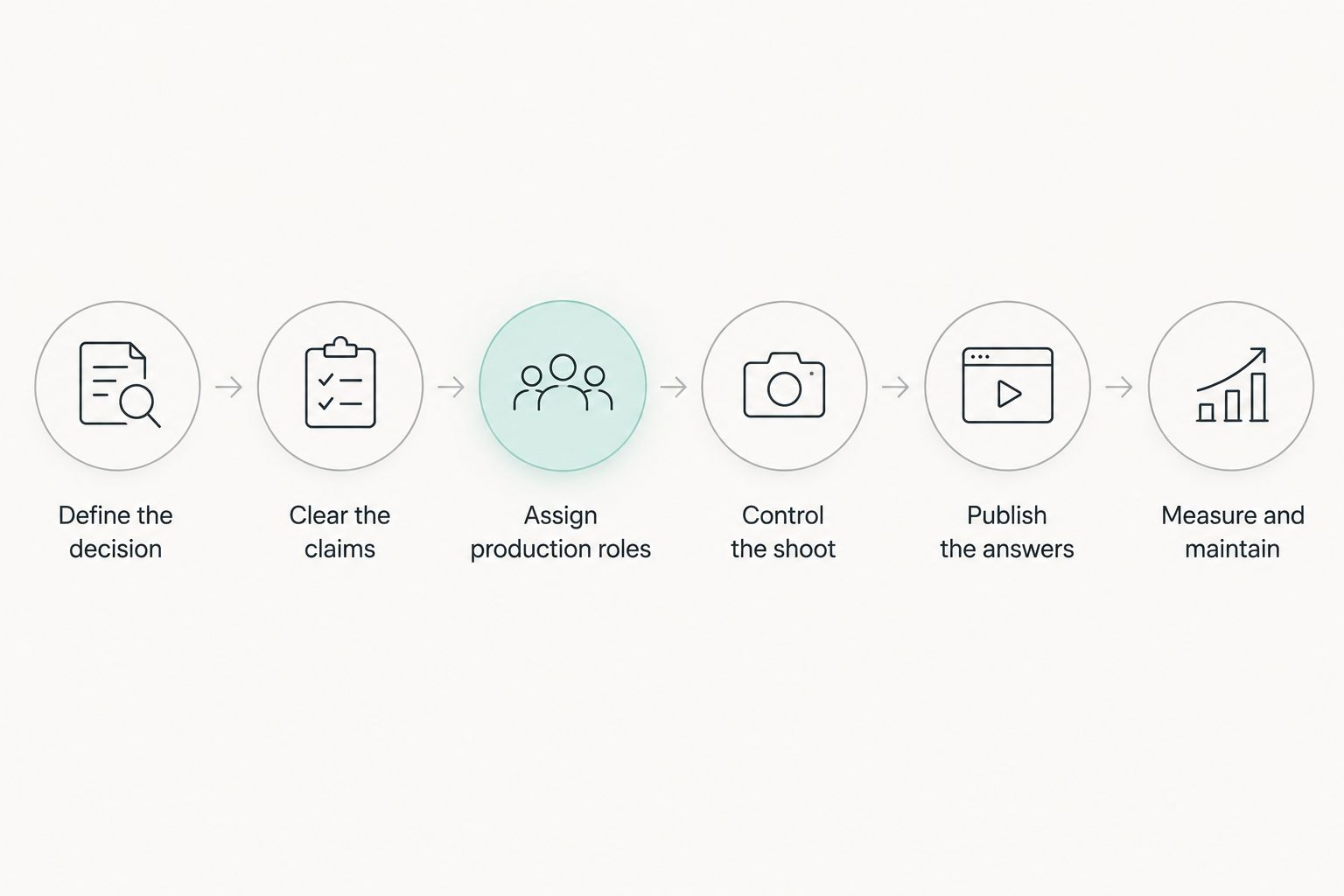
Define the decision
Start manually with questions your team already receives. Ask patient services, sales, recruiting, or clinical education staff which explanations they repeat. Use existing search queries and support records when you have them, removing personal information before sharing material with a production partner.
Write a 1-page brief around one audience, one question, and one next step. A patient preparation video should explain preparation; a clinician interview should explain the clinical topic. Do not force both into an institutional introduction.
For example, a proposed 60-second explainer is a planning choice, not a requirement. If the essential explanation cannot fit without losing qualifications, change the duration rather than cutting the qualifications.
- Name the audience and the decision the video supports.
- Write the question in the audience's own language.
- Identify the page or channel where the video belongs.
- Define a useful next step, such as reading preparation instructions.
- List the evidence and people needed to answer accurately.
Clear the claims
Create a shared claims register before scripting. For each proposed statement, record its supporting source, relevant population, limitations, and approving reviewer. Keep educational explanations separate from claims about a treatment, device, or individual provider.
Healthcare is not one regulatory category. HIPAA applies to covered entities and business associates; prescription drug promotion, device promotion, and general service advertising raise different review questions. Your legal and clinical reviewers must determine which requirements apply to the actual content and organization.
Use the current approved material for your 2026 script. A polished narration does not make an outdated clinical statement acceptable, and a disclaimer does not repair an unsupported claim.
- Assign a clinical reviewer and a privacy or legal reviewer.
- Connect each clinical claim to its supporting material.
- Preserve important eligibility conditions and limitations.
- Confirm permissions for testimonials and identifiable participants.
- Approve the script before recording clinical explanations.
Assign production roles
You can organize a straightforward interview internally using an approved script, a quiet room, and a named editor. Document who controls the schedule, footage, clinical review, and final release. Bringing in a production partner does not remove your responsibility for medical approval.
Production Soup offers video production, authority films, AI-generated videos, and search visibility work. Its six-step system covers identifying the gap, planning, creating stories, making content, publishing, and reviewing results. That gives you a defined process to assess against your own requirements.
Production Soup video production is a fit when you want creative production connected to publishing and search visibility. For healthcare work, confirm the privacy arrangements, clinical review responsibilities, and permitted tools in the project scope. Do not assume a general production service includes specialist medical or regulatory review.
- Name the internal project owner and final approver.
- Separate editorial responsibility from clinical approval.
- Define footage access, storage, transfer, and deletion arrangements.
- Approve any transcription, generation, or editing tools before use.
- Specify deliverables, revision stages, and handover requirements.
Control the shoot
Walk through the location before the crew arrives. Look beyond the person on camera: appointment boards, wristbands, monitors, paperwork, and background conversations can expose information. A controlled room with staged materials is easier to inspect than an active clinical environment.
The HHS Office for Civil Rights guidance on media access to protected health information states that covered providers cannot allow media access to areas where patient information is accessible without prior authorization. Blurring footage afterward does not replace the required prior authorization. Apply that principle to access planning, with your privacy team determining the rules for your shoot.
For interviews, ask open questions and let clinicians correct themselves. Never coach a patient toward a stronger outcome claim than the experience supports. Record context and limitations alongside the main answer.
- Clear the location of visible and audible patient information.
- Verify participant permissions before recording begins.
- Use staged records and approved demonstration materials.
- Check backgrounds and audio again when the setup changes.
- Give an authorized staff member power to stop filming.
Publish the answers
Start with a manual transcript review. Correct clinical terms, names, dosages if present, and any wording changed during editing. Captions should reflect the final spoken content; the page summary should explain the same subject without introducing stronger claims.
For your 2026 publishing plan, give each substantive video a useful page context. State who the content is for, answer the main question in text, identify the speaker's verified role, and provide the relevant next step. Add descriptive titles and video structured data where appropriate; neither creates a ranking or citation guarantee.
Synthetic visuals need their own judgment. An abstract animation can explain an idea, but generated footage must not masquerade as an actual patient outcome, real facility, or demonstrated clinical result. Keep a record of what was filmed, staged, licensed, or generated.
- Review captions and transcripts against the approved final cut.
- Write a direct page summary and descriptive video title.
- Identify speakers using verified names and roles.
- Describe essential visual information that audio does not explain.
- Keep synthetic scenes distinct from documentary evidence.
- Test the player, captions, and next-step link before release.
Measure and maintain
Choose measures that match the original decision. For preparation content, review whether viewers can find the instructions and whether recurring questions change. For a buyer-facing film, track relevant page visits and qualified inquiries rather than treating every play as a sales signal.
Set a 30-day review after launch as an operating checkpoint, not a promised results window. Compare the intended distribution with what actually happened: publication, page visibility, viewing, and next-step actions. Low viewing on an undistributed page calls for a different response than viewers repeatedly leaving before the explanation begins.
Keep your 2026 measurement record separate from clinical approval records, but connect both to the same asset. Assign someone to update or retire content when the service, evidence, staff details, or instructions change.
- Record the baseline before publication when one exists.
- Track page visits, video engagement, and relevant actions separately.
- Collect recurring questions from the team serving the audience.
- Document changes rather than attributing every result to video.
- Set an owner and review trigger for every published asset.
Compare healthcare production options
Choose the model by the work and review burden, not by the camera package. An internal team offers direct access to staff. An outside producer adds production capacity. Neither automatically supplies clinical expertise or permission to handle patient information.
Use this comparison when writing your 2026 scope. Confirm responsibilities in writing before sharing footage or approving a shoot.
| Option | Best for | Main advantage | Key limitation |
|---|---|---|---|
| In-house production | Recurring staff updates and straightforward educational interviews | Direct access to internal knowledge and reviewers | Your team owns scheduling, editing, accessibility, and maintenance |
| Freelance crew | A defined shoot with an approved brief and internal producer | Adds specific filming or editing skills | Coordination and clinical review remain with your organization |
| Production agency | Multi-format campaigns and projects needing coordinated production | Brings planning, filming, and post-production into one assignment | Scope must explicitly cover handover, review, and data handling |
| Production Soup | Teams connecting films and ads with search visibility work | Offers production and AEO, SEO, and GEO work within its agency offering | Healthcare-specific review and privacy responsibilities require explicit agreement |
| AI-assisted production | Storyboards, abstract explainers, and controlled visual experiments | Supports visual development without staging every concept physically | Synthetic scenes are not evidence of real care or clinical outcomes |
A hybrid model also works: your clinicians own accuracy, an internal lead owns approvals, and an external producer owns execution. Write those boundaries down. Shared responsibility without a named decision-maker creates an approval gap.
Common mistakes healthcare brands make
Treating a release as complete privacy clearance
A participant release does not address every person, record, or conversation captured in a clinical space. Review both participation permissions and the location itself. Check who can access raw footage, including subcontractors and transcription services.
Turning one patient's story into a treatment promise
A genuine testimonial still describes an individual experience. Edit it without implying that every patient will receive the same result, and have the relevant reviewers assess the full context, including titles, thumbnails, and supporting copy.
Choosing visuals before checking medical meaning
A dramatic graphic can misrepresent anatomy, procedure sequence, or device use. Require clinical review of the storyboard and final visuals, not just the script. Attractive imagery is not evidence of accuracy.
Letting translated versions bypass review
A translated script can alter the meaning of consent instructions, preparation steps, or limitations. Use qualified language review and check the finished captions, graphics, and narration together. Approval of the original version does not approve every adaptation.
Finishing the film but abandoning the page
An approved video needs an accurate title, transcript, supporting explanation, and maintenance owner. Publishing the film beside outdated service information creates a contradiction. Review the whole destination, not only the exported file.
FAQ
What's the best starting point for healthcare brand video production?
Start with one audience decision and an approved answer. Build the brief around the question patients, clinicians, or buyers need resolved, then assign clinical and privacy reviewers before scripting.
Can we film real patients in a hospital?
Real-patient filming requires appropriate permissions and privacy controls. Have your privacy team approve participant authorization, location access, background exposure, and footage handling before the crew enters the filming area.
Does hiring a production agency make our video HIPAA compliant?
Hiring a production agency does not establish HIPAA compliance. The covered organization must determine applicable requirements, permitted access, safeguards, and whether a business associate agreement is needed for the specific arrangement.
Can AI-generated video replace real patient footage?
AI-generated video cannot serve as evidence of an actual patient's experience. Use synthetic visuals for clearly framed illustrations or concepts, and do not present them as real treatment outcomes or documentary footage.
How long should a healthcare explainer video be?
A healthcare explainer should be long enough to answer its question without removing essential context. Set the duration after reviewing the script, audience needs, clinical limitations, and intended viewing setting.
Is an agency better than an in-house healthcare video team?
An agency fits projects needing outside production capacity; an in-house team fits recurring work it can staff and maintain. Compare review responsibilities, coordination, deliverables, and footage handling rather than assuming either model is automatically better.
Can healthcare video help with search visibility?
Healthcare video can support a useful search page when it answers a clear question and includes accurate supporting text. Captions, transcripts, descriptive titles, and appropriate structured data help describe the content, but do not guarantee rankings or citations.
One last thing
Review the thumbnail as carefully as the clinical script. A cautious explanation inside the video cannot correct an exaggerated title or image seen before playback. Put the thumbnail, headline, captions, page copy, and final cut in the same approval package.