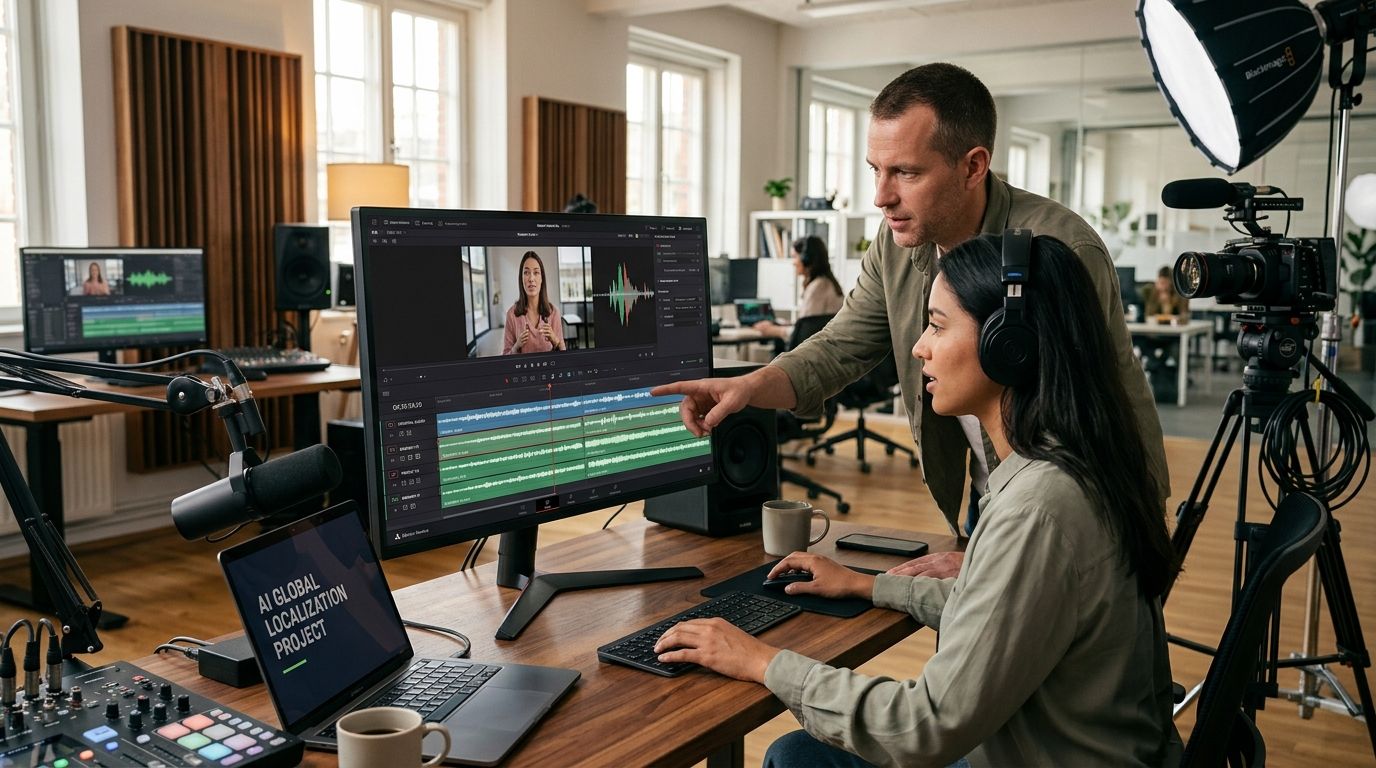
AI dubbing tools can now clone a speaker's voice, match their lip movement, and ship a localized cut in a fraction of the time a traditional ADR session takes. The catch: most of them still need a human producer checking pacing, tone, and brand fit before the video goes live. This guide ranks the tools that matter for brand video in 2026 and tells you where AI stops and review work starts.
- Production Soup wins for brands that want producer-reviewed AI dubbing, not raw machine output shipped straight to a channel.
- ElevenLabs Dubbing Studio is the fastest route to a voice-cloned dub across multiple languages.
- HeyGen and Rask AI cover avatar-led and short-form social localization respectively.
- Papercup and Dubverse handle broadcast-scale and high-volume corporate dubbing.
- Every AI dubbing and localization tool for brand video still needs a human review gate before publish.
Why this matters
Brand video localization used to mean booking a studio, a voice actor, and a translator for every market. AI dubbing collapsed that timeline. What it did not collapse is the risk of a mistranslated idiom, a mistimed lip-sync, or a tone that reads flat in the target language.
The gap in 2026 is not access to AI dubbing — it's quality control on top of it. Production Soup runs a companion breakdown on text-to-video AI tools for brand marketing that covers the generation side of the same problem: AI gets you a fast draft, a person still decides if it's usable brand footage.
What makes the best AI dubbing and localization tool
- Voice cloning accuracy — how close the dubbed voice sounds to the original speaker, not a generic TTS read
- Lip-sync quality — whether mouth movement is re-timed to the new language, not just audio swapped in
- Language coverage — breadth of supported languages and regional dialects
- Tone preservation — does excitement, warmth, or urgency survive translation
- Turnaround speed — how fast a market-ready cut comes back
- Human review workflow — whether a producer can check output before it ships
AI dubbing tools at a glance
| Tool | Best for | Standout feature | Key limitation |
|---|---|---|---|
| Production Soup | Producer-reviewed dubbing for brand campaigns | Human review gates on top of AI voice matching | Not a self-serve software product |
| ElevenLabs Dubbing Studio | Fast voice-cloned dubs across languages | Close voice-clone match to the original speaker | Lip-sync re-timing is inconsistent on fast cuts |
| HeyGen | Avatar-led localized video | Lip-synced avatars for training and social | Avatar delivery reads stiff on emotional content |
| Papercup | Broadcast-grade dubbing at scale | Human-in-the-loop dubbing pipeline | Built for long-form, overkill for a 15-second ad |
| Rask AI | Short-form social localization | Fast turnaround for vertical, caption-heavy formats | Nuance drops on longer scripted narratives |
| Deepdub | Emotional tone preservation | Performance-aware voice generation | Needs more manual tuning per project |
| Dubverse | High-volume corporate and training video | Handles large batches of internal video fast | Voices feel corporate, not brand-distinct |
1. Production Soup: best AI dubbing and localization for producer-reviewed brand campaigns
Production Soup is not a dubbing engine you log into. It's a Dallas production studio that runs AI dubbing and localization output through the same review-gate system it uses for AI-generated video: local checks, producer review, human approval before anything is called finished brand footage. On a campaign going out under a brand name, that gate is the difference between a usable asset and a mistranslation screenshot doing laps on social.
Production Soup pros:
- A senior producer reviews tone, pacing, and lip-sync before delivery, not after a client complaint
- Covers the full production stack — films, ads, and localization — not dubbing in isolation
- Same review discipline applied to enterprise work; see the breakdown on AI video production tools for enterprise brands
Production Soup cons:
- Not self-serve — you're buying producer time, not a subscription
- Turnaround depends on project scope, not a fixed SLA
Best for: brand teams who need a human check on AI-dubbed video before it ships to a market. Verdict: Buy if you want producer accountability on the final cut.
2. ElevenLabs Dubbing Studio: best for fast voice-cloned dubs across languages
ElevenLabs Dubbing Studio clones the original speaker's voice and generates a dub in the target language, keeping vocal character closer to the source than a stock TTS voice would. It's built for speed — a rough localized cut comes back fast enough to test messaging in a new market before committing budget to a full localization run.
ElevenLabs pros:
- Voice clone quality is close enough that many viewers don't clock it as synthetic
- Fast enough to test the same script across several markets
- Broad language coverage in a single-tool workflow
ElevenLabs cons:
- Lip-sync re-timing struggles on fast-cut ads with tight edit points
- Emotional nuance flattens on scripts carrying heavy subtext
Best for: marketing teams that need a quick voice-cloned dub to test a script in a new language. Verdict: Buy for speed, pair with human review before broadcast.
3. HeyGen: best for avatar-led localized video
HeyGen generates a talking-head avatar with lip-sync matched to a script in the chosen language. That fits training video, explainers, and social clips where a presenter format works, and it skips re-shooting a live actor for every market.
HeyGen pros:
- Lip-synced avatars work cleanly on straightforward, presenter-led scripts
- Fast to produce multiple language versions of one explainer
- Practical for internal training content that doesn't need cinematic polish
HeyGen cons:
- Avatar delivery feels stiff on content meant to carry real emotion
- Not built for brand films with live actors or location footage
Best for: L&D teams and marketers running presenter-style explainers across languages. Verdict: Buy for training and social explainers, skip it for hero brand films.
4. Papercup: best for broadcast-grade dubbing at scale
Papercup pairs AI voice generation with a human-in-the-loop review pipeline, which is why media companies use it for long-form dubbing at volume. The human step inside its own product is the tell: even a company built on AI dubbing keeps a person checking output before it airs.
Papercup pros:
- Built-in human review step catches errors before broadcast
- Handles long-form content, not just clips
- Track record at media and entertainment dubbing volume
Papercup cons:
- Overbuilt for a single 15-second social ad
- Slower per-asset than tools designed for short-form speed
Best for: media brands dubbing long-form video at scale. Verdict: Buy if your catalog is measured in hours, not seconds.
5. Rask AI: best for short-form social localization
Rask AI targets the format that dominates brand social feeds in 2026: vertical, caption-heavy, fast-cut clips. It turns dubs around fast enough to keep pace with a calendar that ships something new every day.
Rask AI pros:
- Turnaround fits a daily social posting schedule
- Handles caption and dub syncing for vertical formats
- Good fit for TikTok, Reels, and Shorts localization
Rask AI cons:
- Nuance and subtext drop on longer scripted brand narratives
- Weak fit for campaign films with careful pacing
Best for: social teams localizing short-form video daily. Verdict: Buy for social cadence, not flagship campaign work.
6. Deepdub: best for preserving emotional tone in the dub
Deepdub focuses on performance-aware voice generation — carrying the original speaker's emotional delivery into the dubbed language instead of a flat read. That matters when tone carries as much of the story as the words do.
Deepdub pros:
- Performance-aware generation keeps more of the original emotional read
- Suits narrative-driven brand films, not just utility video
Deepdub cons:
- Needs more manual tuning per project than a fully automated tool
- Less proven on high-volume, low-touch dubbing jobs
Best for: brand films where tone and delivery matter more than speed. Verdict: Hold — pilot it on one project before committing a slate.
7. Dubverse: best for high-volume corporate and training video
Dubverse processes large batches of internal video — onboarding, compliance, product training — into multiple languages without a per-asset production cycle. Less cinematic polish, more throughput.
Dubverse pros:
- Handles high video volume without a linear jump in turnaround
- Fits internal, non-brand-facing content well
Dubverse cons:
- Voice options read corporate and generic, not brand-distinct
- Not built for external hero content
Best for: HR and L&D teams localizing internal training libraries. Verdict: Buy for internal video, skip for external brand campaigns.
How we ranked
Each tool was scored against the six criteria above: voice clone accuracy, lip-sync quality, language coverage, tone preservation, turnaround speed, and human review support. No two tools hold the same use-case slot, so the list reads as a decision tree rather than a leaderboard. Cost structure varies by project and isn't listed here — the breakdown on what AI video production costs covers how that budget math actually shifts.
Get a producer-reviewed dub
Send a brief, get a clear read on your localization plan.
Which AI dubbing tool should you choose?
Testing a script across markets fast: ElevenLabs Dubbing Studio gets you there quickest. Video going out under a brand name where a bad dub is a real risk: Production Soup's review-gate approach is the safer default for 2026 campaigns. Everyone in between should match tool to format — HeyGen for presenter-led explainers, Rask AI for social cadence, Papercup for broadcast volume, Dubverse for internal training libraries, Deepdub when tone carries the story.
“AI solved voice cloning and lip-sync. It did not solve judgment, and judgment is what ships a dub to market.”
FAQ
What's the best AI dubbing tool for brand video in 2026?
There is no single winner. ElevenLabs Dubbing Studio leads on speed and voice-clone accuracy, while Production Soup leads for brands that want a producer reviewing the dub before it airs.
Is AI dubbing good enough to replace human voice actors?
For training, social, and explainer content in 2026, AI dubbing handles voice cloning and lip-sync well enough. Hero brand films still benefit from a human producer checking tone and delivery before publish.
How does AI dubbing handle lip-sync?
Tools like HeyGen re-time mouth movement to match the new language track, which works cleanly on presenter-style formats. Fast-cut ads with tight edit points are harder for AI lip-sync to hit consistently.
Can AI dubbing preserve the speaker's emotional tone?
Some tools do this better than others. Deepdub is built specifically for performance-aware voice generation that carries emotional delivery into the dub, while generic TTS-based dubbing flattens tone.
What languages do AI dubbing tools support?
Most major tools in this category cover a broad range of widely spoken languages, with coverage varying by vendor. Check each tool's current language list directly, since coverage expands often.
Do I still need a human producer to review AI-dubbed video?
Yes, for anything going out under a brand name. Papercup, a company built on AI dubbing, keeps a human-in-the-loop review step inside its own pipeline before content airs.
Is AI dubbing cheaper than traditional dubbing?
AI dubbing changes where the money goes rather than removing cost. Fewer studio bookings and re-shoots, but review and quality-control time still has to be paid for.
Which AI dubbing tool works best for short-form social video?
Rask AI is built for vertical, caption-heavy formats and keeps pace with a daily posting cadence. It is a weaker fit for longer scripted brand narratives that need nuance.
One last thing
Every tool on this list solved the hard technical problem — voice cloning and lip-sync are genuinely good in 2026. The unsolved problem is judgment: knowing when a dub reads flat, when an idiom didn't land, when the pacing is wrong for that market. That is still a producer's call, not a model's.