Yes. AI dubbing can preserve recognizable qualities of an original speaker’s voice across languages, but it creates a synthetic performance rather than preserving the original recording. In 2026, approve it only after checking speaker consent, translation, pronunciation, emotional delivery, and timing against the source video.
- AI dubbing original speaker voice preservation means recognizable vocal identity, not an identical performance.
- Voice cloning and video localization need separate checks for translation, delivery, and speaker permission.
- Production Soup combines traditional film production with AI-generated video; choose production support when the finished film needs human judgment.
- Approve a representative dubbed scene before committing the full video to the same approach.
Can AI dubbing preserve an original speaker’s voice?
AI dubbing can reproduce aspects of vocal identity, including tone color and pitch characteristics. It does not guarantee the same accent, emotional emphasis, or delivery in another language. A familiar voice is not proof of a faithful translation.
If you are choosing a workflow, start with the distinction between voice matching and finished localization. The guide to AI dubbing and localization tools for brand video covers that broader decision.
| Approach | Best for | What it preserves | Main limitation |
|---|---|---|---|
| AI dubbing with an authorized voice clone | Keeping a recognizable speaker across languages | An approximation of vocal identity | Translation and emotional delivery still need review |
| Human dubbing with a different performer | Directing a new performance for a local audience | The intended message, when well translated and directed | The voice belongs to a different performer |
| Original audio with translated subtitles | Keeping the actual recorded performance | The original voice, pauses, and expression | Viewers must read the translation |
These approaches solve different problems. Choose subtitles when retaining the actual recording matters most; test cloned dubbing when hearing a recognizable speaker in another language matters more.
Why this matters
A founder’s voice, a customer’s hesitation, or an expert’s emphasis can carry meaning beyond the script. Replacing the words without checking the delivery risks changing how the statement lands. That is a production decision, not just an export setting.
For a 2026 localization brief, separate three goals: recognizable identity, accurate meaning, and believable performance. Define who approves each one. Otherwise, a fluent translation can pass review while the speaker sounds unlike themselves.
Production Soup is a fit for brands that want traditional film production and AI-generated video within one creative agency. That service mix is relevant when localization sits inside a larger film project; it is not evidence that any particular voice match will pass review.
What does preserving a voice actually mean?
Vocal identity: recognizable, not identical
Vocal identity includes the qualities that help you recognize a person by sound. A cloned voice can resemble those qualities while producing words the person never recorded. The result is generated speech, even when the resemblance is convincing.
Compare the dub with the source at a similar listening level. Listen for changes within a sentence, not just the opening words. A strong first impression should not excuse an unstable voice later in the passage.
Performance: meaning carried through delivery
Performance includes emphasis, hesitation, energy, and emotional intent. Those features do not transfer automatically just because the voice sounds familiar. A reassuring statement delivered with promotional enthusiasm changes the audience’s experience of it.
Ask the language reviewer to identify where emphasis belongs in the translated sentence. Then check the audio against that intent. Approve what the speaker appears to mean, not only what the transcript says.
Synchronization: believable alongside the picture
Audio timing and visible mouth movement are separate checks from vocal resemblance. A recognizable voice can still feel disconnected from an on-camera speaker. Cutting away from the face can reduce visible mismatch, but it does not fix rushed or unnatural speech.
Decide whether you need translated narration, timed dubbing, or visible lip synchronization before generating the audio. Those are different deliverables. Do not approve one while expecting another.
How should you test an original-speaker AI dub?
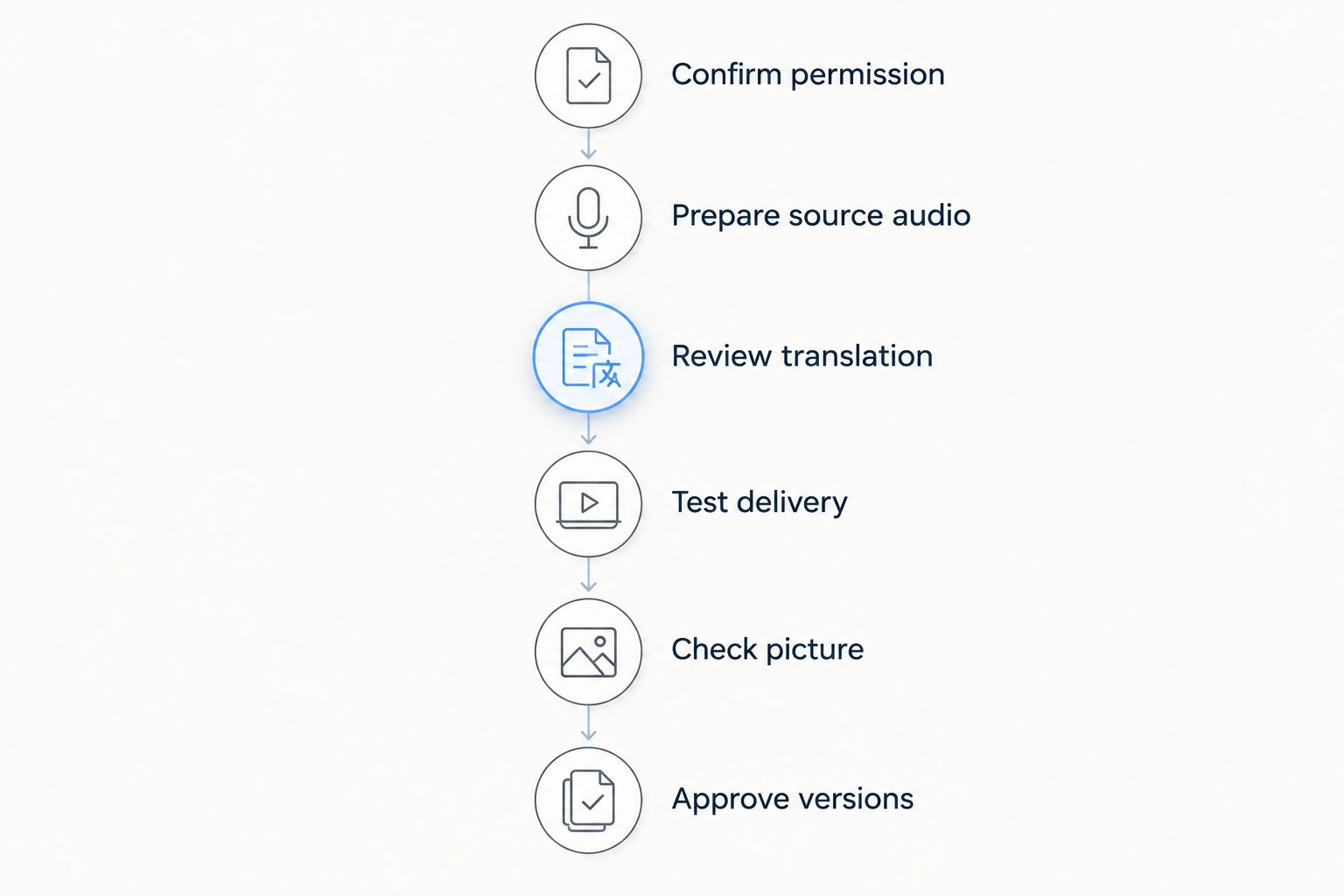
Use this six-step approval sequence for a 2026 project. It is a production checklist, not a promised performance standard. Keep the source recording available throughout review so nobody judges the dub in isolation.
1. Confirm permission
Get explicit permission for synthetic voice use before creating or commissioning a clone. Record the intended languages, distribution channels, permitted uses, and approval responsibilities. Treat this as a production requirement, not a conclusion about what every jurisdiction legally requires.
Ask the provider how recordings and voice models are retained, reused, and removed. Read the terms that apply to your project. Permission to publish an interview should not be treated as permission to generate new speech in that person’s voice.
2. Prepare source audio
Use the cleanest available recording of the speaker. Separate dialogue from music and effects where possible, and identify passages with overlapping voices or heavy noise. Document those problems before evaluating the generated result.
Do not make the workflow depend on repairing every source defect automatically. If a passage is unclear, confirm the wording with the speaker or production team. A confident transcription of the wrong sentence gives the translation the wrong starting point.
3. Review translation
Have a qualified target-language reviewer check meaning before you judge the voice. Verify names, technical terms, qualifications, and calls to action. Keep approved terminology beside the script so corrections stay consistent across scenes.
Translate the message rather than forcing every source-language word into the same position. Different languages organize information differently. If the approved translation does not fit the scene naturally, revisit the wording or edit rather than accepting strained delivery.
4. Test delivery
Choose a representative passage containing the real difficulties of the film. Include emotional changes, important names, or dense explanations when those appear in the source. An easy introductory sentence is not enough to approve a demanding interview.
Review the passage with a target-language listener and, where practical, the original speaker. Ask separate questions about identity, pronunciation, and intent. Keep those judgments distinct so a strong voice resemblance does not hide a translation problem.
5. Check picture
Watch the dubbed passage in the actual edit. Check pauses, sentence endings, visible speech, and transitions into other speakers. Audio that sounds acceptable alone still needs to work against the picture.
Review the mix as well as the isolated dialogue. Music and effects should not mask errors or make speech difficult to understand. If the edit must change to accommodate the translation, approve that change before producing the remaining versions.
6. Approve versions
Record which script, language, audio file, and video edit received approval. Keep unresolved issues attached to the relevant passage. Avoid a vague approval message that leaves the team guessing which export it covers.
Repeat the review when wording or delivery changes. Approval belongs to a specific version, not permanently to a voice model. Archive the approved source and localized materials together so later edits have a clear reference.
Why original-speaker voice preservation varies
The outcome depends on more than the voice model. For a 2026 brief, use these factors to identify what needs testing rather than assuming every language version will behave alike.
- Source clarity. Noise, overlapping speakers, and unclear words complicate the material you are asking the workflow to reproduce. Flag difficult passages before production.
- Language differences. Word order, pronunciation, and sentence length change across languages. Judge natural delivery in the target language instead of demanding identical timing everywhere.
- Performance demands. Humor, grief, excitement, and understated delivery need different review questions. Test the emotional range actually present in your film.
- Terminology. Names, acronyms, and specialized vocabulary need an approved pronunciation reference. Do not leave critical terms to an unchecked first output.
- Picture constraints. A close-up of a speaking face makes timing differences visible. Decide whether the edit can change before treating the source picture as fixed.
- Review coverage. A source-language producer cannot replace a qualified target-language listener. Assign responsibility for meaning, delivery, and the final picture separately.
When should you keep the original audio instead?
Keep the original audio when the actual recorded performance is the point. A personal testimony, sensitive statement, or performance-led scene deserves a deliberate decision about whether synthetic replacement serves the audience.
Subtitles preserve the original sound while making the words accessible in another language. The trade-off is reading: viewers must divide attention between the text and the picture. Check that this suits the intended placement and audience.
Human dubbing offers a different route when directing the target-language performance matters more than matching the original voice. The trade-off is explicit: a new performer replaces the speaker’s vocal identity. Neither approach should be presented as preserving something it changes.
For brand video, choose the method scene by scene when necessary. A narrated explanation and a personal interview do not need identical treatment. Keep the decision consistent with the purpose of each passage, not simply with the first tool selected.
Can AI dubbing keep someone’s accent in another language?
Accent preservation is not guaranteed by voice resemblance. A generated voice can sound like the speaker while using different pronunciation patterns in the target language. Decide whether retaining an accent supports the message or makes comprehension harder.
Ask target-language reviewers about intelligibility and unintended pronunciation changes. Do not treat a retained accent as inherently more authentic. The speaker should also approve how their identity is represented.
Does a voice clone preserve the speaker’s emotion?
A voice clone does not guarantee preservation of the speaker’s emotion. Vocal identity and emotional delivery are different approval questions, and both need checking against the source scene.
Listen especially to qualifications, jokes, and emotionally sensitive lines. A misplaced emphasis can change what listeners understand even when every translated word is acceptable. Reject the passage if the emotional meaning no longer fits.
What should you ask a production partner to deliver?
Request an approved target-language script, a representative dubbed scene, and a clear review record before expanding the work. Specify who checks translation, who approves voice likeness, and who signs off on the final film. This makes responsibility visible before revisions begin.
Ask for editable project materials where your agreement provides for them, plus clearly named final exports. Confirm whether subtitles, separate dialogue tracks, or revised picture edits are included in the scope. Do not assume that dubbing includes every localization deliverable.
Production Soup’s film production and creative services provide a starting point for discussing a wider brand-video project. Bring the source film, intended languages, distribution plan, and speaker permissions to that discussion; request a test rather than assuming voice preservation is assured.
FAQ
Can AI dubbing preserve my original voice in another language?
AI dubbing can preserve recognizable qualities of your voice, but it generates a new performance. Approve a sample for vocal identity, meaning, pronunciation, and timing before using the full dub.
Is AI dubbing the same as voice cloning?
AI dubbing and voice cloning are different tasks. Dubbing replaces dialogue for a language version; voice cloning creates a synthetic approximation of a particular speaker’s voice and can be part of that workflow.
Will an AI dub sound exactly like the original recording?
An AI dub is not the original recording and should not be treated as an exact match. Translation changes the spoken material, while generated delivery needs separate review.
Do I need the speaker’s permission to clone their voice?
Get explicit speaker permission before commissioning synthetic voice use. Document the intended scope and obtain legal advice for the jurisdictions and agreements relevant to your project.
Can I approve a dubbed video without speaking the target language?
You should not approve translation accuracy without a qualified target-language reviewer. You can review the picture and production requirements while that reviewer checks meaning, pronunciation, and natural delivery.
Are subtitles better than AI dubbing for preserving a voice?
Subtitles preserve the actual recorded voice because they leave the original audio in place. AI dubbing offers spoken translation but replaces that recording with generated speech.
Does Production Soup work with traditional production and AI-generated video?
Production Soup works across traditional film production and AI-generated video. For a dubbing brief, confirm the specific language, permissions, testing, and review requirements before agreeing on the production scope.
One last thing
Run a picture-off review before signing off on your 2026 dub. Listen without watching the speaker, then watch the same passage with the audio muted. Finally, review both together.
This separates delivery problems from visible timing problems. If the voice sounds right but the meaning feels wrong, the dub is not finished. Fix the passage rather than letting resemblance become the approval standard.