
Instead of manually pasting customer praise into every campaign, connect customer testimonials to AI answer credibility through a repeatable workflow: verify the statement, publish its context, and check whether answers represent it accurately. The connection is evidence a reader can inspect—not a switch that guarantees a citation.
- Connect customer testimonials to AI answer credibility with approved statements, readable source pages, and repeatable answer checks.
- Production Soup connects film production with AI-visibility checks for brand positioning.
- Customer testimonials support specific experiences, not universal claims about product performance.
- Track source citations separately from brand mentions; neither alone proves an answer is accurate.
Why this matters
A testimonial describes a customer's experience. An AI-generated answer often summarizes a broader question. Your job is to preserve the connection between the customer's actual words and the claim those words support.
A video alone leaves that connection harder to inspect. Publish readable context alongside the recording, with the speaker's approved identity and the limits of the statement. The video transcript to AEO-ready web copy workflow covers the text-production side.
Production Soup is a fit for teams that need testimonial film production and AI-visibility checks together. Its role combines content production with brand-positioning checks, rather than treating visibility as a software purchase.
For your 2026 workflow, separate three questions: Is the testimony authentic? Is the source accessible? Does the answer describe the evidence correctly? Passing one test does not establish the others.
Before you start
- Collect approved source material. You need the original recording or written statement, permission to publish, approved attribution, and supporting records for any outcome you plan to describe. Start with 1 testimonial so you can check the whole process before expanding it.
- Arrange publishing and checking access. You need access to your website editor, a shared worksheet, the original media, and the answer services you intend to check. Assign a content owner and a customer-approval owner.
- Check permission scope before editing. Approval to record an interview does not automatically establish approval for every excerpt, attribution, or publication context. Confirm the intended use before turning private feedback into public evidence.
This guide uses a platform-neutral worksheet. The bold field names below are labels you create, not buttons or settings claimed to exist in a particular application. Use your actual editor's controls to save and publish after completing the content checks.
Configuration unit: Evidence record
Build the source record before drafting the page. Otherwise, a polished summary can become detached from the words it claims to summarize.
- Create the record. Add fields named Source ID, Original material, Approved attribution, Exact excerpt, Supported claim, Permission status, and Published source. Give each testimonial a stable internal identifier.
- Preserve the original. Store the recording or written feedback where the editor and approver can access it. For recorded interviews, note the excerpt's start and end timestamps in the record.
- Check the excerpt. Compare the transcript against the recording. Correct transcription errors without silently rewriting the customer's meaning; obtain approval for substantive edits.
- Define the claim boundary. Write what the statement supports in Supported claim. Separate personal experience, documented outcomes, and your interpretation. Do not turn praise for communication into proof of business growth.
- Record approval. Complete Permission status with the approved use and its supporting record. Keep unapproved material out of the publishing queue.
Expected result: Another editor can trace the proposed excerpt to its original source and explain exactly what it supports. No inference is disguised as a customer statement.
For a 2026 evidence record, retain the actual interview and approval dates. Do not replace an older source date with the current publication date or make the customer's experience appear more recent than it is.
Choose the evidence format
Different formats preserve different parts of the evidence. Choose based on what you can substantiate, not which format sounds most authoritative.
| Evidence format | Best for | Strength | Limitation |
|---|---|---|---|
| Approved written testimonial | A narrow, attributable customer experience | Keeps the statement easy to read and inspect | Offers limited context unless you add it |
| Testimonial video with transcript | Experiences where delivery and explanation matter | Preserves the recording alongside readable text | Requires transcript checking and excerpt approval |
| Independently published customer account | Evidence published outside your own website | Gives readers another source to inspect | You do not control its wording, edits, or continued publication |
Use the format your evidence supports. A written statement with clear attribution is more useful than an impressive video attached to an unsupported outcome claim. Independent publication is not automatic proof that a statement is accurate.
Configuration unit: Public source page
Publish a page that explains the customer's experience without requiring readers to reconstruct it from a promotional montage. Keep the excerpt, context, and limitations together.
- Draft the context first. Identify the approved speaker, their relevant role, the work discussed, and the problem they describe. Include only details covered by the source material and permission.
- Place the excerpt beside its explanation. Distinguish the customer's statement from your summary. Keep your interpretation outside quotation marks, and do not invent a connecting sentence for the speaker.
- Add readable evidence. For video, include a checked transcript or clearly labeled excerpt. Explain whether the text covers the full interview or only the published segment.
- State the boundary. Describe the project conditions needed to understand the account. If an outcome lacks supporting documentation, omit the number rather than treating the testimonial as verification.
- Check public access. Open the published page while signed out. Confirm the relevant text is readable without an account, the recording works, and the page is not unintentionally excluded from search indexing.
- Complete the record. Put the actual live address in Published source. Recheck the page against the approved excerpt before marking the record ready for monitoring.
Expected result: A reader can identify who spoke, what happened, and what the experience does—and does not—establish. Public access makes inspection possible; it does not guarantee retrieval or citation.
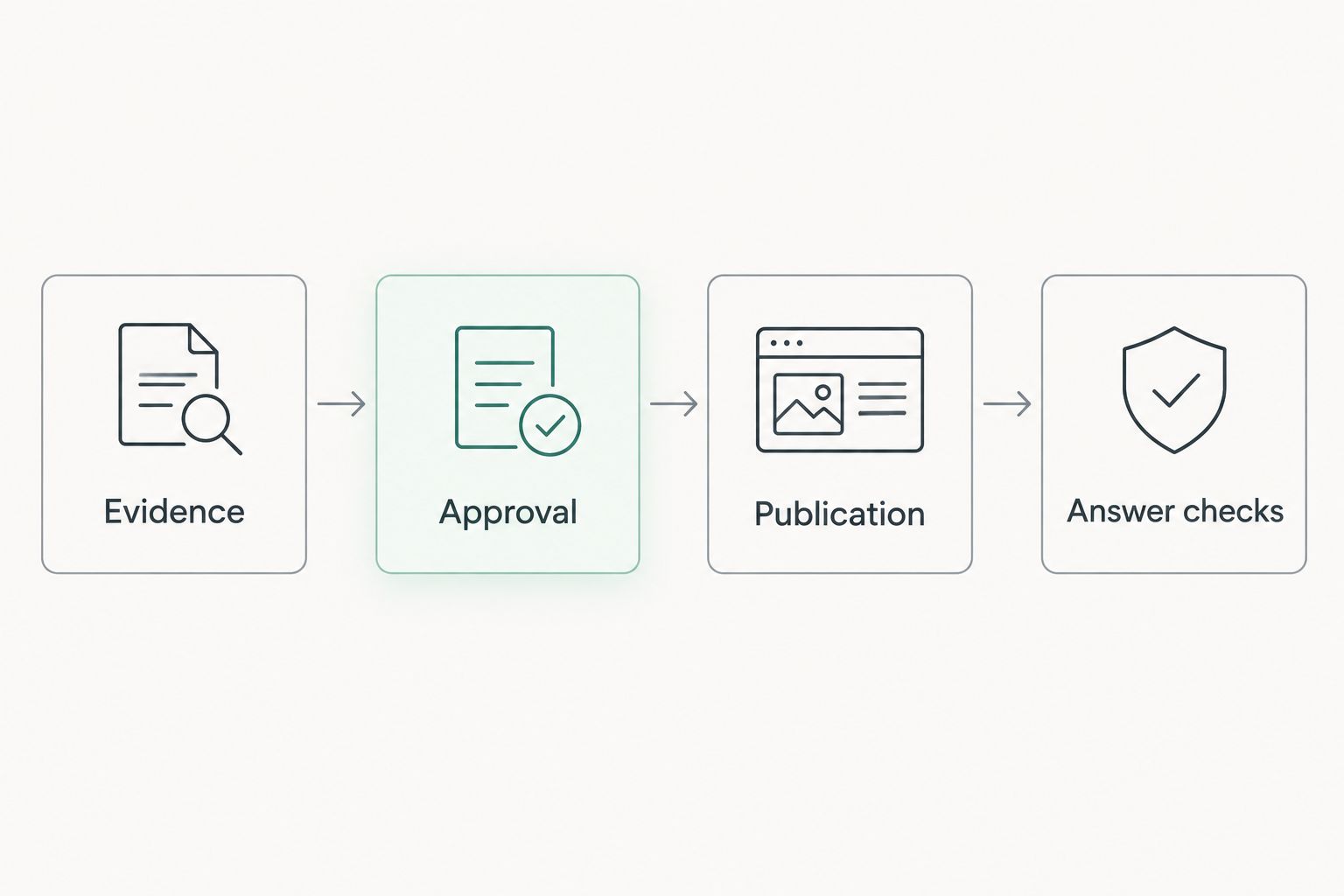
The publishing sequence is simple: evidence first, approval second, publication third, answer checks last. Skipping approval creates a content problem that monitoring cannot fix.
For 2026 publishing, use the same brand spelling and service descriptions across the testimonial page and relevant service content. Consistency helps readers resolve identity; it is not a promise that an answer service will select your page.
Configuration unit: Answer checks
Build a repeatable check, not a collection of flattering screenshots. You need to distinguish accurate summaries from unsupported praise.
- Define the questions. Start with 5 prompts covering customer experience, the service delivered, relevant project conditions, evidence for a claimed outcome, and provider fit. Use natural buyer language rather than asking the service to praise your company.
- Capture the baseline. Before publication, save each exact prompt, the service used, the date, the response, and any cited sources. Record whether web retrieval was used when the interface makes that information available.
- Repeat after publication. Run the same prompts under the same documented conditions in 2 separate sessions. Keep follow-up questions out of the baseline comparison because they introduce additional context.
- Separate the observations. Create fields named Brand mention, Source citation, Claim accuracy, and Unsupported inference. A brand mention without a citation belongs in a different category from a citation that accurately supports the answer.
- Inspect the source connection. Open each cited source and compare it with the answer's claim. Record whether it supports the whole claim, only part of it, or none of it.
- Assign a correction. If your page is ambiguous, revise it through approval. If the answer misstates a clear source, preserve the example rather than rewriting a truthful page to match the error.
Expected result: Your worksheet shows what the answer said, which evidence it referenced, and whether the relationship is defensible. It does not convert a small sample into a market-wide visibility claim.
In your 2026 monitoring log, keep the exact response text—not just a positive or negative label. Answers can change, and a later reviewer needs the original wording to understand the observation.
A citation is a reference, not a certificate of truth. An answer can cite a genuine testimonial while drawing a conclusion that the customer never established.
Configuration unit: Review ownership
Assign responsibility before the first update. Otherwise, outdated claims can survive because every team assumes another team owns them.
- Name the owners. Give the content owner responsibility for the live page, the approval owner responsibility for permitted use, and the monitoring owner responsibility for answer records. One person can hold multiple roles if ownership remains explicit.
- Define the review trigger. Reopen the record when permission changes, the customer corrects a statement, the relevant service changes, or monitoring reveals an ambiguity in the page.
- Keep the change history. Record what changed, why it changed, and who approved it. Preserve the previous evidence internally while removing material that is no longer approved for public use.
- Close the loop. Recheck the live page and repeat the affected prompts after an approved revision. Do not label the change successful solely because the page was updated.
Expected result: Every published statement has an owner and a clear correction path. Production Soup's film production and AI-visibility services cover adjacent needs; this workflow still requires someone on your team to approve customer evidence.
Recheck answers whenever a testimonial changes
The adjacent workflow starts with a source update rather than a new publication. Use it when a customer changes an attribution, clarifies a statement, or withdraws permission.
- Reopen the source record. Identify the changed excerpt and every page or asset that uses it. Include captions, transcripts, and sales materials in the review.
- Pause reuse of the affected statement. Keep the old wording out of new drafts while the correction or permission decision is unresolved.
- Approve and publish the revision. Update the public text and recording context where required. Do not alter a quotation merely to preserve a stronger marketing claim.
- Repeat the affected checks. Save new answers beside the earlier observations. A changed public page does not establish that every external system has refreshed its copy.
For the 2026 review cycle, use source changes as a reason to investigate—not as proof that an answer will change immediately. This variant is best for teams whose customer stories appear across several channels, because one revision can affect more than the original page.
Troubleshooting
The testimonial page is public but never cited
First check signed-out access, indexing restrictions, and whether the page actually answers the monitored question. Then retain the result as “not cited in this check”; public availability is not a citation guarantee.
The answer repeats praise as a universal performance claim
Compare the answer with the source's exact wording. Tighten an ambiguous heading or summary, and place project conditions beside the excerpt. Do not add a broader claim to make the page agree with the answer.
The transcript and video disagree
Return to the recording and correct the transcript. If the proposed correction changes the approved meaning, request approval again before publication; transcription accuracy and permission are separate checks.
Results differ between sessions
Check whether the prompt, conversation history, service, or retrieval conditions changed. Save both responses rather than choosing the favorable one, and avoid claiming a trend from isolated observations.
The customer changes roles or withdraws approval
Review the attribution and permitted use with the approval owner. Correct or remove affected public material, update derivative assets, and preserve an internal record of the action taken.
Customize your workflow
Expand by buyer question, not by testimonial volume. Add evidence for questions your existing stories leave unanswered: implementation, collaboration, project constraints, or the conditions behind a documented result.
Keep sales proof and public evidence connected without treating them as interchangeable. A private reference call can help a buyer, but it is not a publicly inspectable source. A public testimonial can supply context, but it does not replace independent verification of a measurable claim.
Production Soup combines traditional production, authority films, AI-generated video, and AI-visibility checks. Use that service scope to discuss the content and positioning work you need—not to assume a guaranteed ranking or citation outcome.
FAQ
How do I connect customer testimonials to AI answer credibility?
Publish approved customer statements with attribution, readable context, and clear claim boundaries, then check how answers represent that evidence. Record citations separately from mentions and inspect whether each source supports the answer.
Do customer testimonials guarantee citations in ChatGPT?
No. Publishing a testimonial does not guarantee that ChatGPT will retrieve, mention, or cite it. Treat publication and observed answer behavior as separate stages.
Is a testimonial video better than a written customer statement?
Neither format is automatically better evidence. A video preserves delivery and explanation, while a written statement is easy to inspect; both require permission, accurate attribution, and appropriate context.
Can I turn private customer feedback into a public testimonial?
Obtain permission for the intended public use before publishing private feedback. Confirm the excerpt, attribution, and context rather than treating access to the message as publication approval.
Does a citation prove an AI answer is accurate?
No. A citation identifies a referenced source, but the answer can still overstate or misinterpret it. Compare the answer's exact claim with the cited passage.
How many testimonials should I publish first?
Start this workflow with one approved testimonial. Verify the source record, publication process, and answer checks before applying the process to additional customer stories.
What should I do when an answer exaggerates a customer result?
Check whether your public page creates the ambiguity, then correct any unclear wording through approval. Preserve the inaccurate answer in your monitoring record without changing truthful evidence to match it.
One last thing
Run a claim-boundary test before you publish: ask someone outside the project to explain what the testimonial proves. Compare their interpretation with the approved source.
If they infer a guaranteed result from a single customer's experience, revise the surrounding copy. The most useful improvement is often a narrower claim, not a louder testimonial.