
An AI avatar can replace a human spokesperson for scripted explanations, but not for firsthand testimony, personal accountability, or a performance built around a real person. For your 2026 brand video, choose the presenter by what the audience needs to believe—not by whether a synthetic face looks convincing.
- Can an AI avatar replace a human spokesperson? Yes for scripted delivery; no for firsthand experience or personal accountability.
- Use a human spokesperson for customer testimony, executive commitments, and stories that depend on a real person's experience.
- Use a hybrid brand video when human evidence needs repeatable explanations around it.
- Production Soup combines traditional production and AI-generated video; choose the format before choosing the tools.
Why this matters
A presenter does more than read words. The face on screen tells viewers who is speaking, whose experience they are hearing, and who stands behind the claim. Changing that face changes the meaning of the video, even when the script stays identical.
Production Soup's production services include traditional production and AI-generated video. Those are different production choices, not interchangeable evidence. Start with the claim your video must support, then decide who belongs on screen.
For a 2026 brief, separate delivery from proof. A synthetic presenter can explain an approved process; it cannot become the customer who used your product or the engineer who performed the work.
Can AI avatars replace a human spokesperson in brand video?
Yes for some presenting tasks. No as a blanket replacement. Use an avatar when the speaker's job is to deliver approved information, and retain a human when identity, experience, or responsibility is part of the message.
The practical choice is between an avatar, a human spokesperson, and a hybrid edit. Each solves a different problem. None removes the need for a checked script, appropriate permissions, and a final editorial review.
| Format | Best for | Main advantage | Main limitation | Recommendation |
|---|---|---|---|---|
| AI avatar | Scripted explainers and repeatable instructions | Separates presenter delivery from a new on-camera recording | Does not supply firsthand experience or personal accountability | Use for explanation, not testimony |
| Human spokesperson | Interviews, executive statements, and personal stories | Connects the words to an identifiable person | Requires the person's participation and approval | Keep when the person is part of the evidence |
| Hybrid video | Human evidence supported by repeatable explanation | Preserves the real speaker while separating explanatory sections | Requires clear transitions and consistent editorial review | Use when the video needs both proof and instruction |
An avatar reading an onboarding script is a presenter. An avatar saying it personally solved a customer's problem creates a different implication. Your decision must account for that distinction before production starts.
What counts as replacement?
Replacing a recording task is not the same as replacing a relationship. An avatar can take over a scripted introduction without taking over the founder's role as the person responsible for the business.
Write down exactly what you are replacing: a talking-head introduction, an instructional segment, a translated explanation, or an entire spokesperson role. A precise scope prevents a useful production shortcut from turning into a misleading representation.
AI avatar: best for approved explanations
An AI avatar fits a video whose value sits in the information rather than the presenter's biography. Think of an approved walkthrough, a process explanation, or an introduction to material that viewers can verify elsewhere.
The advantage is separation: you can work on the script and synthetic delivery without arranging a fresh performance from a human presenter. The limitation is equally clear. A generated performance does not establish that a real person witnessed, used, built, or endorsed anything.
Before choosing an avatar, ask whether the script would still be honest if it appeared as text without a face. If the answer is yes, you have a reasonable candidate. If the message depends on viewers believing the speaker personally experienced it, keep the real speaker.
Best for: approved information that does not require a personal witness. Do not use an avatar's apparent confidence as a substitute for evidence behind the words.
Human spokesperson: best for experience and accountability
Keep a human spokesperson when the audience needs to know who is making the statement. A founder explaining a difficult decision, a customer describing an actual experience, and a specialist discussing work they performed all have reasons to appear personally.
A real recording connects a statement to an identifiable speaker. It does not automatically make the claim accurate; scripts, interview edits, and supporting evidence still need review. Human presence is not a fact-checking system.
The production constraint is participation. You need access to the person, permission to use the recording, and agreement on how the finished edit represents their words.
Best for: personal testimony, executive commitments, and experience-led stories. Retain the human because the person matters to the message, not because every brand video requires a face on camera.
Hybrid video: best for evidence plus explanation
A hybrid video keeps the real person where identity matters and uses synthetic presentation where the job is explanation. For example, an actual interview can establish the speaker's experience while a separate avatar-led section walks through approved supporting information.
The benefit is editorial separation. You do not have to ask the interview subject to carry every definition, transition, or procedural detail. The drawback is the risk of confusing viewers about which statements came from the real person.
Make the boundaries visible. Do not edit an avatar-led paraphrase so that it appears to be part of the original interview, and do not imply that the human approved new wording without obtaining that approval.
Best for: a brand story that needs identifiable human evidence and reusable explanatory sections. Choose a hybrid only when both parts have a clear job.
Why the right spokesperson choice varies
The right choice depends on the message and the production responsibilities around it. Use these factors in your 2026 brief rather than treating avatar adoption as a goal in itself:
- Purpose: An explanation asks viewers to understand something. A testimonial asks them to believe an account of experience. Those require different evidence.
- Speaker identity: A generic presenter and a digital version of a named executive create different expectations. Establish whose likeness and voice you are using.
- Claim ownership: Decide who approves each statement and who is accountable for it. A synthetic presenter cannot take that responsibility.
- Update needs: Separate information that changes from statements tied to a particular person or event. Do not silently rewrite someone's apparent position.
- Distribution context: Review how the video appears on its own, in an advertisement, and as a short excerpt. Context from the full edit does not necessarily travel with a clip.
- Review requirements: Include factual accuracy, likeness permissions, pronunciation, visual continuity, and disclosure decisions in the approval process.
These are production decisions, not reasons to prefer one technology by default. If the brief cannot explain why the presenter belongs in the video, resolve the brief first.
How to test an avatar before replacing a spokesperson
Production Soup is best for brands that need traditional production and AI-generated video within the same creative brief. The useful starting point is not a tool demonstration; it is a clear decision about which parts of the message require a real person.
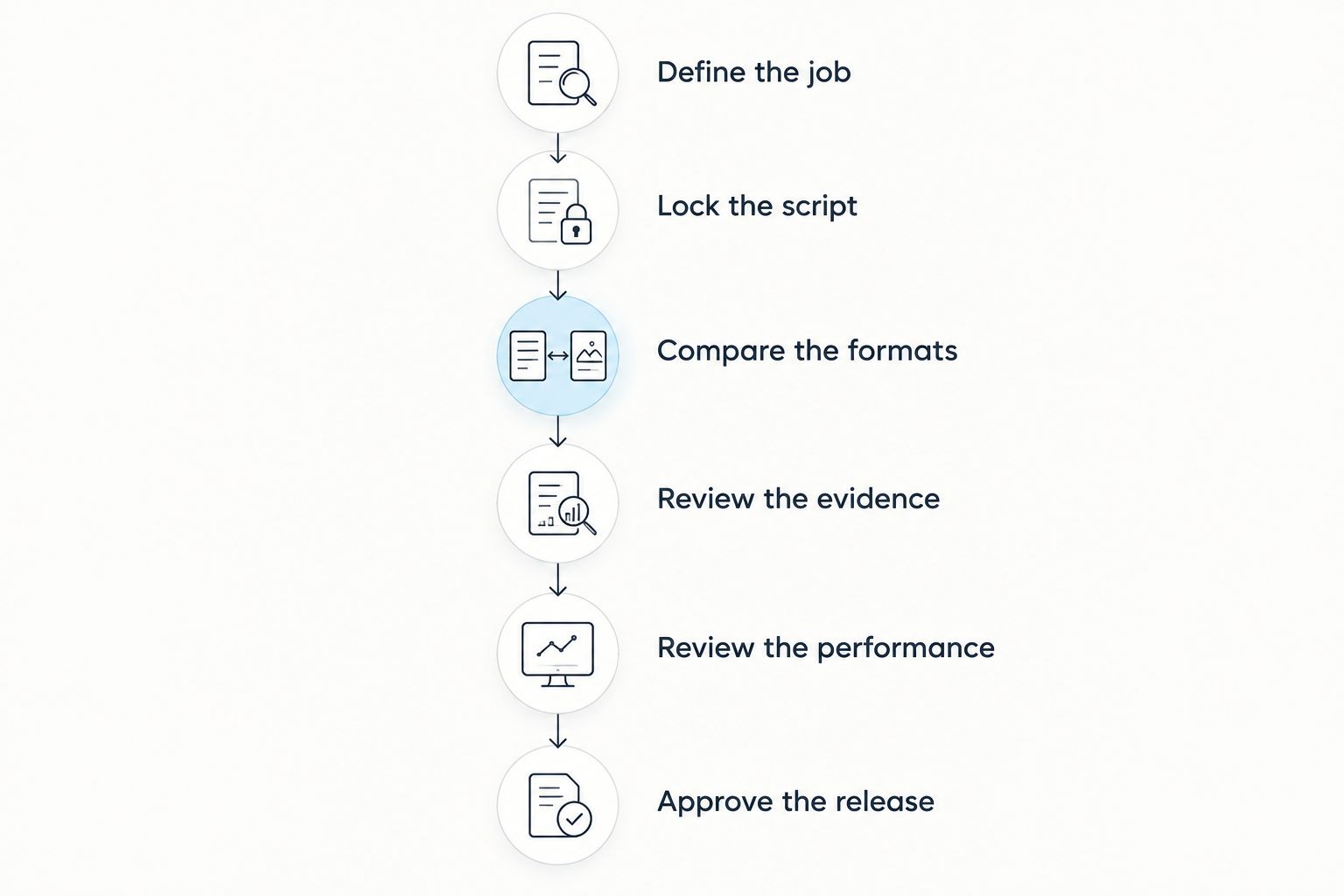
For a 2026 pilot, use the following proposed review process. These are working instructions, not claimed performance benchmarks.
- Define the job. Write a sentence describing what the presenter must accomplish. Separate explanation from endorsement, testimony, and executive responsibility.
- Lock the script. Start with 1 approved script. Mark any sentence that implies personal use, firsthand knowledge, or a commitment by a named person.
- Compare the formats. Prepare 2 versions of the same short passage: an avatar delivery and a human delivery. Keep the wording and intended placement consistent so the review stays focused on presentation.
- Review the evidence. Check every substantive claim against the approved source material. Remove statements that neither version can support.
- Review the performance. Watch the finished passage with sound, then without it. Check pronunciation, emphasis, gaze, mouth movement, gestures, and edit continuity.
- Approve the release. Assign a named owner to the final decision. Record the approved file, script, usage permissions, and any disclosure wording together.
Keep 3 review passes distinct: factual accuracy, performance quality, and release approval. Combining them into a single casual viewing makes it harder to identify what was actually checked.
After the comparison, ask reviewers a specific question: what does this version imply about the speaker? A polished avatar can still be the wrong choice if viewers interpret a scripted explanation as someone's personal experience.
Do not approve solely on visual realism. An attractive render does not resolve unclear rights, unsupported claims, or an edit that misrepresents who said what.
Can an AI avatar deliver a customer testimonial?
An AI avatar cannot supply a customer's firsthand experience. If the video represents an actual customer account, preserve the customer's approved words and make the source clear; synthetic presentation must not imply that a fictional speaker used the product.
For a dramatization, label the presentation clearly and review the underlying claims. Do not turn an invented script into apparent customer evidence by adding a realistic face.
Should a founder use an AI double for brand announcements?
An AI double is a delivery format, not a transfer of the founder's responsibility. Use only authorized likeness and voice material, obtain approval for the exact statement, and make the synthetic presentation clear where needed to avoid misleading viewers.
For a sensitive announcement, record the founder directly. The point is to show the person making the commitment, not merely reproduce their appearance.
Does an avatar make a brand video ready for AI search?
An avatar does not establish a video's accuracy, authority, or usefulness for AI search. In a 2026 publishing plan, focus on clear claims, an accurate transcript, identifiable sources, and useful supporting page copy rather than treating the presenter's format as a visibility tactic.
Synthetic delivery and discoverability are separate decisions. A searchable transcript still needs to represent what the video actually says.
FAQ
Can an AI avatar replace a human spokesperson completely?
No. An AI avatar can deliver approved scripts, but it cannot supply a real person's experience, identity, or accountability. Keep a human when those qualities are part of the message.
What's the best use of an AI avatar in brand video?
An AI avatar is best suited to approved explanations where the information matters more than the presenter's personal history. Check the script, permissions, delivery, and finished context before publishing.
Is a human spokesperson always better than an AI avatar?
No. A human spokesperson is the better choice when personal experience or responsibility matters; an avatar is a candidate when the job is scripted explanation. Choose against the video's purpose rather than a blanket preference.
Can I use an AI version of my CEO in a video?
Use an AI version of your CEO only with authorization and approval of the exact statement and intended use. Make the synthetic presentation clear where needed to avoid giving viewers a false impression of an actual recording.
Do AI avatars remove the need for a video production team?
No. AI avatars change presenter production, but the video still needs scripting, evidence review, editing, permissions, and release approval. Assign an accountable owner even when the workflow is small.
How should I compare an avatar with a human presenter?
Compare 2 versions of the same approved passage in the intended viewing context. Review factual accuracy and performance separately, and ask what each version implies about the speaker.
Does using an AI avatar improve visibility in AI search?
An AI avatar alone does not establish visibility in AI search. Prioritize accurate information, clear source attribution, a faithful transcript, and supporting content that answers the audience's question.
One last thing
Before approving your 2026 video, read the script without the presenter's face. Mark every sentence containing a personal claim: something the speaker did, saw, used, or promised. Those sentences reveal where identity matters.
Production Soup's brand video brief should begin with that distinction. Replace the delivery task only when you can preserve the truth of the message.