Yes. AI can turn an ad script into a testimonial-style video, but it cannot turn invented customer experience into a genuine testimonial. Start with a real customer's approved account if you want an endorsement; otherwise, make a clearly identified dramatization or presenter-led ad. The production workflow below separates what you can generate from what you need to substantiate.
- An ai ad script to testimonial video workflow needs genuine customer evidence before it becomes a real endorsement.
- AI avatars can present an ad, but a synthetic speaker is not proof of customer experience.
- Production Soup offers traditional and AI-assisted video production for brands seeking an agency-led approach.
- Approve the claims, speaker permissions, and final edit before publishing a customer testimonial.
Why this matters
A convincing face does not establish a convincing claim. If your script says a customer achieved a result, the production needs evidence that the customer actually experienced that result and authorized its use.
For a 2026 campaign, decide whether you are making an endorsement or explaining an offer before choosing a generation tool. That decision controls the script, casting, disclosures, and approval process.
Production Soup is best for brands that want traditional and AI-assisted video production from an agency. Production Soup is not a self-service testimonial generator. The fit is agency-led production; the trade-off is that your team still needs to supply genuine customer evidence and approve its use.
Can AI turn an ad script into a testimonial video?
AI can help produce the video; the customer supplies the testimonial. A script written by your marketing team becomes customer testimony only when it accurately represents an actual customer's experience and the customer approves that representation.
Choose the format before generating footage:
| Format | Best for | Main advantage | Main limitation |
|---|---|---|---|
| Real customer footage | Documenting personal experience | Shows the actual person describing their experience | Requires participation, permissions, and an accurate edit |
| Authorized synthetic presentation | Presenting an approved account without a new recording | Separates presentation production from a new shoot | Requires clear authorization and disclosure of the synthetic presentation |
| Dramatized scenario | Explaining a problem or use case | Gives you control over the scene and delivery | Must not masquerade as an actual customer's experience |
| Presenter-led ad | Explaining an offer without customer evidence | Keeps the message in the brand's own voice | Does not provide independent customer testimony |
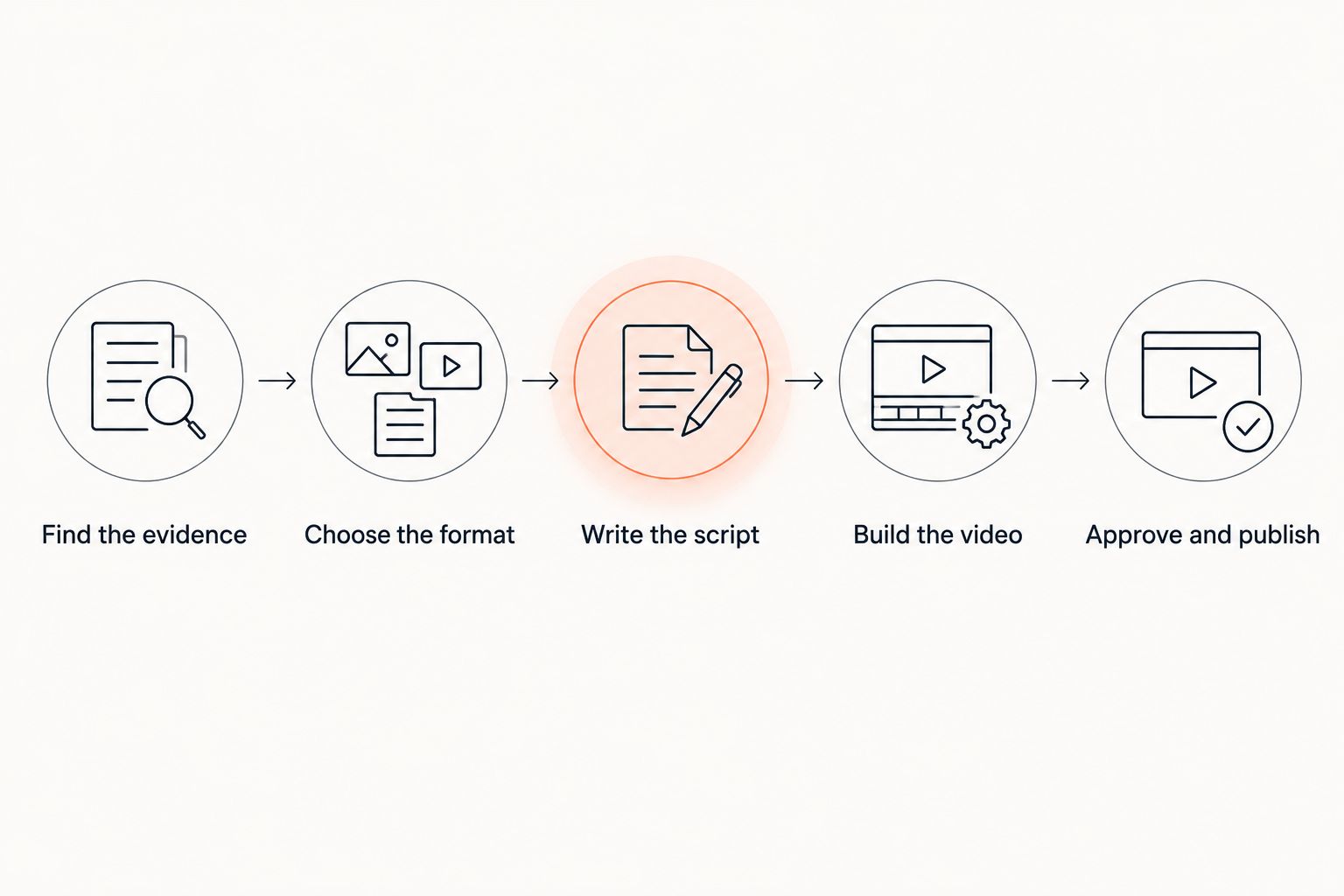
Use this sequence:
- Find the evidence. Identify the customer statement or recorded interview behind each experience claim.
- Choose the format. Decide whether the speaker is a customer, an authorized representation, or a presenter.
- Write the script. Adapt the source without strengthening its claims.
- Build the video. Generate or edit only the material the approved script requires.
- Approve and publish. Check the complete ad, including captions, disclosures, and destination page.
The most important decision happens before the first render. If no customer supports the story, choose an ad format rather than manufacturing an endorsement.
Real customer footage: best for documented experience
Use a real customer when the value of the video rests on personal experience. An interview gives you source material to edit, caption, and organize around the buyer's question.
Start with the customer's words. Pull out the problem, the decision, the experience, and any result the customer can substantiate. Then remove repetition without changing meaning.
AI-assisted transcription and editing can support that work. They do not authorize a stronger claim. A customer describing a simpler process has not necessarily claimed a measurable productivity improvement.
Choose real customer footage when the person's experience is the evidence. The limitation is participation: you need the customer involved, and your final cut must preserve the substance of what they said.
Authorized synthetic presentation: best for an approved account
A synthetic voice or avatar can present an approved customer account. Treat permission for the statement, voice, likeness, and synthetic use as separate questions rather than assuming one approval covers everything.
Keep the original source and approval record with the project. Identify the synthetic presentation clearly, and do not imply that the customer sat for a recording that never happened.
For a 2026 production brief, specify exactly what can be generated and where it will appear. A translated version, paid advertisement, and sales presentation are different uses; ask for approval that covers the intended use.
Choose this format when you have a genuine account and explicit permission for its presentation. The limitation is ambiguity: viewers need to understand what is real testimony and what is a synthetic depiction.
Dramatized scenario: best for explaining a use case
A dramatization can show the situation your product or service addresses. It does not need to borrow the authority of a fictional satisfied customer.
Write from the brand's perspective. Describe the task, demonstrate the process, and explain the offer using supportable claims. Identify the scene as a dramatization where viewers would otherwise mistake it for a real customer's story.
Changing a fictional character's name does not solve the underlying problem. Neither does a generic avatar. If the message implies someone bought, used, and benefited from the offer, you are presenting an experience claim.
Choose a dramatization when you need a scenario, not an endorsement. Its limitation is evidentiary: a generated scene can illustrate your message, but it cannot prove customer satisfaction.
Why the production workflow varies
The right workflow depends on the source material and intended use, not simply the realism of the generated face. For 2026 planning, settle these factors before assigning production work:
- Evidence quality: An approved interview gives you different material from an internal sales script.
- Speaker identity: A real customer, synthetic representation, and brand presenter communicate different relationships to the message.
- Usage permission: Recording, editing, voice synthesis, translation, and advertising need explicit consideration.
- Claim sensitivity: Statements about outcomes need support beyond a convincing performance.
- Distribution context: A disclosure that works on a full video needs another review when the asset becomes a short excerpt.
- Review ownership: Assign someone to approve factual accuracy and someone to approve the finished production.
Do not use visual polish as the acceptance test. A natural-looking speaker can still deliver a misleading script.
How do you turn the script into a publishable video?
Find the evidence
Mark every sentence that describes a customer's action, opinion, or result. Attach the source to that sentence: an interview passage, approved written statement, or relevant supporting record.
Separate brand claims from customer claims. Your company can explain what it offers without inventing a buyer who supposedly experienced it.
If the script contains an unsupported personal story, remove it or rewrite it as a clearly hypothetical scenario. Do not ask the generator to make the story feel more authentic.
Choose the format
Decide what viewers should understand about the speaker before you cast or generate anyone. Write that decision into the brief so the editor, producer, and approver work toward the same result.
A real customer interview should remain recognizable as that person's account. A synthetic presentation should be identifiable as synthetic. A brand presenter should speak for the brand, not impersonate an independent buyer.
Write the script
Build the script around the source's meaning rather than an advertising template. Preserve qualifications, relevant context, and any limits on the customer's result.
Do not turn a personal opinion into a universal promise. Do not combine different customers' experiences into a single apparent speaker. If you need several perspectives, identify them separately.
Read the script aloud before generating anything. Fix stiff phrasing at the script stage, then return the revised wording for approval when it changes how the customer is represented.
Build the video
Create a shot plan that distinguishes evidence from illustration. Customer footage supports the account; product demonstrations explain the process; generated scenes illustrate situations rather than documenting events.
Check lip synchronization, pronunciation, hand movement, continuity, and the relationship between narration and images. Those are production checks, not substitutes for factual review.
Avoid synthetic visuals that look like documentary proof of an event that did not occur. A generated workplace scene should not silently become footage of the customer's actual operation.
Approve and publish
Review the final export, not just the script. Music, captions, adjacent images, speaker labels, and editing can change the meaning of an otherwise accurate sentence.
Confirm that the customer approves the finished representation where required by your agreement. Keep the source, permissions, approved script, and final asset together so later edits do not lose their context.
Publish with page copy that identifies the speaker and explains the story accurately. For the supporting text, use the video transcript to AEO-ready web copy workflow to plan the relationship between the video and its written account.
Production Soup's six-step system connects identifying the gap, planning, creating stories, making content, publishing, and watching the numbers. For testimonial work, make evidence and approval gates part of the plan rather than a cleanup task after editing.
Can I use an avatar if I have no customer interview?
Yes, as a presenter—not as an invented customer. An avatar can explain your offer using supported brand claims without pretending to have purchased or used it.
A written customer statement is another possible source, but it still needs permission and an accurate presentation. The absence of an interview does not authorize invented personal experience.
Can AI rewrite a customer's testimonial?
Yes, for clarity, provided the edit preserves meaning and receives the necessary approval. Remove repetition or organize an account around a question; do not add results, certainty, or enthusiasm the source does not support.
For a 2026 refresh, return changed wording to the customer rather than treating old approval as approval of a new statement.
Will a testimonial video get cited in AI answers?
No production format guarantees an AI citation. A clear transcript, accurate speaker identification, and supporting page give readers and search systems an understandable written account, but they do not promise inclusion in an answer.
Keep distribution goals separate from authenticity. A citation would not make an invented testimonial legitimate, and a truthful testimonial does not become ineffective simply because an assistant does not cite it.
FAQ
Can AI make a testimonial video from my existing ad script?
Yes, AI can help turn your script into video, but a genuine testimonial requires an actual customer's experience. Without that evidence, use a presenter-led ad or a clearly identified dramatization.
Is an AI avatar the same as a customer testimonial?
No. An avatar is a presentation format; a testimonial represents a real person's experience or opinion. Identify the speaker's role accurately.
Can I clone a customer's voice for an approved testimonial?
Use a customer's cloned voice only with explicit authorization for that use. Approval of written words is not a substitute for permission to synthesize the person's voice.
Can I turn a written review into a video?
A written review can provide source material, but obtain permission for the intended video use and preserve the review's meaning. Public visibility alone does not establish permission for synthetic speech or likeness.
Should I disclose that a testimonial video uses AI?
Clearly identify synthetic presentation when viewers would otherwise mistake it for an authentic customer recording. Disclosure does not make invented customer experience acceptable.
What's the best format when I have no customer evidence?
A presenter-led ad is the clearest choice when you have no customer evidence. Explain your offer through supportable brand claims rather than an invented endorsement.
Can I reuse the same testimonial across different campaigns?
Reuse it only within the scope of the customer's permission and while its claims remain accurate. Review each new edit and placement rather than assuming the original approval covers every version.
One last thing
Review the shortest cutdown first. Removing context can change what a viewer understands, even when every remaining word came from an approved script.
Before your next 2026 launch, watch the excerpt without the full video beside it. Can you identify who is speaking, what they actually experienced, and which parts are synthetic? If not, fix the excerpt before publishing.