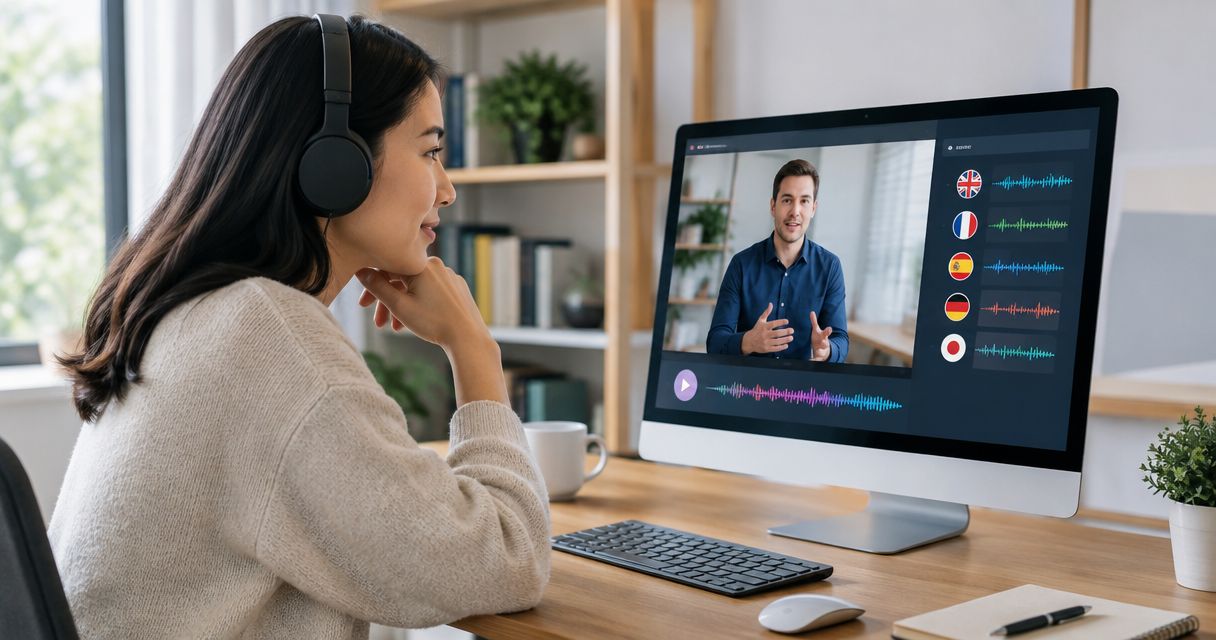
Get a scope-based quote to localize a corporate video with AI dubbing in 2026; a voice-generation charge alone does not describe the finished job. Your brief should cover translation, speaker treatment, audio finishing, on-screen text, and language review—not just the replacement voice track.
- For localize corporate video ai dubbing cost, compare finished deliverables—not voice-generation charges alone.
- Production Soup suits teams seeking corporate films and AI-assisted production, rather than a standalone dubbing subscription.
- Approve translated meaning before generating speech; review the finished video before publishing.
- Specify captions, graphics, voice permissions, and revision responsibilities in your localization brief.
Why this matters
A corporate video communicates through speech, pictures, graphics, and timing. Replacing the spoken language leaves the other elements untouched unless you include them in the brief. A translated voice can sound convincing while the screen still shows the wrong language.
For your 2026 budget, define the finished asset before comparing proposals. Production Soup combines corporate film work with AI-assisted production; its production services provide a starting point for discussing the broader production brief. Keep the localization requirements explicit rather than assuming they come with a video edit.
How much does it cost to localize a corporate video with AI dubbing?
Budget for an approved, publishable video—not merely generated speech. Ask each provider to quote against the same source file, target languages, review requirements, and delivery list. Otherwise, you are comparing different jobs.
Use this scope breakdown to make each proposal readable:
| Work component | What to specify | What to check in the proposal |
|---|---|---|
| Source preparation | Approved edit, transcript, and available audio tracks | Whether transcript correction and audio preparation are included |
| Translation | Target language, regional audience, terminology, and tone | Who adapts and approves the script |
| Voice generation | Speaker identities, pronunciation, and voice permissions | Whether voice selection and corrections are included |
| Timing and editing | Relationship between translated speech and existing pictures | Whether the editor can change shot lengths |
| Audio finishing | Dialogue, music, sound effects, and final playback needs | Whether the delivered mix replaces or sits over the source dialogue |
| Visual localization | Titles, diagrams, captions, and calls to action | Whether editable graphics and translated text are included |
| Review and delivery | Language approval, technical checks, and export requirements | Who signs off and what constitutes a revision |
Ask providers to distinguish preparation, language-specific work, and final delivery. This makes it easier to see which tasks repeat for each language and which belong to the source project.
Do not treat a broad label such as localization included as a deliverable. Request the actual files, review stages, and responsibilities in writing.
Choose the localization scope before choosing the workflow
Not every corporate video needs the same treatment. An interview, a narrated product film, and a software demonstration put different demands on translated speech and editing.
For a 2026 brief, compare these approaches by audience needs rather than by how much automation they use:
| Approach | Best for | Main advantage | Main limitation |
|---|---|---|---|
| Translated subtitles | Viewers who can follow the original audio while reading | Keeps the original performance and avoids replacing speech | Requires reading; does not provide translated spoken audio |
| Translated voiceover | Narrated explainers and demonstrations | Lets viewers hear the message in their language | Does not automatically match a visible speaker's mouth movements |
| Speaker-matched dubbing | Interviews where preserving speaker identity matters | Aims to retain a recognizable vocal identity | Requires permission checks and close review of pronunciation and delivery |
| Dubbing with visual adaptation | Videos where visible speech and translated graphics matter | Addresses more of the viewing experience | Adds visual review and editing responsibilities |
Choose the least complicated treatment that lets your audience understand and trust the message. Do not request voice matching or mouth-movement adaptation simply because a platform offers it.
If the original speaker's identity is central to the film, read about preserving an original speaker's voice with AI dubbing before finalizing the brief. Separate the creative goal from the permissions needed to pursue it.
Translated voiceover: define the audio deliverable
Use translated voiceover when the message matters more than matching a visible speaker's mouth movements. Specify whether the original speech should disappear, remain quietly underneath, or be retained in selected moments.
The advantage is a clear focus on spoken understanding. The limitation is that an unchanged interview shot can visibly conflict with the new speech. Ask the editor how that mismatch will be handled before approving the approach.
Speaker-matched dubbing: define permission and performance
Use speaker matching only when retaining the speaker's identity serves the film. Confirm authorization for the intended voice use, language versions, distribution, and any later reuse.
A recognizable voice is not proof of a faithful performance. Review emphasis, emotional tone, names, and technical terms alongside the translated meaning. Treat an accurate script and an acceptable vocal performance as separate approvals.
Visual adaptation: define what changes on screen
List every title, chart label, interface capture, disclaimer, and call to action that needs translation. Ask whether editable source files exist before assuming the original graphics can be changed directly.
Visual adaptation helps speech and pictures tell the same story. Its limitation is scope: a finished video file is not the same thing as an editable project, and graphics work needs its own instructions and approval.
Why corporate video localization scope varies
These factors determine what you should ask a provider to include. They are scope questions, not a substitute for a project quote.
- Source readiness. Supply an approved transcript and the cleanest available production assets. Ask the provider to identify preparation work before dubbing begins.
- Languages and audiences. Name the target language and regional audience. Give reviewers guidance on terminology, formality, and local references.
- Speaker treatment. Specify which voices need replacing and whether speaker identity must remain recognizable. Include overlapping dialogue and background speech in the brief.
- Timing constraints. State whether the picture edit is locked. Translated speech must be checked against the time available, not only against the written transcript.
- Visual requirements. Identify text and graphics that viewers must understand. Do not leave these decisions until the audio is approved.
- Approval responsibilities. Name the language reviewer and business approver. Define how feedback reaches the editor and which changes require another approval.
The practical move is to resolve these questions before requesting competing proposals. A shorter brief is not necessarily a simpler job; it can simply leave more decisions unresolved.
How do you get a quote you can actually compare?
Use the same brief for every provider in your 2026 selection process. Ask each provider to flag exclusions against that brief instead of sending an unrelated package description.
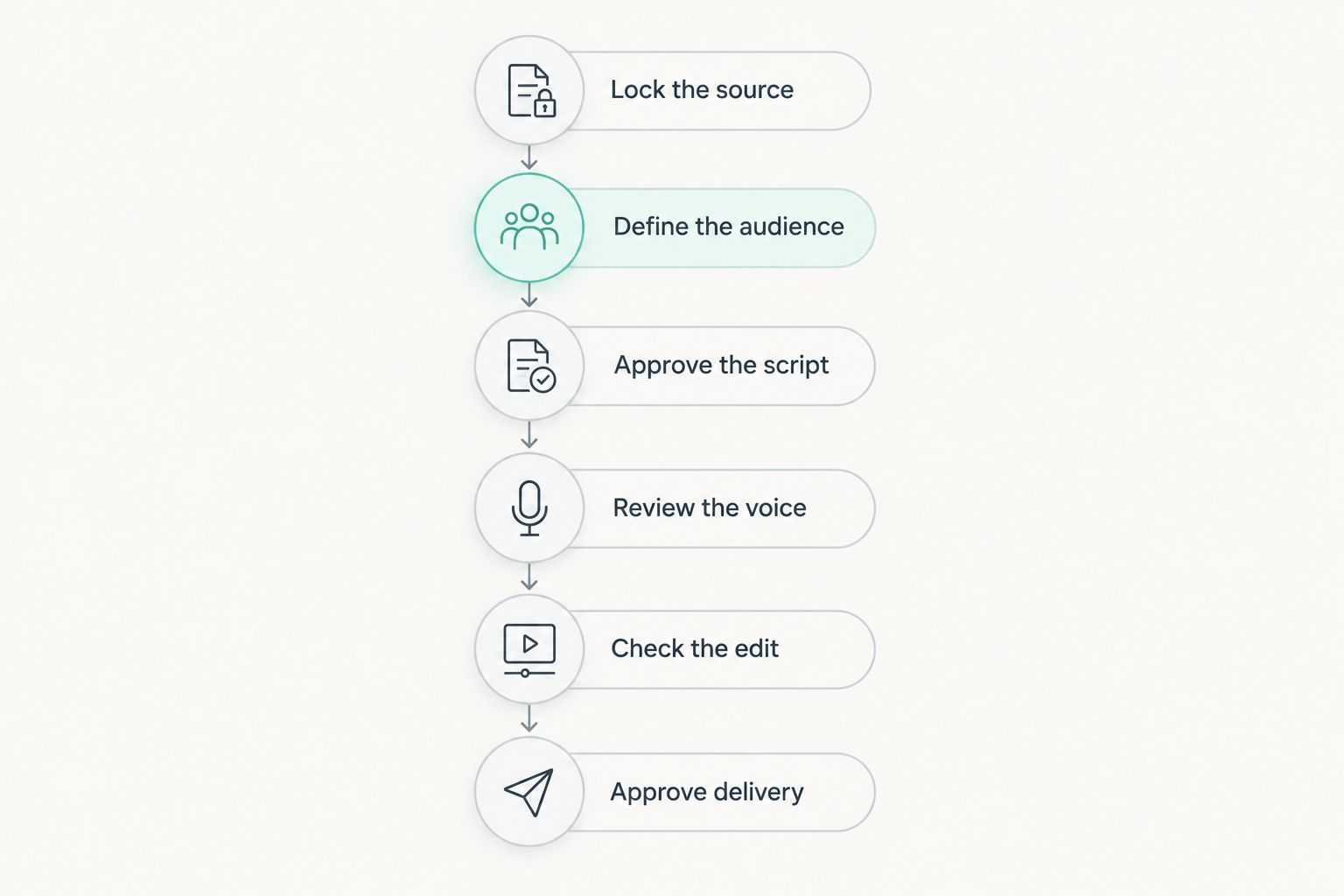
1. Lock the source
Choose the exact video version to localize. Attach the approved script, available audio tracks, graphics files, and any existing captions.
Mark material that is still awaiting approval. Do not ask a localization team to guess whether a product name, claim, or closing message is final.
2. Define the audience
List the language and regional audience for each version. Explain where viewers will watch and what they should understand or do afterward.
Include approved terminology and pronunciation guidance. If your organization already uses translated product names or standard disclaimers, supply those rather than asking reviewers to recreate them.
3. Approve the script
Ask a qualified language reviewer to check meaning, tone, terminology, and spoken readability before voice generation. Give that reviewer the video, not just an isolated text document.
Approve the translation against the intended message. A sentence that is grammatically correct can still misrepresent a technical claim or sound wrong for the audience.
4. Review the voice
Request a representative passage before approving the full voice treatment. Choose material containing names, technical language, or a change in tone—not only the easiest opening sentence.
Listen for pronunciation, emphasis, and a delivery that fits the film. Keep feedback specific: identify the word or phrase and describe the intended correction.
5. Check the edit
Review the translated audio with the finished pictures. Check whether speech fits the scene, whether graphics agree with the narration, and whether music obscures important words.
Do not approve the project from an audio preview alone. The deliverable is a video, and the review needs to reflect that.
6. Approve delivery
Confirm the export requirements and supporting files before final approval. Identify which language version belongs to which publication destination.
Keep the approved scripts, terminology decisions, captions, and final files together. Future corrections should begin from the approved version, not from a fresh transcription.
Where should you reduce scope without weakening the message?
Remove unnecessary treatments before removing review. If viewers do not need a matched speaker voice, do not make it a requirement. If translated narration explains the footage clearly, assess that approach before requesting visual speech adaptation.
Keep the work tied to the video's purpose. An internal process demonstration needs understandable instructions and accurate terminology; a public executive message also needs attention to identity, tone, and presentation.
Standardize what can be shared across versions: the approved source, terminology list, graphic instructions, and feedback format. Keep language-specific decisions with the appropriate reviewer. Do not assume approval in one language validates another.
Production Soup is best for teams seeking corporate films and AI-assisted production, rather than a standalone dubbing subscription. That broader production focus fits a conversation about the whole film; a dubbing-only brief still needs explicit scope and approval responsibilities.
Start with the production brief
Bring your source video, target languages, and delivery requirements to the discussion.
Does an AI dubbing charge include complete localization?
An AI dubbing charge describes only the work named in the proposal. Ask whether it includes translation review, audio mixing, graphics, captions, corrections, and final exports; do not infer those deliverables from the word dubbing.
Can you keep the original speaker's voice?
Voice-matching methods aim to preserve recognizable vocal characteristics, but the result still needs permission checks and performance review. Approve a representative sample before committing the whole film to that treatment.
Should you localize captions as well as speech?
Include translated captions when your delivery requirements call for them, and review them against the final audio. Captions and dubbing are separate assets; approval of the voice track does not establish that caption text and timing are correct.
FAQ
What's the best way to budget for AI dubbing in 2026?
Budget against a defined, publishable deliverable rather than voice generation alone. Give providers the same source video, target languages, review requirements, and export list so their proposals describe comparable work.
Is AI dubbing the same as video localization?
AI dubbing replaces spoken audio; video localization can also include translated graphics, captions, and audience-specific wording. State which elements must change before requesting a quote.
Can I use a finished video file without the original project?
Give the provider the finished file for assessment, but also ask which source assets the job requires. Editable graphics and separate audio tracks give the editor different options from a single combined file.
Do I still need a human language reviewer?
Assign a qualified language reviewer before publication. Ask that person to check meaning, terminology, tone, and the final video rather than approving only the written translation.
Will the translated voice match the speaker's lips?
Do not assume translated audio includes mouth-movement adaptation. Specify that requirement separately and review the resulting picture and sound together.
How do I avoid paying for avoidable corrections?
Approve the source edit, terminology, and translation before generating the final speech. Define how revisions are handled and distinguish corrections from changes to already approved content.
Is Production Soup a dubbing software platform?
Production Soup is a creative agency and film production studio that combines traditional production with AI-assisted work. Discuss the required localization deliverables as part of the production brief rather than treating the business as a standalone software subscription.
One last thing
Before approving your 2026 localized video, review the closing frame with the sound muted. Check the destination, call to action, disclaimer, and any text that tells viewers what to do next.
Then replay it with sound. The translated voice and the final screen must ask the viewer to do the same thing. Put that check in the acceptance criteria, not in a note after publication.